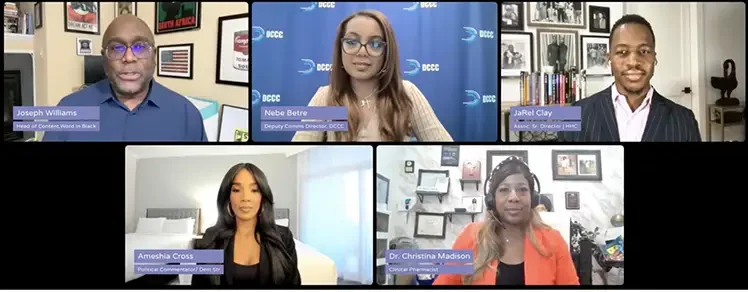
Black voters are turning out in force to cast their ballots early ahead of Tuesday’s midterm elections despite having little faith in the workings of Washington. At Word In Black’s virtual event “Know Before You Vote: Preparing for the Midterms,” panelists said this contradiction shows the Black electorate is a community voting with some hope and a great sense of necessity.
“People always talk about how Black votes are very important. Now it seems we Black voters are determined to prove it,” said Joseph Williams, WIB’s head of content, who moderated the Oct. 28 discussion. “Across the South, in particular, things are really surging. In North Carolina, Black voters represent just a little more than 19% of all registered voters, but nearly 22% of all ballots cast so far in the election.
“But here’s the paradox,” Williams continued. “A recent Black Census survey found that 95% of all those respondents intend to vote, but just 3% actually trust the federal government. So, what’s driving enthusiasm? What do Black voters want in return?”
Answers were provided by a panel that included Nebeyatt Betre, deputy communications director at the Democratic Congressional Campaign Committee; JaRel Clay, associate senior director of digital and production at the HipHop Caucus; political commentator Ameshia Cross; and Dr. Christina Madison, a clinical pharmacist and public health advocate.
Suspicious But Engaged
“There can be people who are suspicious of the government but also know that the path forward involves them taking part in the democratic process,” said Cross, stressing that distrust and participation can coexist. “Black people have put on the cape for democracy over and over and over again.”
Younger voters are turning out in larger numbers than in the last midterm, Cross said, noting that affordability issues are driving the change. After the 2024 election, many people “were going to sit back and see what happened. Let America fix itself. What they found was that America had a very strict backlash, and they are now re-engaging.”
It’s Always “the Economy…”
The affordability crisis — initiated by the elimination of thousands of federal jobs under the Trump Administration’s DOGE and exacerbated by higher prices from President Donald Trump’s tariffs and the Iran war — permeated the conversation, reflecting its status as a top issue among voters. Cross noted that more than 700,000 Black women have lost their jobs since 2025. Add to that about 300,000 Black men, Madison said. “They’re also feeling the economic turmoil of what has happened post-2024,” Madison said.
Cross added that the private sector contributed to unemployment damage as companies followed the administration’s anti-DEI executive orders. While those orders didn’t hold any legal teeth, rhetoric from the White House “gave credence to a private sector that never really wanted us at the table to begin with,” Cross said.
Voting rights under pressure
Adding to the pressure and “change in the wrong direction” has been the ascent of Republican control in Washington and an attack on voting rights, said Betre.”Donald Trump said, ‘Please redraw these seats [to oust Democrats and protect Republicans].’ And the Republicans said, ’Yes, sir,’ ” Betre said.
Congressional districts across the Black Belt, including in Alabama and Louisiana,, and in states including Ohio and Tennessee, were redrawn outside the normal 10-year redistricting cycle. Analysts estimated that about a third of the districts represented by Black members of Congress or that contained majority Black populations were eliminated or severely altered. These harmful changes are also stoking voter turnout, panelists said.
“When you’re [seeing] voting rights being gutted, to everyday life just being more expensive, I think we’re seeing that Black voter backlash really pop up in early voting,” Betre said.
Clay noted that students are also pushing back. At North Carolina A&T University in Greensboro, students organized a recent march to make sure classmates would vote early when local officials removed a polling place from the HBCU campus. In scenes Williams said echoed the freedom marches of the civil rights era, students at Texas Southern, Xavier and Dillard are doing the same.
“These are not anomalies,” Clay said. [With] the “power of social media, when you see something happening and it’s a success, you’re going to see ripple effects across the board.”
Caping for Democracy, Again
Madison said Black women, many of them heads of household, are voting because “health is on the ballot.”
“I always say if you want something done, ask a Black woman,” Madison continued. But vigilance takes a toll. “I am sick of having to save the world as a Black woman. Like, we’re sick of it.” Still, “the alternative is way worse,” she said. And that goes for healthcare.
As someone who has watched patients skip their medications to pay for groceries or gas since the loss of the Affordable Care Act subsidies last December, Madison warned that future Medicaid changes likely will hit Black Americans disproportionately and cost many their coverage.
“It only takes one hospitalization, unfortunately, to bankrupt a family,” Madison said.
Cross echoed that the One Big, Beautiful Bill Act’s healthcare cuts will not be undone in one election because they were phased in. “Some things happened this year, some things will happen next year and some things were planned not to [take effect] until 2028,” she said.
Betre added that voters have noticed that money from the federal cuts to Medicaid and food stamps now “go directly to the billionaire donor class.”
Black Men Reconsider 2024
Cross said a swath of young Black men, including Black business owners across the South, who supported Trump in 2024 are now frustrated seeing their returns go down” because of the tariffs.
Clay confirmed that the current economic turmoil is pushing these Black men to find their place alongside Black women “who have been carrying the mantle for centuries” to seek change.”We are witnessing a moment where folks are showing us what they will do when they feel their backs are against the wall,” he said. This is especially true among younger voters, he said.
“What we’re hearing on the ground with HipHop Caucus … is that [this election] is about affordability;, it’s about the right to the vote itself; and it’s about safe and healthy communities. All of these things we see are on the ballot, and particularly with young voters.”
Accountability over loyalty
The panelists cautioned against expecting a Democratic House to fix everything after one election.
“There is no Black deity that’s going to take over in the nation’s capital and all of a sudden eradicate all of the ills,” Cross said.
Clay put it most plainly. “This loyalty to any party without accountability is not power,” he said. “We are not red people, we’re not blue people, we are Black people.”
The real work, he said, continues after Election Day, in local offices, on ballot measures and in pressing elected officials to keep their promises. “There is no savior that’s coming.”