By Kiara Doyal, The Seattle Medium
Black women shouldered the brunt of layoffs in 2025, a disparity driven largely by cuts in the public sector. These layoffs, combined with ongoing reports of workplace mistreatment, point to broader systemic inequities.
In response, the Washington State Women’s Commission and Blacks United in Leadership & Diversity surveyed 410 Black women across Washington’s public sector. Nearly every respondent reported experiencing barriers affecting well-being, career advancement and decisions about whether to remain in the field.
Only one respondent reported experiencing no workplace harm, underscoring the widespread nature of these challenges.
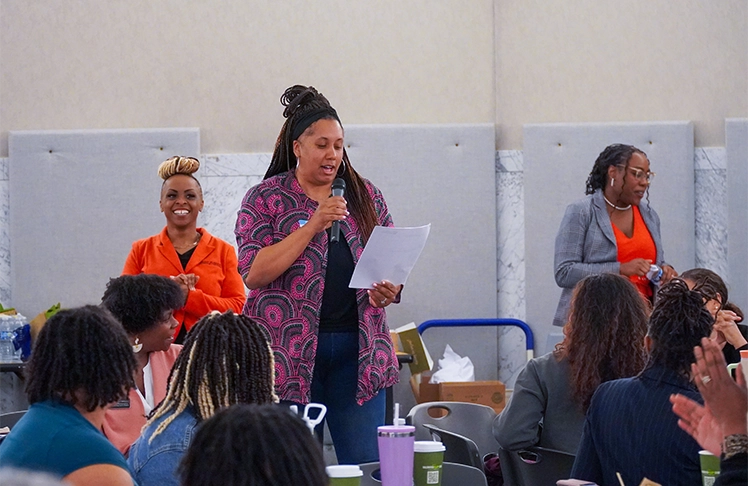
More than 70 Black women recently gathered in Olympia for the Black Women in the Public Sector: Training, Co-Creating and Self-Care event. The event created space to share experiences and identify solutions.
“We were just reading story after story about how Black women who are deeply represented in the public sector, across government, nonprofits, and social human services were not receiving the same care,” said Brittany Gregory, Washington State Women’s Commission executive director. “They were facing mistreatment and discrimination and harassment, and taking into consideration some of the layoffs, like unemployment numbers for Black women and how Black women were getting laid off at three times the rate of other women, it was really important that the Women’s Commission would uplift the stories of Black women at this time and provide them some support.”
Survey findings reveal patterns across agencies and roles. Respondents rated workplace experience an average of 2.68 out of 5, while human resources support received an average rating of 1.92 out of 5. Nearly half of respondents gave human resources the lowest possible rating, reinforcing concerns that reporting systems are not experienced as safe or effective channels for addressing harm.
Microaggressions were the most commonly reported form of harm, with 88% of respondents reporting the experience, alongside unequal standards, exclusion from decision-making and fear of retaliation.
Ayanna Colman, chief human resources officer at the Office of Administrative Hearings, participated in the survey and attended the event. After 14 years in state government, this effort marked the first initiative centered specifically on the experiences of Black women in public service.
“I think this was a very unique experience. With all due respect to the private sector, corporate, and all of those other industries, this really spoke to my heart. Walking into that room and seeing a full room of women, and as we talked, I learned we all had so many different backgrounds,” said Colman. “But what united us is that we are Black women in the public sector, called to public service. And as much as we care about our neighbors and our communities, we need our workspaces to care about us too.”
Hiedi Popochock, director of aviation finance and budget at Seattle-Tacoma International Airport, said the event underscored the persistence of workplace inequities.
“These spaces are important because anti-Black racism is alive and well. It is an experience that Black women, and Black people experience every day in the workplace,” said Popochock. “Black executive leaders are not immune from anti-black racism, having anti-black racist staff or anti-black racist supervisors. We have seen it all. We have experienced it all.”
Survey findings also highlight the impact of these experiences. Seventy-five percent of respondents reported negative effects on mental health, along with impacts on sense of belonging, confidence and career advancement.
Many respondents also reported that workplace experiences influenced decisions about remaining in public service, pointing to broader retention challenges for agencies that depend on experienced workers.
“This might not be surprising for some, but it was pretty surprising for us that 99.8% of all the respondents have experienced some form of harmful behaviors and systemic barriers in the workplace, and 75% of respondents said that their treatment in the workplace impacted their mental health. There was only really one respondent who said they hadn’t experienced any type of history in the workplace,” said Gregory. “However, the most surprising finding was that the more senior you are in your organization or agency, the worse your experience was.”
Most respondents were experienced professionals, with more than 60% reporting eight or more years in the public sector across roles ranging from entry-level to executive leadership.
“Society, our education, our family structure, and our neighborhoods. By the time we get to the workplace, we have proven ourselves over and over again to be there. And then you get to the workspace, and you still have to deal with so many of those barriers that you thought were gone. What more do we have to prove?” said Colman. “Black women absolutely need these spaces to connect, to hear from one another, to learn from one another, and to have a safe place to just let things out.”
Popochock described a sense of isolation in leadership spaces, even after more than 20 years in public service.
“Personally, it was very meaningful to be around other Black women sharing lived experiences in the public sector. Professionally, it was very supportive,” Popochock said. “There aren’t that many Black women executive leaders in the public sector in Washington. So, it was reassuring and validating to have us there in the same room connecting with one another.”
Colman described how isolation and workplace dynamics can push highly qualified Black women out of roles.
“The higher I went up in my career, the less of me were in the room and I had walked away from roles, quite honestly because dealing with the workplace dynamics and overall not having that support, I had to make a change and exit those situations,” said Colman. “I heard other Black women say that you need to know when to exit. Which is so unfortunate because so many of us are highly educated and qualified, and we deserve to be in those rooms.”
Gregory said findings will help shape future programs, partnerships and policy priorities.
“Black women are some of the most educated people out there, and so we are choosing to use that expertise to help others who need help, and then getting mistreated in response?” said Gregory. “[The survey] confirms the need for more expansive, holistic training, and for us to have a deeper conversation. It also reflects the bigger conversation that state agencies and other nonprofits are facing right now about what we’re characterizing as DEI and how some folks are shying away from it.”