Carl Talmadge “Duke” Washington, a long-time Seattle public high school teacher and a pioneer in the integration of college football in the 1950s, passed away Feb. 16 due to complications from pneumonia. He was 84.
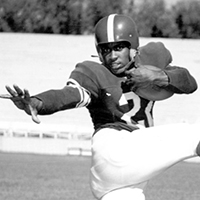
In many ways Washington was a Renaissance Man. An insatiable reader with burning curiosity, his interests were wide and his knowledge deep. Jazz music, art, education, the great existential philosophers and modern-day race relations among his favorite topics.
Washington is often characterized as the “Jackie Robinson of Cougar Football” because he not only helped break color lines at Washington State University from 1951-54 but did so in spectacular fashion. He was a team captain and an All-Coast and honorable mention All-America selection, and his Cougars defeated rival Washington three times in his four years on campus. In 2011, he was inducted in the WSU Athletics Hall of Fame. He called the honor “one of the greatest moments in my life” and said “all my roads go back to Pullman.” He often referred to WSU as “my true north” and said it was where he “learned how to learn.”
His ground breaking extended to the Jim Crow south, where as a WSU senior, he put a stake in the heart of segregation at the University of Texas as the first Black athlete to play on the Longhorns’ home field. He literally brought people to their feet at Memorial Stadium in Austin on Oct. 2, 1954, turning a first-half draw into a 73-yard touchdown for the Cougars. Texas’ athletic director had suggested in the weeks before the game that Washington ought to stay home. WSU’s then-athletic director, Stan Bates, replied that if Duke wasn’t permitted on the field the Cougars would cancel the game.
“Duke was an exceptional football player but also instrumental in helping to break the color barrier that plagued college athletics at the time,” says WSU athletic director Bill Moos. “Above all, he was a true scholar and gentleman.”
Washington was born in Forest, Miss., on March 4, 1933 to Rosetta and Talmadge Washington. He recalled the living conditions there for African Americans as “horrific.” His journey to the Pacific Northwest began as his stepfather followed construction jobs in the West. It was in Stockton, Calif., as a middle schooler, that Washington picked up the nickname Duke. By the time he landed in Pasco, Wash., in the late 1940s when his stepfather went to work at the Hanford Reservation, the name was permanent. He starred at Pasco High – where he is member of the PHS Hall of Fame – and became the first African American athlete to play in the state’s East-West high school all-star game. He accepted a scholarship to WSU over offers from UW and others.
Washington was drafted by the Philadelphia Eagles but released in training camp when a trade resulted in the team exceeding its quota for Black players. He spent two years in the Army, including a stint in Europe, and later played one season for the CFL’s B.C. Lions. He then joined the University of Washington as a counselor in the education department before embarking on a long and distinguished career with the Seattle Public Schools. He taught art at Nathan Hale, Franklin, West Seattle and Ingraham high schools, and coached football at Nathan Hale and Franklin.
“Duke set high standards for his students and provided them guidance, not just in the classroom but for life. He was a leader and role model for them and to this day I run into former students who talk about his influence,” said Bob Gary, a retired Seattle Public Schools administrator and principal whose friendship with Washington began when both were students at WSU.
Washington once told a reporter, “Never in my life did I aspire to be ordinary.”
Today, those who knew him can enthusiastically proclaim “mission accomplished.” Duke Washington was one for the ages.
A celebration of the life for Washington will be held at the Central Area Senior Center at 500 30th Ave. S. in Seattle on Sat., June 3 at 2:00 p.m.
Donations to honor Mr. Washington’s life and legacy may be made to either the Cougar Athletic Scholarship Fund at Washington State University (Bohler Complex 120, Pullman, WA 99164-1602; cougarsareyouin.com) or the Northwest African American Museum (2300 S. Massachusetts St., Seattle, WA 98144; www.naamnw.org/donate-now/).