The topic of reparations is not going away. It has actually become a bigger topic as time goes. Some have looked at programs benefiting Blacks as reparations with other names. But, how have those program benefited Blacks? Urban renewal is recognized as a code word for perpetuating unsustainable development and increases in property values, social exclusion, gentrification and the displacement of marginalized communities.
Seattle, Washington’s King County Reparations Project is inviting the community together in remembering the history of Black Wall Street while advancing the project of local reparations and racial reconciliation. It’s also being touted as an evening that will remember the history and tragic loss of Black Wall Street in Tulsa, Oklahoma.
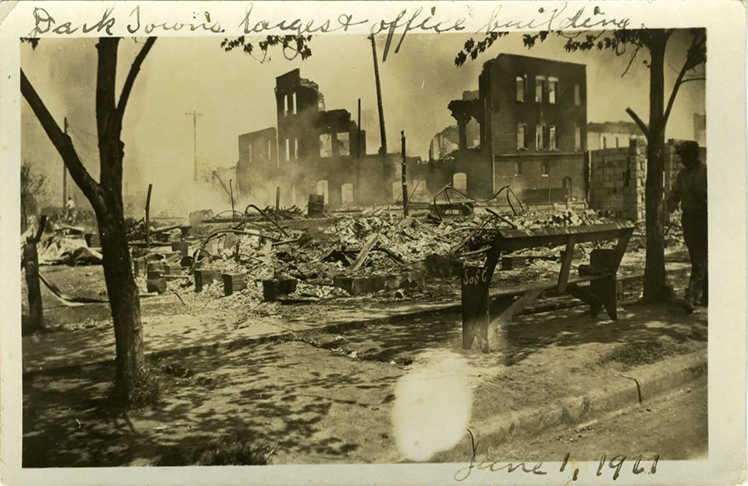
Greenwood had been a thriving African American district in Tulsa. On May 31st, 1921, the district was looted and burned by white rioters, the governor declared martial law, and National Guardsmen swarmed the district. Within 24 hours, city blocks were left in ruins and hundreds died. This event became known as the Greenwood Massacre.
Should Seattle pay Blacks reparations? These are the type of questions that will be discussed. For decades, Seattle congregations and communities have been forced to withstand racist policies, land grabbing, pressures from for-profit speculative developers, and insignificant economic support from the city that have resulted in the loss of Seattle’s cultural spaces. In addition, there was displacement of tens of thousands who once called Seattle neighborhoods home. Reparations means the city making right this historic and intentional wrong.
The SURE organization believes that it l is never too late to address Seattle paying reparations for its specific harm to the Black community. Seattle Urban Renewal Enterprise, or SURE, is an effort motivated by federal government programs to clear “blighted areas” in inner cities under the mantle of “urban renewal,” the “war on poverty” and “Model Cities” policies in the 1950s and ’60s.
Government programs were racist and targeted Black neighborhoods, resulting in the massive loss of Black ownership in commercial and residential properties. One of the key initiatives adopted by SURE was the Yesler Atlantic Neighborhood Improvement Project, which aimed to redevelop the Central Area. The Central Area, once a neighborhood full of Black community activity and amenities, Black-owned commerce, and Black home ownership, was defined by SURE in its 1961 Yesler Atlantic Report as home to “the colored, the poor, the ignorant, the unfortunate, the undesirable, the weak.” SURE’s solution, as recommended to the city of Seattle, was “a ghetto” for “the undesirables” and “encouragement to middle and upper-income whites to move into the community,” resulting in a lack of investment opportunities for Black home ownership.
In recent years, the city has relented to social pressure to generate more resources for the Black community. The path to reparations doesn’t end with housing. “The end game is to create a self-sustaining economic entity that can begin in Seattle, to grow economic capacity for African American people, and business capacity for African American people, by providing them housing, providing business loans, and business assistance,” said New Hope Missionary Baptist Church’s Dr. Robert Jeffrey. The King County Reparations Project says it addresses the impact “urban renewal” has had on Seattle’s housing and the Black community. Implemented across the country, this practice was unique to neither Seattle nor Tulsa.
The community focus across the country, much like the partnership for this event, is key. “Then, to be able to transport this model, from community to community, to community,” said Jeffrey, “to create engines across the nation that will begin to solve the problem of economic incapacity that Black people have right now. That’s what we’re trying to create here.”