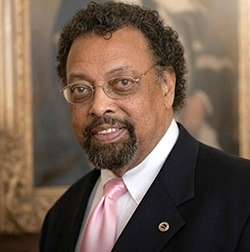
Jerome Whittington Page, a pioneering civil rights leader who guided the Urban League of Metropolitan Seattle during a pivotal period in the city’s history and went on to a decades-long national career in advocacy, died Feb. 8, 2026, following a dementia-related illness. He was 90.
Page, who led Urban League affiliates across four cities over more than three decades, arrived in Seattle in 1968 following the assassination of his predecessor, Edwin Pratt, stepping into leadership at a moment of profound loss and transition. He helped stabilize and strengthen the organization during a time of uncertainty and grief.
From 1968 to 1979, Page emerged as a key voice for civil rights and economic equity in the region. He advocated for fair employment practices and stood in solidarity with workers protesting discrimination, including joining airport employees on the runway at Seattle-Tacoma International Airport to demand equitable labor conditions.
His leadership also extended into the cultural life of the city. Alongside his wife, JoKatherine Holliman Page, he co-founded one of the first major exhibitions of Black artists in the region, featuring both local and internationally recognized figures such as Jacob Lawrence and Gwendolyn Knight. The effort helped elevate Black art in Seattle and broaden recognition of African American artists within the city’s cultural institutions.
During his tenure, Page strengthened partnerships among community organizations, businesses and civic leaders, expanding opportunities for Black residents in employment, housing and education. By the time he left Seattle in 1979, he had helped solidify the Urban League’s role as a leading force for equity and inclusion in the region, leaving behind programs and relationships that continued to benefit the community.
“While I did not have the privilege of knowing Jerome Page personally, I recently spoke with his wife and was deeply moved by the love and respect that define his legacy,” said Michelle Merriweather, president and CEO of the Urban League of Metropolitan Seattle. “To have led three Urban League affiliates, beginning in Seattle, is a powerful testament to a life committed to service and empowering the Black community. His legacy challenges all of us to continue the work with intention, courage and a deep sense of responsibility to those who come after us.”
Born March 6, 1935, in Denver, Page was the middle son of Brittania Yardley Whittington Page, a nurse, and Daniel Page, who operated one of the largest Black-owned electrical companies in Colorado. Raised in a segregated city shaped by redlining and racial barriers, Page developed an early awareness of inequality that would guide his life’s work.
A standout student-athlete, he attended Colorado A&M, now Colorado State University, earning a bachelor’s degree in 1958. He later served in the U.S. Army as an intelligence analyst stationed in Turkey during the Cold War, where he joked he spent his time “listening to the Russians,” an experience he often described as the beginning of a lifetime of global exploration.
After completing his military service, Page became one of the first Peace Corps volunteers from Colorado, serving in Caracas, Venezuela. There, he worked with youth through YMCA programs and hosted then-Vice President Hubert Humphrey, introducing him to community-based initiatives aimed at supporting young people.
Those early experiences abroad deepened his commitment to service and led him into a career with the Urban League that would span more than three decades. After his tenure in Seattle, Page went on to lead affiliates in Washington, D.C., Chattanooga, Tennessee, and Colorado Springs, Colorado, building programs focused on economic opportunity, cross-cultural collaboration and community development.
In Washington, D.C., he founded the “Home Town Run,” one of the first 5K races through inner-city neighborhoods, and was arrested while protesting apartheid at the South African Embassy. In Chattanooga, he helped establish partnerships across racial and economic lines, including serving as a founding board member of the Chattanooga School of Arts and Sciences. He concluded his Urban League career in Colorado Springs, where he developed a career center for working mothers that included an adjacent daycare facility, expanding access to both employment and child care.
Throughout his career, Page worked alongside prominent civil rights leaders, including John Lewis, Andrew Young, Jesse Jackson and Vernon Jordan, while maintaining a focus on grassroots community impact.
Even in retirement, he remained deeply engaged. He founded the Denver Minority Opportunity Fund to support students and young professionals and later served as a civil rights officer with FEMA, assisting communities recovering from major disasters, including Hurricane Katrina.
Page was known for a leadership style rooted in mentorship, accessibility and community connection. Colleagues and community members alike experienced his ability to move easily between boardrooms and neighborhood spaces, offering both strategic vision and personal encouragement. Whether supporting young professionals, advocating for working families or building bridges across communities, he remained committed to ensuring that opportunity extended to those often left behind.
He instilled in his children a belief in possibility, often reminding them, “You can go anywhere you want in this world.” Much of that guidance came through simple family traditions, including weekend breakfasts and reading the newspaper together, where he encouraged curiosity, critical thinking and engagement with the world.
He remained active well into his later years, leading faith-based social justice discussions and mentoring younger generations. Even in his late 80s, he continued to serve in leadership roles within his community.
Page was preceded in death by his daughter, Leslye Lynne Mundy. He is survived by his wife of 54 years, JoKatherine Holliman Page; his sons, Hank Lewis and Jason Page; grandchildren; a great-granddaughter; and an extended family whose work continues his legacy of service and advocacy.
A celebration of life and interment will take place in Denver in late July. Details will be announced.