By Aaron Allen, The Seattle Medium
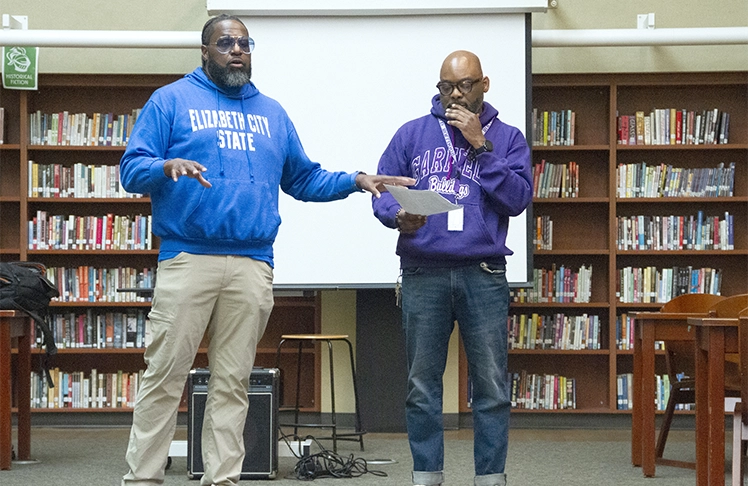
Community members gathered at Garfield High School last Saturday to confront persistent racial disparities in student achievement and call for urgent action. Organized by Principal Tarance Hart and community advocate Chukundi Salisbury, the event focused on mobilizing parents, educators, and students to address academic inequities affecting Black and Brown students.
“This meeting is to highlight the real work that we have in front of us at Garfield,” said Principal Hart. “Work that has to address the inequalities. Sports of course has always been a beloved aspect of this community, but I think there is also a deeper story that we need to talk about just how our students are doing and how we need to address the achievement gaps that we are experiencing for Black and Brown students.”
Attendees were presented with detailed academic data that underscored the challenges. From 2021 to 2025, English language arts proficiency for all Garfield students declined from 68 percent to 63 percent. Math scores dropped more sharply, from 46 percent to 38 percent. Science showed improvement overall, rising from 23 percent to 52 percent, but the data revealed sharp racial disparities in every subject.
Black students continue to perform well below their white, Latino, and Asian peers. In English, while most non-Black students averaged between 75 and 80 percent proficiency, Black students remained at 38 percent. In math, Asian and white students scored around 60 percent, while Latino students fell to 17 percent and Black students dropped to just 12 percent. Science scores followed the same pattern, with Black students at 27 percent compared to 40 percent for Latino students and more than 60 percent for white and Asian students.
Salisbury emphasized the urgency of the situation and the importance of community involvement in reversing these trends.
“What we want to do is really help bring that culture, from a legacy point of view, we talk about reclaiming the village, we are reclaiming the idea that it really takes a village,” said Salisbury. “I contend that a lot of the village is online. They are not here on the soil, in the village. Come to the village. We need everybody involved to be right here, around the fire. How are you going to help raise a village if you are not being a part of it?”
The meeting was the second in an ongoing series aimed at galvanizing long-term engagement. Organizers announced plans to hold monthly gatherings to track academic progress, share updates, and ensure accountability.
Speakers and parents urged meaningful community involvement to address academic support and school climate. Salisbury stressed that athletic success, while important to many families and students, should not overshadow academic priorities.
Salisbury pointed to the memorials lining the school’s entrance, tributes to young people lost to violence, as a stark reminder of the trauma many students carry with them each day. He said those visible symbols of grief reflect deeper challenges that extend beyond academics and affect students’ ability to thrive in the classroom.
“I think one of the things that should really be paid attention to is how current students have to walk over all of these memorials,” Salisbury said. “Look at these memorials, but current events have us concerned about jerseys. What I am personally trying to do is activate Bulldogs and former Bulldogs and community members to come up here and be a resource for the community, a resource in the school.”
“And so, whatever that is, if you are into academics come and volunteer, be a tutor,” Salisbury continued. “You want to be campus security, come and walk along the hallways. If athletics are your thing, be with the team and volunteer. But we need people to get involved. The school just cannot do it by themselves.”
The meeting also referenced a report by Allie Holly-Gottlieb titled “A Tale of Two Schools, At Garfield High School, the Education You Get Depends on Your Color.” The report critiques the district’s efforts to address racial disparities and challenges policymakers and educators to examine outcomes for dropouts, graduates, expulsions, advanced class placements, and teacher diversity. The report noted that last year district statistics showed the mean GPA for Black students was 2.2 while the mean GPA for white students was 2.8.
The report states that educators often deflect responsibility when discussing disparities. “Educators like to point the finger away from the themselves when it comes time to assign blame for the disparities at Garfield,” the report says. “Racism is a citywide, statewide even nationwide problem.”
Seattle City Council President Joy Hollingsworth spoke at the meeting about the need for community-driven accountability.
“What would I like to see come out of this meeting is this,” Hollingsworth said. “I would like us to have a sense of direction about some actionable items where the community can hold us, the city council, accountable and give action items that they want to see. Our mayor’s office, the whole city, what they need from us to support this community.”
Parents and advocates at the meeting described a desire for clear, measurable goals and sustained investment in academic supports, tutoring programs, culturally responsive teaching, and deeper engagement between families and school leadership.
Organizers emphasized that monthly meetings will provide opportunities to revisit data, share progress, and continue building partnerships. Parents at the meeting expressed hope that sustained dialogue and collaboration can translate into improved outcomes for students of all backgrounds.
For many attendees the urgency of the moment was clear: without intentional efforts to close achievement gaps and expand support for students of color, disparities will continue to undermine academic achievement and future opportunities. Many community members reiterated their commitment to staying engaged beyond the meeting.
“This is not just talk,” said one parent. “We want action and we want results. Our students deserve nothing less.”