By Patience Idegwu
Seattle Medium Intern
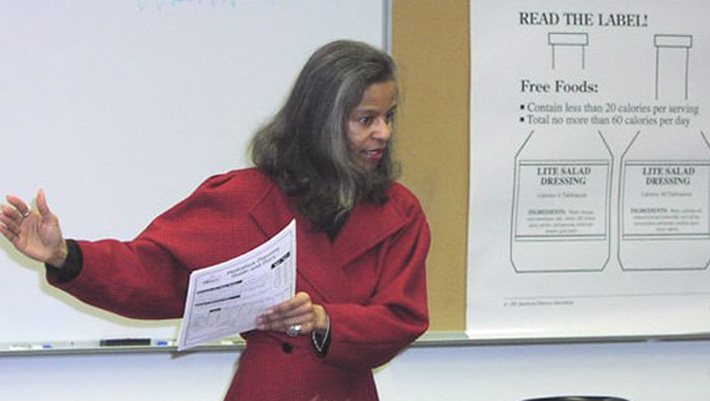
It is 9:45 a.m. and Dr. Juana R. Royster, a community health education specialist, takes little steps as she quietly opens the front door of the Central Area Senior Center. The front desk attendant quickly spots Royster’s usual stride in the building and greets her accordingly. Royster, who volunteers at the center, returns the greeting as she enters the Solarium where she teaches a weekly class on how to manage and prevent diabetes. As the participants start to fill the room, a warm smile comes across Royster’s face as her excitement fills the air and her voice welcomes the crowd.
Royster is a unique individual who has always thought of the importance of community and health in her life. With her experience, she educates others to help them live a better life. This is something that was instilled in her as a child, and is a big part of who she is today.
“There are some people that are out there with the community, then there are those that are very quiet and are just quietly doing things that they feel is right and not flashy, and that is Juana Royster,” expressed Dr. Liz A. Reynolds Thomas.
Born and raised in Detroit, Michigan, Royster grew up with two very strong single women, her mother and grandmother, who taught her the importance of getting an education and being involved in the community.
Although she was an only child in a single parent household, Royster was surrounded by cousins and very close friends that were like her sisters and brothers. She was not only embraced by her community, she was a product of her community – a sentiment that helps drive her to give back to the community today.
“Even though I was an only child, I never felt like an only child,” said Royster. “I was surrounded by everyone in my neighborhood. The community protected me and guided me. I knew what they did and said was for my best benefit, and that’s how I grew up. I was never alone.”
At an early age, her family and her community stressed the importance of getting an education. For Royster, the expectation was clear, “you will go to college.”
Royster knew that it was not only important to get an education, but to also to give back to her community. Throughout her career, she has utilized her education to ‘educate’ her community about making healthy choices and better decisions.
“Many people go to school to make money. But, that was never my focus,” said Royster. “I knew that working with people was my station. That’s how I programmed myself.”
Royster graduated from Cass Technical High School in Detroit, Michigan. She then graduated from Wayne State University in Detroit with bachelors’ and masters’ degrees in both food and nutrition and in clothing and textiles. She later received her doctorate from the University of Washington in higher education administration.
From the time she was a little girl, Royster had a fascination with food. According to Royster, she would watch her grandmother cook and help out in the kitchen as much as she could; she loved being in the kitchen. She had a unique interest and a natural tendency with all types of food. When she got older, she not only helped her grandmother prepare the food, but she also was proficient in table etiquette and took over full reign of setting the table. She also had a special interest in fashion, but when she graduated from college she chose to pursue a career in food and nutrition because it would allow her to leave a lasting legacy in the community.
After leaving Michigan, Royster worked at Rutgers University, where she trained nutrition assistants to work with families and teach them about food and nutrition. She later took a position at Central Washington University (CWU), where she taught more classes on food and nutrition. According to Royster, she had the best time of her life: learning how to teach in a fun way.
“If you can’t have fun, what’s the point,” she stated.
Dr. Luther Baker, who was chair of the department at the time, saw that she had skills in other areas as well, therefore, asked her to start teach Homemaking for the handicapped as well. Not knowing much about homemaking, she was reluctant to accept the offer. Nevertheless, she agreed to teach the class because Dr. Baker felt strongly about his decision, and according to Royster, it was the best class she has ever taught. She was able to collaborate with the students. She focused on working with them instead of lecturing them.
“I believe strongly that you do not just throw things at people; you have to really bring them in if you really want them to learn,” said Royster. “Talk with them [the students], not at them. That was how I taught.”
After receiving her doctorate from the University of Washington, Royster worked for various places like Magnin, a fashion store in San Francisco, where she sales associate for coats, suits, dresses and furs. She then took a position at Florida Agricultural & Mechanical (A&M) University as a health and nutrition teacher. Both jobs gave her a better understanding of women and girls, as well as the community at-large.
Everywhere she went and everywhere she worked, Royster always made it a point to be involved in the community. Even when she started working for Washington State University (WSU) as a professor teaching health and nutrition, she did everything she could in the community.
“I was working in the community and everything you can think of, I did. I was in the community. I worked with all kinds of agencies and organizations. You name it, I taught it,” Royster proclaimed.
Royster was later named chair of the WSU King County extension, which was a job that helped her provide solutions to local problems. She was involved in a three-way partnership with WSU, King County and the U.S. Department of Agriculture to inform people about health, nutrition, and diabetes. One of the things she was also involved in was the 4-H Youth Program, a youth development program. As part of the Seattle 4-H program, she helped ensure young people of color, particularly young Black people, are educated and prepared for their future.
In addition to her work with WSU, Royster actively volunteers in the community, including at the Central Area Senior Center where she educates seniors about diabetes.
Clifford Holland, a 68-year old retiree, and a type 2 diabetic is a participant of Royster’s workshops. According to Holland, once he found out that he had diabetes, he started attending Royster’s class with his girlfriend. He noticed how thorough Royster was in her teachings and how important the information was. In one of the sessions, Royster told the group to ask their doctor about their vitamin B-12 levels and when Holland did, his doctor was amazed. Holland’s vitamin B-12 level was low, which is bad because B-12 vitamins are important for the manufacturing of red blood cells and for sustaining the nervous system. Holland wouldn’t have known about this deficiency if it were not for Royster.
Another of Royster’s workshop attendees, Julia P. Doyle, a 90-year old diabetic stated that her doctors were pleased with her lab results, which she claims were due to Royster’s workshops. According to Doyle, even though you may not want to know the information Royster gives you, you listen because you know it will help you and help you live.
Royster is also a member, and past president, of the Greater Seattle Chapter of The Links, Inc., an international organization of African American women who are committed to organizing and supporting educational, cultural, and civic activities that enhance our community.
Dr. Liz A. Reynolds Thomas, a long-time friend and fellow member of The Links, says that Royster has done a lot in the community that many don’t know about. For example, she used to teach prison inmates about health, nutrition, hygiene and self-esteem at Purdy, a women’s correctional facility in Gig Harbor, WA. She has also worked with the Hope Heart Institute, the Multicultural Health Institute and many other organizations.
“She is tiny and takes big, humongous jobs,” said Thomas. “She is a stickler about young people learning and how you take pride in who you are and what you put forward, because it reflects who you are.”
“She uses her knowledge to teach and help others so that they can make better decisions with their life,” added Thomas. “She is just a genuine person.”
Dr. Mildred W. Ollee, also a member of The Links, agrees that Royster has her own unique personality and does not care what people think about her. She immerses herself in the community in a personal way.
Royster, who was recently recognized by the National Education Association for her work in the community, is currently working on a pilot program utilizing skype, launched in October of 2015, to introduce registered dietician nutritionist from around the globe to the senior center.
“Whatever information I must bring, I will do that. I think God tapped me to get food and nutrition information into our community. I believe I have done that, and I shall continue doing that,” said Royster. “I love what I do.”