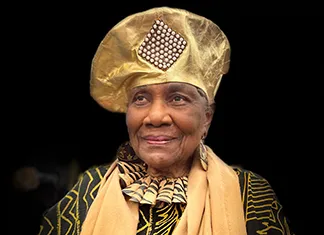
Dr. Maxine Buie Mimms spent her life opening doors through education, creating opportunities for generations of students and helping shape communities across Washington state and beyond.
Born on March 4, 1928, in Newport News, Virginia, Mimms was the youngest of five children in a family rooted in cultural pride, education and service. Her father, Benson Ebenezer Buie, followed the teachings of Marcus Garvey, while her mother, Isabella DeBerry Buie, taught neighbors to read and write at the family’s kitchen table. From an early age, Mimms saw firsthand how education could uplift individuals and strengthen entire communities.
She attended Booker T. Washington School and graduated with highest honors from Huntington High School in 1946 before earning a bachelor’s degree from Virginia Union University. She later earned a master’s degree from Wayne State University in Detroit and a doctorate in educational administration from Union Graduate School in San Francisco.
Her career in service began in Detroit, Michigan, where she worked as a social worker alongside her husband, Jacque Mimms. In 1953, the couple relocated to Seattle, where Mimms began her work in education, following in her mother’s footsteps. She became Seattle Public Schools’ first contracted African American elementary teacher, teaching fourth- and fifth-grade students at Leschi Elementary School.
While in the classroom, she and colleague Ora Franklin worked to increase the number of Black educators by recruiting teachers from Historically Black Colleges and Universities, helping ensure students could see themselves reflected in those leading their classrooms. In 1961, one of her students was a young Jimi Hendrix, who once taught his classmates a song to help them remember the names of the continents.
Mimms later taught in Kirkland Public Schools and returned to Seattle Public Schools in an administrative role. In 1969, she moved to Washington, D.C., where she served as special assistant to Elizabeth Duncan Koontz, director of the Women’s Bureau in the U.S. Department of Labor during the administration of President Richard Nixon.
She returned to Washington state in 1972 and joined the faculty at The Evergreen State College. There, her vision for accessible, community-centered education began to take shape. Recognizing the barriers many adult learners faced, particularly in Tacoma’s Hilltop neighborhood, Mimms began holding classes in her home, meeting students where they were and building on the example she had seen growing up at her mother’s kitchen table.
What started as small, informal classes grew into a lasting institution. In 1982, under her leadership, the Tacoma campus of The Evergreen State College was established to serve adult learners and expand access to higher education. Guided by the principle “Enter to Learn, Depart to Serve,” the campus became a nationally recognized model for community-based education.
Many of the students who came through the program were working adults and veterans, including those discharged from nearby military bases, who were seeking opportunities that had long been out of reach.
Mimms’ commitment to education extended well beyond traditional classrooms. After retiring, she continued to mentor, teach and advocate, later founding the Maxine Mimms Academy in 2004 to support students who had been displaced from public schools.
She believed education should be accessible, rooted in culture and responsive to the needs of the community she served.
Throughout her life, Mimms remained deeply connected to the communities she touched. She considered Tacoma home and was awarded the Key to the City in recognition of her impact. She also lived in Bellevue and spent her later years in Kamilche, where her home served as both an art gallery and a place of reflection.
Even in her later years, Mimms remained active, continuing her work as an elder and mentor across multiple organizations, including Africatown Community Land Trust, Rainier Valley Leadership Academy, First Place Imani Village and Life Enrichment Community Conversations. Her global reach included travel to Kenya, where she participated in a “Conversation Between Elders.”
Her contributions were recognized through numerous honors, including the first annual Sustainable Community Outstanding Leadership Award in 2001. Her legacy is also reflected in Seattle’s Africatown, where her image is etched into a building along 23rd Avenue and Union Street.
Dr. Maxine Buie Mimms died on October 8, 2024, at the age of 96.