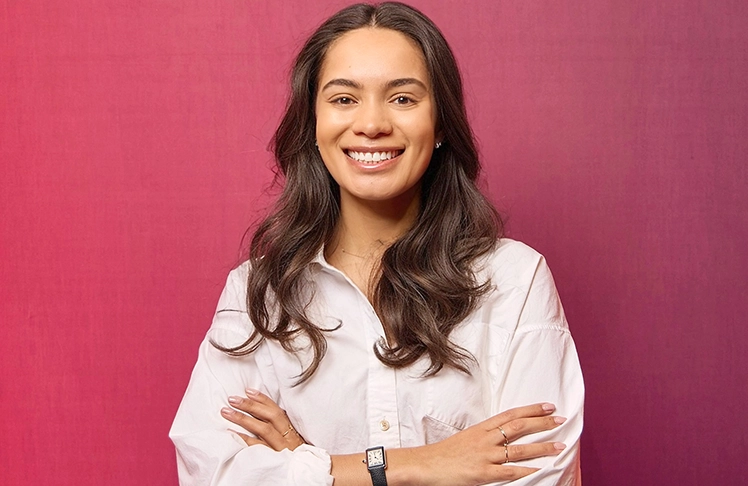
By Aaron Allen, The Seattle Medium
Growing up in Kirkland, Dr. Olivia Ware remembers searching for a Black dermatologist who could help her understand concerns about her skin, hair and scalp. She couldn’t find one nearby.
Years later, after leaving Washington for medical school and dermatology training, Ware returned to the Seattle area as a dermatologist herself. Now practicing at Harborview Medical Center, she is working to provide the kind of culturally informed care she struggled to find growing up.
“I grew up in a not very diverse community. I was like the only Black kid in any of my science classes, my math classes, so I felt ‘othered’ for a lot of my life,” said Ware.
As a teenager dealing with hyperpigmentation and scalp-care concerns, Ware said finding a Black dermatologist in the Bellevue and Kirkland areas proved difficult. The experience helped shape how she would eventually think about medicine and the relationship between patients and physicians.
“That is a space where you really can’t or shouldn’t feel othered, or feel like somebody can’t listen to you or recognize your needs.”
Ware completed her undergraduate degree at Whitman College in Walla Walla before attending medical school at Howard University in Washington, D.C. For Ware, attending the historically Black university provided something she had rarely experienced growing up in the Pacific Northwest: an educational environment where she was surrounded by Black peers from across the country.
“Howard educates the most Black physicians in the country. Just the idea of sharing a classroom space with Black people from all over the country was I almost don’t even have words for what it meant,” said Ware. “I felt a sense of belonging and purpose that I really lacked as an elementary school kid and teenager.”
Her experience at Howard also became personally important in ways that extended beyond formal medical training. Ware said conversations with classmates helped her better understand her own hair, something she had struggled with while growing up in the Seattle area.
“Something that I personally struggled with was how the heck I was supposed to do my hair growing up, and nobody around Seattle knew how to do anything with my curls,” said Ware. “To be in medical school, fully in my twenties, learning about my hair texture from peers who have lived all over the country was so personally enriching. It was the best hidden curriculum.”
Her medical education also brought attention to gaps Ware saw in how dermatological conditions were represented in medical literature and training materials.
“A lot of our derm literature is in non-people of color,” said Ware. “If you look at a picture of acne or psoriasis in a textbook, it doesn’t include people that look like me. In that patient population, I saw a lot of really complicated skin diseases that just were not well represented.”
Following her dermatology residency at the University of California, San Francisco, Ware returned to the Seattle area. For the past two years, she has served on the faculty at the University of Washington and practiced at Harborview Medical Center.
Ware’s return also brought her back to a region where, based on her own experience, finding Black dermatologists had been difficult. According to Ware, Black physicians remain underrepresented within dermatology nationally, a disparity she sees reflected in some of the patients who arrive at her clinic after seeking care elsewhere.
“African Americans present at later stages of disease,” said Ware, pointing to conditions including hidradenitis suppurativa, commonly known as HS, and scarring alopecia, including central centrifugal cicatricial alopecia.
For Ware, the consequences become particularly apparent when patients describe the paths they have taken before receiving a diagnosis.
“It is a very common thing in all honesty for patients to come to my clinic and be like, ‘You’re the eighth dermatologist I’ve seen, and you’re the first person who has diagnosed this thing correctly in me.’”
At Harborview, Ware has established subspecialty clinics focusing on hair loss and HS, with particular attention to conditions affecting Black women. Her approach also takes into consideration how medical recommendations fit into a patient’s everyday life.
That can mean something as practical as understanding why a standard recommendation about washing someone’s hair may not work for every patient.
“Sometimes some of the recommendations we give for non-curly, coily hair is that you have to wash your hair every day or put this shampoo on,” said Ware. “As a Black woman, I would never do that because I just spent five hours in a chair getting my hair done, and I’m not going to ruin it the next day. We have those conversations of: ‘I know this is something you’re not going to do because I wouldn’t do it either, so here is an alternative recommendation.’”
Ware’s approach is also reflected in the experiences of patients Aaron spoke with, who described the importance of having a physician consider their lives and experiences when making decisions about their care.
“Dr. Ware is absolutely AMAZING!” said Barbara A., one of Ware’s patients. “She makes sure that she’s always doing what is medically appropriate but takes my lived experiences into consideration when making final medical decisions about my care and I love that!”
William, another patient, pointed specifically to Ware’s approach to cultural differences during medical consultations.
“I’d like to recognize Dr. Ware for her cultural sensitivity and being receptive to my lived experiences when she delivers care!” said William.
A third patient, who asked not to be identified, similarly emphasized the importance of feeling heard during treatment.
“She was everything you hope for in a physician: patient, professional, thorough, and most importantly empathetic. She answered every question with care and made me feel truly supported.”
The patients’ experiences illustrate what culturally informed medical care can look like in practice. Rather than separating a medical recommendation from the realities of a patient’s life, Ware said she tries to find treatment options patients can realistically follow.
Her experience growing up in Kirkland also continues to influence how she thinks about where dermatological care is available. Looking ahead, Ware said she would like to expand access in South King County communities such as Kent and Des Moines, where she believes more dermatological services are needed.
She is also interested in building relationships with hairstylists and salons, particularly around hair and scalp conditions. Such partnerships could give Ware connections to trusted community professionals while giving patients additional resources outside a medical setting.
For Ware, those relationships would represent another step in addressing some of the same gaps she encountered growing up in the Seattle area.
“I’m not going anywhere. I’m from the Seattle area, my family is here, and I’m hopeful for a decades-long partnership with the community,” said Ware. “I want to know the good people in the community that I can send patients to, especially for hair stuff. It’s an equal playing field, and I want to be a part of knowing what the community needs are.”