Abdul El-Sayed needs Black voters to win Michigan’s closely contested U.S. Senate race against Republican Mike Rogers. But former Flint Mayor Karen Weaver says some of those voters have a question for the Democratic candidate: What’s in it for us?
“Our vote really, it’s like a diamond,” Weaver says. “What are you going to give me for my diamond? What are you going to give me for my vote?”
With Election Day approaching, El-Sayed, a progressive physician and former Detroit health director, needs strong turnout in Detroit, Flint, Pontiac, Saginaw and other Michigan communities with substantial Black populations. But Weaver says voters who have reliably supported Democrats for generations are questioning whether that loyalty has paid off.
“There seems to have been more party loyalty than people loyalty,” she says. “We’re tired of being taken for granted.”
Lingering Resentment

Some of that frustration stems from the 2024 presidential election, when Arab American voters in Michigan and elsewhere protested the Biden administration’s support for Israel during the war in Gaza by withholding their vote. Weaver says some Black voters still resent what they viewed as a lack of Arab American support for Kamala Harris, who ultimately lost Michigan — a must-have swing state — by a narrow margin.
“You didn’t come out for us, but now we’re supposed to come out for you,” Weaver says, describing a sentiment she’s heard.
El-Sayed, an Egyptian American, must navigate those tensions, especially since Michigan has the nation’s largest Arab American population; his race could also determine whether Democrats take the Senate. But Weaver says the deeper issue is a Democratic Party that depends heavily on Black voters to deliver victories without necessarily delivering what those voters need in return.
Given that Trump-era Republicans seem downright hostile to Black interests, “We’ve gotten a raw deal from both sides,” Weaver says.
We’re tired of being an afterthought. We’re tired of people thinking, ‘ Where else do they have to go?’
Karen weaver, Former Flint, Michigan Mayor
Weaver doesn’t dismiss El-Sayed’s progressive credentials. She knows he’s worked in public health and supports expanding health care access, including maternal and infant care. But she says his broad progressive agenda doesn’t necessarily address the particular challenges Black communities face.
“When we talk about access to economic dignity, when we talk about those other kinds of things that are so important to us — I haven’t heard that,” she says.
Some Boats Have Holes
It’s the familiar rising-tide argument: Improve conditions for everybody, and Black people will benefit, too. Weaver isn’t convinced. She wants specific plans for Black economic opportunity, struggling schools, health disparities and communities still dealing with decades of disinvestment.
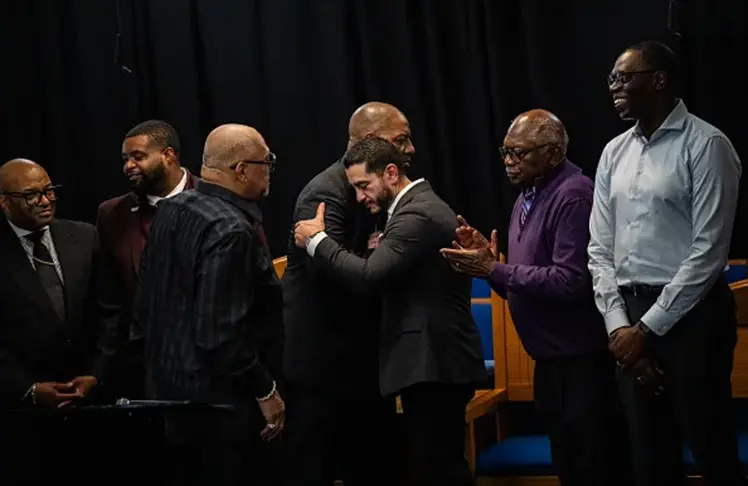
El-Sayed, it seems, has gotten the memo: He launched his general election campaign at Detroit’s historic King Solomon Baptist Church, visited community gatherings, and deployed canvassers in predominantly Black neighborhoods. His THRIVE agenda addresses Black business development, maternal health, education and infrastructure.
He’s won the endorsement of the Congressional Black Caucus PAC and the Michigan Democratic Party Black Caucus, while prominent Black Democrats, including Rep. James Clyburn, Sen. Raphael Warnock, and Kamala Harris, Biden’s former vice president, have supported his campaign or appeared with him.
Still, it’s uncertain whether that outreach can overcome lingering mistrust.
For Weaver, there’s another important question that matters just as much as a candidate’s platform: who gets a seat at the table after the election? Will El-Sayed’s leadership team include Black people whom their communities know and trust?
‘Feeling Abandoned, Forgotten’
Weaver’s skepticism isn’t theoretical. She led Flint through part of its notorious water crisis, an environmental and public health disaster that brought international attention to the majority-Black city. More than a decade later, she says, Flint is still waiting for promises — new water pipes for the city and financial settlements for consumers — to be kept.
“We’re still in the midst of a water crisis,” Weaver says, noting that several water infrastructure projects remain unfinished and residents still buy bottled water and filters. She also worries about the lasting educational, behavioral and mental health consequences for children exposed to the crisis.
The former mayor says residents have watched elected officials from both parties declare progress while everyday problems persist. For many, the experience has reinforced the belief that their communities become political priorities only when an election is approaching.
“Just feeling abandoned, forgotten, disregarded, like we’re disposable people, and we are not,” she says.
It’s a lesson Weaver believes applies beyond Flint, including to other predominantly Black communities struggling with aging infrastructure, inadequate public services and political neglect.
Despite those concerns, Weaver doesn’t believe Black voters will abandon El-Sayed. Indeed, she expects him to perform well in Flint, where she says residents are attending rallies, asking questions and listening to candidates they might once have dismissed.
“I think people are going to come around and vote for him,” she says.
Accountability
But there’s a difference between voting for a candidate and giving that candidate a blank check.
Weaver wants Black voters to recognize the leverage they hold, particularly in a close election where their turnout could determine the winner. That means asking difficult questions before Election Day and remembering the answers afterward.
“You can’t hold people accountable if you don’t know what they’ve said,” she says.
Black voters have repeatedly been told their participation is essential to protecting democracy, defeating political opponents and keeping Democrats in power. Weaver isn’t disputing the importance of voting, but she questions why the people so essential to winning elections often have to fight to be heard afterward.
“We’re tired of being an afterthought,” she says. “We’re tired of people thinking, ‘ Where else do they have to go?’”