By Ashley Nelson, Special to The Seattle Medium
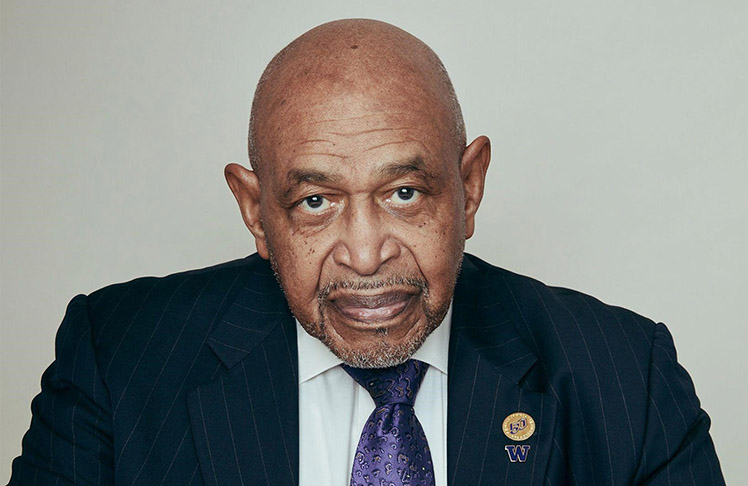
Emile Pitre is, in fact, an institution. Even over Zoom he is distinguished, seated in a purple jacket in front of an array of awards, almost as though he actually precedes his reputation.
Since he stepped foot on campus in 1967 as a graduate student in chemistry, he has lived a life of service and justice at the University of Washington (UW).
Pitre grew up in Louisiana to a family of sharecroppers, the fourth of eight children. At a young age his teacher saw his promise and pushed him to foster his academic potential. He was the first in his family to graduate high school, and he earned a full ride scholarship to Southern University in Baton Rouge, where he completed his undergraduate degree.
At the UW, Pitre was a founding member of the Black Student Union (BSU), which in 1968 occupied the office of the then-UW President Charles Odegaard to negotiate the BSU’s demands for more diversity and equity at the university.
It was a tumultuous event that Pitre at the time thought would get him arrested, but the outcome was worth it.
After a long negotiation and some pressure, Odegaard established what is now known as the Office of Minority Affairs & Diversity (OMA&D), the first of its kind at any university in the country.
The university eventually created the Odegaard Award for Diversity, which Pitre won in 2020. Truly a full circle moment.
Pitre is also famous for his contribution to the Instructional Center (IC), a program through the OMA&D that offers academic help to students. He worked at the IC as a chemistry instructor while a grad student. He later became the IC’s director.
“I have the highest respect and admiration for Emile,” said Therese Mar, the current director of the IC. “His dedication to social justice and the students that we serve — underrepresented minority, first-generation college, and economically disadvantaged students – is truly inspirational.”
When Mar first started at the IC, Pitre was the associate vice president for assessment at OMA&D. He would often visit the IC to spend time with the instructors and students.
“I was always amazed that he knew so many students by name,” Mar said. “He has left a legacy that still lives at the IC.”
Pitre’s life journey has amounted to a tremendous impact for thousands of students who benefit from his work at the IC. However, he said, there’s much to be done.
“In 2001 the Instructional Center received two awards of excellence, the Brotman Award for Instructional Excellence, and the Brotman Award for Diversity,” Pitre said. “But twenty-some years later we’re still trying to get full philanthropic support for the program that is a national model.”
Support exists, but more is needed for a wide array of students. “Currently there’s more than 6,300 students who are participants in the OMA&D’s family of programs,” Pitre explains. The IC itself serves about 2,000 students annually, a far cry from the total number of students the center could be serving.
“With the proper staffing and space, we could serve three times that many,” Pitre said with urgency.
Even in retirement, Pitre deeply cares for the state of the OMA&D and the IC. He continues his involvement by acting as senior adviser to Rickey Hall, vice president for minority affairs and diversity at the university.
“I call him the legend,” Hall said. “He’s just a wealth of history and continues to be a champion and fighter for student rights but also civil rights and justice in general.”
Hall is grateful for Pitre’s input as he continues to work towards diversity, equity and inclusion at the university.
When asked about how the BSU has evolved since its inception, Pitre thought back to when he first came to UW.
“In 1967 we thought there were about 200 [Black] students, but we later found out it was estimated that there were only around 180 Black students in an enrollment of 30,000,” Pitre said.
Pitre rattled off numbers from memory throughout the interview, choosing his words calmly and carefully. When he says something as ‘“matter of fact” you know that it really is.
“We were determined to change things,” Pitre said of the BSU.
There was only one Black faculty member on campus, a visiting professor at that. After the famous negotiation with Odegaard, by 1968 the number increased to five.
“In 2021 I think there may be 81 Black faculty members,” Pitre said.
He’s not far off.
The most recent 2020 report from the UW Office of Academic Personnel shows 99 Black-identifying faculty members across all three campuses, Seattle, Bothell and Tacoma.
With a grand total of 4,760 faculty members, Black-identifying members make up a mere 2%.
Pitre said he regularly checks up on the diversity statistics at the University of Washington, noting that less than 3% of students at the University of Washington are Black.
The numbers are clear: more change is needed, and Emile Pitre is watching.