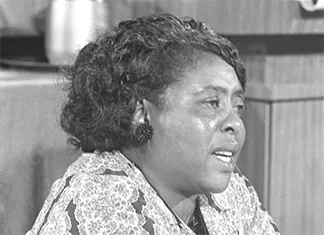
Long before the nation came to know her voice, Fannie Lou Hamer knew hardship.
Born into poverty in the Mississippi Delta and forced to leave school as a child, Hamer rose to become one of the most powerful voices of the civil rights movement, transforming personal hardship into a lifelong fight for voting rights, dignity and economic justice. Her journey from the cotton fields of Mississippi to the national political stage remains one of the most compelling stories in American history.
As the youngest of 20 children in a sharecropping family in Mississippi, Hamer’s childhood was defined by hard labor and limited opportunity. Her family later moved to Ruleville, where they worked the land, and by age 6 she was already picking cotton alongside them. Though she showed an early love of reading and excelled in spelling and poetry, she was forced to leave school at 12 to help support her family.
Those early experiences helped shape a life grounded in resilience, faith and determination. In 1944, her ability to read and write led to her becoming a plantation timekeeper, a role that placed her between landowners and workers and sharpened her ability to communicate across worlds. A year later, she married Perry “Pap” Hamer, and together they built a life under the constraints of sharecropping in Mississippi.
That life took a painful turn in 1961, when Hamer was subjected to a hysterectomy without her consent while undergoing surgery to remove a tumor. The procedure was part of a widespread practice that targeted poor Black women in Mississippi. Unable to have children of their own, she and her husband adopted children and continued to build a family despite that loss.
Hamer’s path into activism began in 1962, when she joined efforts to register Black voters. Her first attempt in Indianola ended in failure after she was blocked by a literacy test, but she refused to be discouraged. She returned again and again until she succeeded in becoming a registered voter, only to find that additional barriers, including poll taxes, still stood in the way of casting a ballot.
The consequences for trying to claim that right were swift and severe. She was fired from the plantation where she had worked for years, threatened and forced to move for her safety. Shots were fired into the home where she was staying. Rather than retreat, Hamer stepped further into the movement, working with the Student Nonviolent Coordinating Committee to help others navigate the same obstacles she had faced.
In June 1963, while returning from a voter registration workshop, Hamer was arrested in Winona, Mississippi. While in jail, she was brutally beaten after officers ordered inmates to attack her. The assault left her with lasting injuries, including kidney damage and vision problems that never fully healed. Despite the physical toll, she returned to Mississippi and continued organizing voter registration efforts, determined to press forward.
By 1964, Hamer had become a national figure. She helped organize Freedom Summer and co-founded the Mississippi Freedom Democratic Party, challenging the exclusion of Black voters from the state’s political system. That same year, she brought the realities of Mississippi to a national audience when she testified before the Credentials Committee at the Democratic National Convention.
Her testimony laid bare the violence and intimidation faced by Black citizens attempting to vote and forced the country to confront the gap between its ideals and its reality. When party leaders offered only a limited compromise, Hamer refused, making clear that justice could not be reduced to symbolism or partial measures.
She continued her work beyond the convention, organizing voter registration drives, running for office and helping document widespread disenfranchisement. Her efforts contributed to a growing national awareness that helped drive meaningful change.
Hamer understood that political rights alone were not enough. For her, true freedom meant economic independence as well. In the years that followed, she helped launch efforts such as a pig bank and the Freedom Farm Cooperative, initiatives designed to provide food, land, housing and opportunity for Black families striving to build stability and self-sufficiency.
Her leadership was rooted in authenticity and lived experience. Without formal education or political polish, she spoke with a clarity and conviction that resonated across the country. Drawing from her faith, her upbringing and her deep connection to her community, she delivered messages that moved people not through performance, but through truth.
Among her most enduring words is the declaration that continues to echo across generations: “I’m sick and tired of being sick and tired.” It captured both the weight of injustice and the determination to confront it.
In 1971, Hamer co-founded the National Women’s Political Caucus, emphasizing that freedom must extend to everyone. She remained committed to that belief throughout her life, speaking to the shared struggles and hopes that connect communities across race and circumstance.
Hamer died on March 14, 1977, at age 59, in Mound Bayou, Mississippi. In the years since, her legacy has been recognized nationally, including her induction into the National Women’s Hall of Fame in 1993 and the posthumous award of the Presidential Medal of Freedom in 2025.
Fannie Lou Hamer’s life stands as a testament to what can happen when ordinary people refuse to accept injustice.