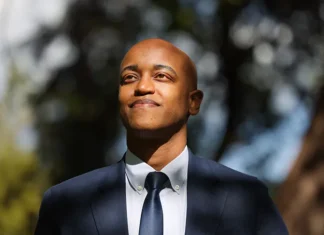
In a room full of agitators, activist, leaders, and wanna-be movers and shakers, Ed Prince may be easy to overlook. When surrounded by loud-talkers, name droppers and fancy shoe wearers, Prince, who is the executive director of the Washington State Commission on African American Affairs and president of the Renton City Council, can be seen engaging other progressive and like-minded individuals into meaningful conversations that lay the framework for addressing many of the issues facing our community, confirming follow-up meetings so that the issue(s) can continue to be addressed long after the “social events” are over, and listening to the concerns brought forth to him by those who have been affected by the issue the most.
He might not be on the front page of the newspaper or on the evening news, but Prince has been instrumental in pulling people together and working both out front and behind the scenes to make things happen since his days at Washington State University (WSU).
“I was raised to think that public service is a noble calling,” says Prince. “Nothing bugs me more than someone who claims that they are working for the public, but the public can’t approach you. You can’t do this work without being accessible and approachable.”
Born and raised in Seattle, Prince, a graduate of Franklin High School who went on to become the third African American to be elected student body president at WSU, credits his grandmother and his uncle, former State Senator George Fleming, with igniting his interest in public service. He readily recalls a time when his grandmother, a community organizer in her own right, recognized that the predominately White neighborhood two blocks away from their neighborhood was able to, once a year, set junk out on their curb and have it removed for free by the city.
“They had been doing this two blocks away from our neighborhood for a couple of years,” said Prince. “My grandmother said this isn’t right. So she organized and got a petition going with the neighbors.”
“She said we should have [the same opportunity]. We have stuff in our neighborhood that we need to get rid of and we shouldn’t have to pay a junk man to come and haul it away,” continued Prince.
The effort proved to be successful and three months later the city provided free junk removal for their neighborhood.
From that experience, Prince learned at an early age that bringing people together to work towards a common goal is a powerful tool to bring about change. This also fueled his passion on issues relating to equity and inclusion – which are the cornerstones of much of the work that he does as a councilmember and with the Commission.
As a councilmember, Prince is very proud that he was able to include equity and inclusion provisions in Renton’s new business plan. As it relates to his work on the Commission, Prince, who previously served as a staff assistant and interim Executive Director of the Commission, has pushed for the Commission to broaden its efforts to address issues like economic development, police relations, suspension and expulsion rates of African American students, juvenile justice and other issues of disproportionality.
“Before I came back to the commission, the commission worked mainly in the arena of education,” says Prince. “But the way I look at it, African Americans have a hard time in multiple areas, and when you say I’m only going to work in one area then that leads people who care about other areas not to contact you.”
“I want to start a legacy with the commission where people say, ‘You know the commission may not have been what we thought it was, you know it’s not a civil rights organization, but they really did do hard work to move the needle on policy issues that are important to our community’,” he added.
Prince sees himself as a consensus builder, who works hard at maintaining relationships and leveraging those relationships into solving problems. It was through some of these connections that Prince found himself being recruited to run for public office and applying for the open executive director position with the Commission, virtually at the same time.
“I actually decided to run for Renton City Council before I was recruited to apply for the commission position,” says Prince. “I had been three or four months into my campaign for council when I got a phone call [from someone] saying, ‘Hey there’s a vacancy at the commission. I can’t promise you anything but you should apply.’ I applied and I was hired a month before I was elected for the Renton City Council.”
The circumstances put Prince in a unique position to not only serve his constituents in Renton, but also to serve African Americans across the state through the Commission and leverage knowledge and resources that would benefit both groups. However, Prince quickly found out that he needed to properly balance his time in order to be effective in both positions.
As a city councilmember, which is a part-time position, Prince commits about 25 hours per month to advocate and serve the needs of Renton’s 97,000 residents – many of whom are voiceless as it relates to the growth, development and political direction of the city because they don’t vote.
As Executive Director of the Commission, Prince works in Olympia, but travels across the state to advocate for African Americans regardless of where they live. While the task may seem simple, the various needs and unique dynamics of each local African American community across the state vary in such a way, that there is no one size fits all solution that can be used as a blueprint for policies from a state level.
“Our community is not monolithic,” says Prince. “The issues in Tacoma are different than the issues in Seattle, and different from the issues in Whatcom County.”
“In fact one can say where there are fewer African Americans they have a more difficult time because there are not really enough [people] to rally and galvanize,” he continued. “It’s not like Seattle or Tacoma where we have no problem raising a ruckus if there is something that we feel is discriminatory or unfair because we have larger numbers, when there is 1,000 of you, you don’t have that same sense of security.”
While there are numerous success stories from across the state as it relates to the work of the commission, the position of executive director inherently is a constant tug of war between serving the needs of the community and serving the political interest of the governor and the state.
“The commissions are very unique because the communities look at the commissions as their entities, and they should have that ownership,” says Prince. “But you’re appointed by the governor, and the governor can fire you whenever he wants to. So I always have to balance where can I find something that is good for the community but also doesn’t do any negative damage to the enterprise [of the state].
Prince, however, does not let the dynamics of his position stop him from pressing forward on issues critical to the African American community, regardless of their popularity in Olympia, Renton or elsewhere. He’s fully aware that many issues like education, unemployment, incarceration rates, and police relations have been ongoing problems in our community that have virtually gone unresolved, but he refuses to allow decision-makers to continually acknowledge the issues with a token gesture and then dismiss them through lack of action.
“Sometimes in government we get so caught up in admiring the problem that we don’t solve the problem,” says Prince. “I want to solve problems. So my goal is to always solve the problem and always try to bring something value added to the table.”
In many ways, Prince’s legacy may be as humble as his demeanor. He’s not an agitator, but is willing to do so if the situation calls for it. But he does believe in creating framework within organizations, particularly as it relates to the Commission, that will have a lasting effect on the masses regardless of whose name appears on the letterhead.
“I don’t want the commission to be a one man show, because if that one man decides to take his ball and go home then the agency is not left with much,” says Prince. “I’d much rather have it be an agency where there’s ten of us working in concert for the betterment of the African American community. I want to get the commission to a place that someday when my time is up the work continues to thrive.”
At the end of the day, Prince shy’s away from all the titles and formalities. He’s not looking for a pat on the back for every little thing that he gets paid to do, but he is looking to make a difference in the lives of others, and spending quality time with his wife and two young kids.
“I’m really a public servant,” says Prince. “There’s not a lot of glamour in either of the jobs. I really, truly, as corny as this sounds, wake up in the morning wondering what I can do good for the communities that I serve. I love both my jobs and I think it’s a privilege to have them.