By Aaron Allen, The Seattle Medium
Garfield High School is working to bring families and community members back into the school through an initiative that grew out of the disruptions of the COVID-19 pandemic and concerns about whether Black students and families still felt connected to one of Seattle’s most historically significant schools.
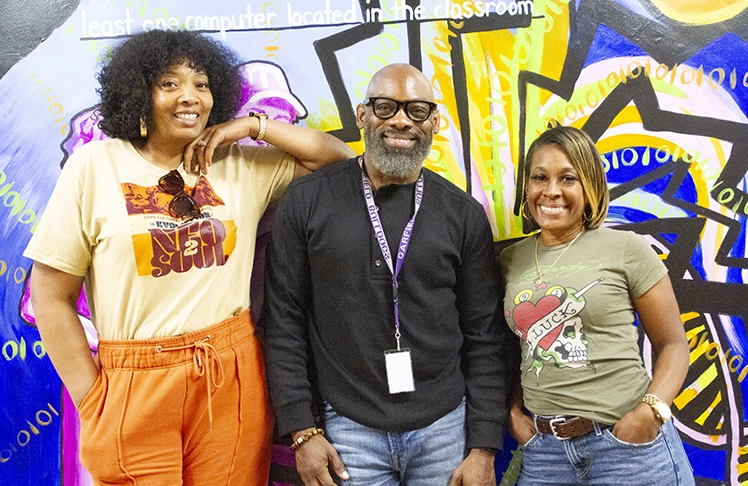
Called Reclaiming the Village, the effort brings parents, students, educators, alumni and community advocates into conversations about student achievement, teacher development and the culture inside Garfield. Garfield High School Principal Dr. Tarance Hart said the initiative grew from his recognition that rebuilding those relationships could not be accomplished by school employees alone.
Hart relocated to Seattle in 2021 to take the job at Garfield after previously working as an educator in Mississippi. Arriving as both a new principal and someone new to the community, Hart said building relationships with Garfield families, alumni and the surrounding community became an important part of his work.
The need for those relationships became particularly clear as the school emerged from the disruptions of the COVID-19 pandemic.
“The success of students can’t just be done by the school staff; it really takes community. It takes families, school staff, and alumni,” said Hart. “The importance of it is, how can we better engage families who haven’t traditionally been welcomed in schools, or who haven’t felt welcomed, or who’ve had not-so-positive experiences in education themselves?”
For Hart, that question became part of the foundation for Reclaiming the Village. He worked with community leaders already engaged in grassroots efforts in Seattle to develop the initiative and bring families and community members back into the school.
“What I wanted to do, and the origin of Reclaiming the Village, is bring back community who, from what I understood, had been a big part of Garfield and its legacy. COVID shut all of that down. Being a new leader not from the community, I wanted a way to say, ‘We need you. The only way we can do our job and be successful is if we have community as part of the work.’”
Garfield serves a racially diverse student body, with students of color making up roughly two-thirds of the school’s population. Black students account for about 30% of enrollment, providing additional context for the initiative’s emphasis on family engagement, student advocacy and helping educators better serve students from different backgrounds.
Reclaiming the Village focuses on three interconnected areas: bringing families back into the school, strengthening student voice and advocacy, and helping teachers better serve a diverse student population. The initiative also works with student organizations, including Garfield’s Black Student Union, as part of its effort to give students a greater voice in their educational experience.
Hart said he wants those efforts to become part of Garfield’s long-term culture rather than remain a temporary program.
“Those are the three buckets of the work, and for me, that’s the legacy I want to leave here at Garfield: that we are better engaging families and students, and we are better training a teacher workforce who can more effectively teach all types of students.”
For community leader Nichelle Page, however, bringing families back into Garfield requires more than simply inviting them into the building. She said schools must also consider why some families have felt disconnected or uncomfortable in educational spaces.
“When I think of Reclaiming the Village, I think of families, but I also think of ecosystems,” said Page. “Our families don’t want to be asked to come back to something that’s toxic. Anytime there’s something in the ecosystem that is off, you see it in our youth. I’m wanting to address how we support educators in a way where they’re not increasing trauma and harm in Garfield’s ecosystem.”
Page pointed to a summer leadership initiative involving Black Student Union students as an example of the relationship between student advocacy and what happens in the classroom. She said students learned emotional regulation techniques and ways to advocate for themselves when dealing with difficult situations.
“Our children were in a leadership academy this summer that focused on the vagus nerve and how to de-escalate ourselves when things become stressful. Their language began to change. They started to challenge facilitators, saying, ‘That language is the colonizer’s language. We want to change it to how it makes us feel in excellence.’ Now you have teachers who may not necessarily know what to do with a child who comes back as an advocate for themselves and other students.”
Page also pointed to a partnership grant with the University of Washington focused on teacher support and family outreach. For her, some of the most meaningful signs of progress have come from families asking how they can become involved.
“All babies must be educated. All families must be seen about. A phone call, showing up at a game, introducing yourself that makes a difference. Having this conversation about Reclaiming the Village with our families, now we have generational families coming in asking, ‘How do we get involved?’ Just two weeks ago, we had a great-grandmother who was 92, a grandmother who was 72, a mom who was 42, and a student who is a sophomore here at Garfield, all saying, ‘Give us something to do. What can we bring to this space?’”
That multigenerational involvement reflects a broader effort to expand who participates in the life of the school. Reclaiming the Village is working to bring a more diverse group of families into Garfield, including parents who may not already be involved through traditional organizations such as the PTSA.
Community advocate Arika Townsend sees those relationships through the lens of her own experience as a student and the changes she has witnessed in Seattle’s Black community.
“I’m going to start with a quote that was cemented in my mind as a young adult: ‘You cannot be successful with my child without me,’” said Townsend. “It was important that my teachers had a relationship with my parents, because the expectations at home weren’t necessarily the same at school. Bridging both together made me a successful student and human being.”
Rebuilding those relationships has become more complicated as the community surrounding Garfield has changed. Townsend said gentrification and displacement have scattered Black families who once had stronger geographic ties to the Central District.
“The dynamic of the school has changed. Back in my day, there were more Black administrators, Black instructors, and educators. I felt it was more culturally sound and comfortable, whereas I don’t see that as much today, and that can be a barrier for some. Gentrification did not just affect the Central District, affecting the South End and beyond, moving families as far as Tacoma.”
For Townsend, rebuilding family and community relationships does not mean recreating the past. Instead, she sees value in identifying the practices that helped students feel supported and adapting them to the school community that exists today.
“Bringing all those dynamics back full circle, looking at data, and seeing how it affects change, Reclaiming the Village is a big factor in that. It brings us back to the things that did work, which is the family dynamic and the support system. When you feel good about who you are, you show up differently.”
One way Garfield is putting that approach into practice is through Learning Walks, which allow participants to observe what is happening inside classrooms.
Traditionally conducted by administrators, the Learning Walks at Garfield are expanding to include teachers, parents and students. Participants observe classroom instruction together and gather information about broader patterns in the school environment and student engagement.
According to Hart, the observations are intended to identify schoolwide patterns rather than evaluate or discipline individual teachers. Information gathered during the walks can then help identify areas where educators may need additional professional development.
The initiative’s focus on family participation, student advocacy and teacher development reflects what Hart said he hoped to establish when he arrived at Garfield: a school where community involvement is part of the work rather than something separate from it.
For Page, the larger goal is for those relationships and expectations to remain recognizable even as students and families move between schools and communities.
“That’s the work of Reclaiming the Village: bringing us back together, speaking one language, where now we are empowered amongst each other. No matter where we go, whether here at Garfield or Rainier Beach, the language is still the same.”