By Aaron Allen, The Seattle Medium
Byrd Barr Place has formally transferred the First Right of Refusal for Seattle’s historic Liberty Bank Building to Africatown Community Land Trust, marking a significant step toward ensuring one of the Central District’s most important Black landmarks remains under Black community stewardship for generations to come.
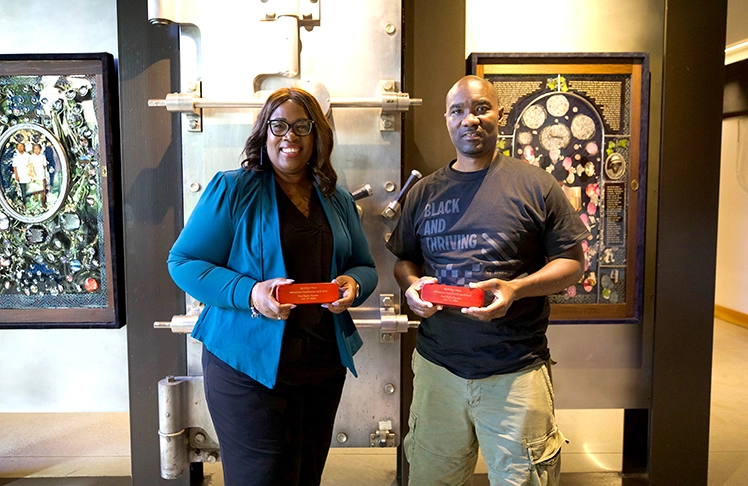
The agreement, finalized during a ceremony on July 19, reflects a shared commitment by both organizations to preserve the Liberty Bank Building as a lasting symbol of Black leadership, ownership and community investment. Following a $32 million redevelopment, the building now provides 115 permanently affordable apartments and fully leased commercial spaces in the heart of Seattle’s Central District.
A First Right of Refusal gives an organization the first opportunity to purchase a property if the current owner decides to sell. While the agreement does not immediately transfer ownership of the building, it ensures that if the property is ever offered for sale, Africatown Community Land Trust will have the first opportunity to keep it under community ownership.
For Dr. Angela Griffin, president and CEO of Byrd Barr Place, Sunday’s agreement fulfills a commitment that was envisioned years ago when plans for the building’s redevelopment first took shape.
“When it came about for the Liberty Bank Building to be revitalized and kept as an asset in the Black community, Byrd Barr Place was brought to the table. At the time when all that was set up, the development company, Community Roots Housing, had a 15-year investment… and Byrd Barr Place had first rights of refusal to purchase or own the building, while Africatown had the second right,” Griffin explained.
Griffin said the original agreement anticipated that Byrd Barr Place would eventually transfer its First Right of Refusal once Africatown Community Land Trust had established itself as a stable nonprofit organization with a proven record of serving the community.
“At the time, Africatown was still establishing itself as a non-profit organization. The agreement was that once they had established themselves and shown a good track record, Byrd Barr Place would transfer our First Right of Refusal to Africatown and move into the second right position,” said Griffin. “Africatown has now reached its 10-year mark, has a proven track record, and manages operations and housing at the building. Now is just the perfect time to make that transition happen.”
The Liberty Bank Building’s importance extends far beyond the agreement itself.
When Liberty Bank opened on May 31, 1968, it became the first Black-owned bank in the Pacific Northwest and one of the first Black-owned financial institutions west of the Mississippi River. Located at the corner of 24th Avenue and East Union Street, the bank was established during the Civil Rights Movement to address systemic discrimination that prevented many Black families and entrepreneurs from accessing mortgages, business loans and other financial services.
At a time when discriminatory redlining practices routinely denied Black families mortgages and business loans, Liberty Bank became a critical source of capital and economic opportunity for Seattle’s Black community. Demonstrating remarkable community investment, Black residents purchased approximately 80 percent of the bank’s original stock, ensuring the institution remained rooted in the community it was created to serve.
The effort grew out of Sentinel Credit Union, established by members of the Prince Hall Masonic Grand Lodge. After years of regulatory challenges, Black civic leaders James and Mardine Purnell, Rev. Dr. Samuel McKinney, Dr. James E. Jackson and Holbrook Garrett joined with community allies George Tokuda and Jack Richlen to establish the commercial bank.
Although Liberty Bank ultimately closed in 1988 because of financial pressures, its legacy endured. After briefly operating as Emerald City Bank, the property was eventually acquired by KeyBank. In 2015, KeyBank intentionally sold the property below market value to Community Roots Housing, then known as Capitol Hill Housing, to help preserve the site as community-centered affordable housing instead of market-rate development. Today, the building incorporates elements of the original bank, including its historic vault door, safety deposit boxes and brickwork.
For Wyking Garrett, president and CEO of Africatown Community Land Trust, Sunday’s agreement fulfills one of the central commitments established when the redevelopment partnership first came together nearly a decade ago.
“In 2016, we entered into a Memorandum of Understanding… regarding prioritizing businesses, honoring the legacy of Liberty Bank, and securing long-term ownership for our community,” said Garrett. “This coincides with the 10-year anniversary of the founding of Africatown Community Land Trust, making this an opportunity to fulfill the intent of that historic memorandum to secure long-term community ownership.”
Garrett said preserving the Liberty Bank Building is about more than protecting a historic landmark. It is also about expanding economic opportunity for future generations.
“The biggest challenge is access to capital, for organizations, individuals, and families,” said Garrett. “In a city becoming increasingly expensive, this is exacerbated by systemic denial of economic advancement. That’s why reparative policies, investments, and focusing on reparations to address the capital, wealth, and income gap are so critical.”
Sunday’s ceremony also highlighted an upcoming feature-length documentary. The film chronicles the Liberty Bank Building’s 58-year journey, from its founding as a pioneering Black-owned financial institution to its transformation into a symbol of community-led redevelopment and affordable housing. The signing ceremony will serve as the documentary’s closing chapter.
Although the transfer centers on a legal agreement, leaders from both organizations said its broader significance lies in protecting a landmark that represents generations of Black resilience, entrepreneurship and community investment in Seattle’s Central District.
“Legacy isn’t something we simply inherit; it’s something we actually need to choose to protect, invest in, and pass on to the next generation,” said Griffin. “This demonstrates the power of community organizations working together to create lasting intergenerational impact.”