By Kiara Doyal, The Seattle Medium
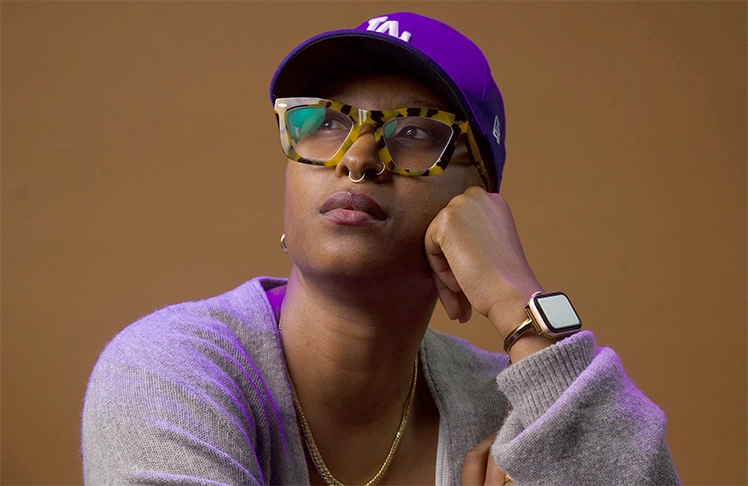
Seattle choreographer and conceptual artist Jade Solomon Curtis is bringing years of personal reflection, community collaboration and technological innovation together in her newest work, Keeper of Sadness, making its public debut Aug. 1 and 2 at The Union in Seattle’s Chinatown-International District.
The free, two-night performance blends live choreography, the testimonies of Black women and an artificial intelligence presence built entirely from community voices. Through movement, storytelling and innovative technology, the work examines grief, resilience and the emotional experiences of Black women while inviting audiences into a shared space for healing and reflection.
Keeping the performances free was an intentional decision for Curtis. She said because the project was created alongside community members from its earliest stages, she wanted to ensure cost would never prevent people from experiencing it.
“The foundation for this work is community, and I have involved community in every stage of this work,” said Curtis. “The work is about and for community, and so in this particular instance, I didn’t think that anyone should be charged. But I also didn’t want money or a ticket price to be a barrier for attendance.”
Curtis said the inspiration for Keeper of Sadness came during one of the most difficult periods of her life.
“Much like a lot of my work, I’m inspired by a personal experience. There was a time when I was navigating a lot of personal things with my family. I was depressed, and I wasn’t certain of what to do with it,” said Curtis. “This led me to have conversations with the women in my family, and I would ask them very simply, ‘How do you do this? How do you keep going when it feels like the weight of the world is on you?’ And many times, their responses were, ‘You just do.'”
Those conversations eventually grew into interviews with 30 Black women in Seattle’s Chinatown-International District. Rather than simply documenting their stories, Curtis said she invited the women to help shape every stage of the project.
“How do we start to think about how we are the blueprint? How our experiences and the things that we navigate are the blueprint and guide for other Black women,” said Curtis. “If we have the ability to put our pain where it needs to be without continuing to disrupt our lives, we have the capacity to support and help others. And so, I came up with this idea and we have built this ancestral intelligence.”
A defining feature of Keeper of Sadness is its use of artificial intelligence. Rather than relying on publicly available data or outside sources, the AI component was created exclusively from the voices and experiences shared during those interviews.
“This ancestral avatar is built off of only these 30 interviews. So, Black women are the knowledge, and they are the source code, and for me that was intentional,” said Curtis. “As a protector of stories and also knowing that Black communities, for as long as I have existed, and many generations before me, have been extracted from, pulled apart, taken and sold, and never really had ownership over our work, spirits, or bodies, I wanted to make sure that what we created with this ancestral avatar honored that. I wanted to make sure our stories remained in our hands.”
The title Keeper of Sadness also carries deeply personal meaning. Curtis said the phrase originated during a conversation with her mother-in-law while she was experiencing depression and eventually became a way to describe the emotional burdens many Black women carry.
“I think about all the things that we as Black women hold on to, whether we are given permission or whether we give ourselves permission to release it or explore our rage,” said Curtis. “And that comes up a lot for me because I am from the South. I let my daughters know you can be nuanced. You hold a lot of different emotions, and happiness and joy are just one of them. So, knowing what we hold publicly, what we release privately in that realm of sadness, what we allow ourselves to do, and what other people allow us to do, to me is what that title holds.”
Curtis said creating the project has also marked a turning point in her artistic journey, strengthening her confidence in creating work that asks audiences to actively engage rather than simply observe.
“I think there’s just more certainty in my work,” said Curtis. “The validity and the credibility that I receive comes from the conversations that I’ve had with the women. I am asking people to slow down and be more than just voyeurs in the space and really understand that this is very spiritual work. Even though there are all of these innovative technologies and things that are happening, we Black women are the technology. We are the source code. So, even speaking about this out loud again reminds me that the evolution in my work is really about the certainty in the path that I am on.”
Beyond the performance itself, Curtis hopes Keeper of Sadness encourages audiences to continue conversations about humanity, healing and emotional vulnerability long after they leave the theater.
“I think specifically with Black women, I want this to be a reminder that you actually don’t have to hold all that you’re holding. It’s not yours alone,” said Curtis. “I hope they are reminded of the nuance of their humanity and the emotions they carry. In terms of everyone else, I hope they can see that too. I feel like not just in my artistic practice, but in my day-to-day life, I’m constantly having to prove my humanity, prove my value, prove that what I say is credible. I hope audiences walk away recognizing that we all hold that same emotional spectrum.”