By Chris B. Bennett
The Seattle Medium
The notion that becoming a professional football player means that a person will be set for life is a myth that gets debunked year after year.
While the average NFL salary in 2015 was $2.1 million, Maurice “Mo” Kelly, Vice President of Player Engagement with the Seattle Seahawks, says that number is very misleading.
“The majority of the guys will make much less than that,” says Kelly, a former player himself, who is responsible for developing programs to assist players in making a smooth transition into and out of professional football with the Seahawks. “I like to talk about the minimum salary because that is a more realistic figure.”
The minimum salary for an NFL player is $450,000 per year, and the median income for an NFL player is $860,000 per year. Kelly says that after taxes, agent fees, union dues and other related professional expenses the players can expect to take home about 50% of their gross earnings.
“Don’t get me wrong, that’s good money,” says Kelly. “Especially for a guy coming straight out of college who has never had a job before.”
According to Kelly, the average NFL career is 3.5 years, which also is about the same amount of time it takes for a player to become vested (3 years, plus three games) – which means they will qualify for benefits (pension, health care, etc.) when their playing days are over.
Many people have heard about the financial problems that some major sports stars have encountered after they retire, but what about the vast majority of players who don’t receive huge contracts and big signing bonuses?
These players need to plan on careers after football, and for many players this is a reality that has not even crossed their minds.
“They all think they are going to do this for a long time,” says Kelly. “This year we had ten draft picks, and I’d be stretching to think two of them are thinking about ‘what if this doesn’t work out.’”
“They are truly blessed,” continued Kelly. “They’ve been told all their lives that they are too slow, not big enough, etc… They defy the odds, so they don’t look at themselves as normal.”
In an effort to help players network and think about job opportunities outside of football, Kelly along with Mark Hatcher, Inventory/Supply Chain Lead with Coca-Cola, developed a job shadowing program for current Seahawk players.
The program, now in its fourth year, has introduced 26 Seahawk players to job shadowing experiences with companies like Microsoft, Starbucks and this year with Coca-Cola.
According to Kelly, Microsoft was their partner for the first year, and the hiring manager agreed to interview six players with the expectation of maybe hiring one of the players.
“I took it as though he was almost insulting us,” said Kelly. “These guys go through one of the most grueling job interview processes in the world at the NFL Combines, so having them go through a normal interview process is easy for them.”
“All of them went in and hit it [the interview] out of the park,” said Kelly. “He wanted to take all six who interviewed. He said, ‘If I put these guys into a pool of normal people we wanted to hire I would still hire all of these guys.’”
This year, six players participated in the program by job shadowing employees at the Coca-Cola plant in Bellevue, where they were exposed to everything from production to marketing and distribution. According to Hatcher, four players – Steven Terrell, DeShawn Shead, Will Pericak and Drew Ferris – completed the program, which was modified to give the players a more comprehensive experience than previous years.
“The players were originally supposed to be confined to one area,” says Hatcher. “However, after the second day, I decided to provide a more robust experience so I reached out to other areas of the business [for their involvement]. These areas included inventory, warehouse, production, transportation, sales, recycling, merchandising, and maintenance.”
“The first thing that always comes out of the employee’s mouth when you ask them if one of the players can shadow them is ‘Why would the players want to do this?’” says Hatcher. “That’s because often times they don’t understand that outside of football [these] guys have lives too.”
Shaniqua Clark, an inventory control assistant at Coca-Cola, was pleasantly surprised by her interaction with the players during their job shadowing experience.
“I think one of the fears in doing this was if they wanted to be here,” said Clark. “Did they really want to learn, and without a doubt from the first day every single one of them proved that they wanted to be there and that they wanted to learn.”
According to Hatcher, each of the players participated in a total of six program sessions over the course of three weeks. Hatcher says that the program allows players to develop relationships as the foundation for ongoing mentorship and career transition opportunities that can help them evolve into life after football.
“Your time as an athlete is finite,” says Hatcher. “So it’s going to end someday. So the better networked you are, the better connected you are to roles and responsibilities and understanding of corporations will enable you to leverage that presence and that exposure that you had to do something different.”
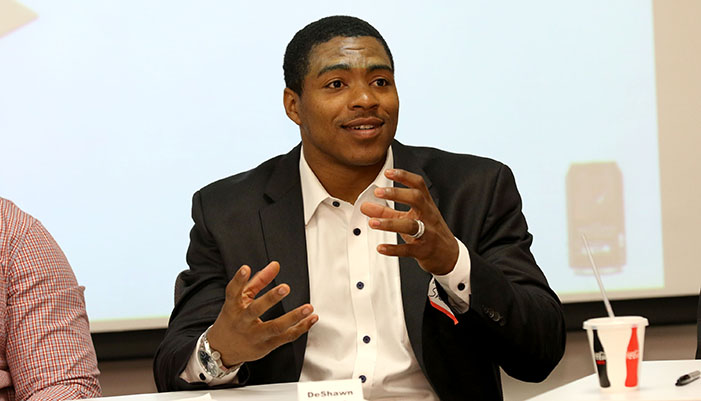
For players like defensive back DeShawn Shead, the opportunity was eye opening.
“It was a wonderful experience for me,” says Shead, whose previous work experience outside of football was holding signs on the corner when he was younger. “I just appreciate the opportunity because I’ve never really been in the business world.”
I don’t know exactly what I want to do after I’m done with football,” he continued. “I have some ideas and I’m willing and open to do things.”
Seahawks long snapper Drew Ferris also thought the experience was enlightening.
“I thought the program was great,” said Ferris.
“I saw a lot of parallels between all of the jobs here and the football world. I think it was great [that we were] able to see that stuff still lives on even past [our] playing days and branching out into the real world,” he added.
The success of the program can be measured by the enthusiasm of the players. From a bottling and distribution perspective the players got a chance to see the entire process from beginning to end, and changed not only the way they look at Coke but also life after football.
“When we first get to the NFL we go through rookie minicamps. This was kind of like our rookie minicamp to Coca-Cola,” says defensive back Steven Terrell. “I was lucky enough to see the production of the cans from the beginning to the end. I’ll never look at Coke the same.”
While it may be easy to hang his hat on the success of the program, Kelly is looking to expand it even more.
“We’re looking to develop our players on and off the field,” says Kelly. “We want them to touch base and rub elbows with major employers in the area.
“The whole purpose of putting a job shadowing program together is to be able to expand it and hopefully turn it into an internship,” continued Kelly. “These guys have done a tremendous job of coming out and just looking at their future, investing in themselves. So it says a lot about [them]. They’re going to be successful and hopefully this relationship will continue in the future.”