By Aaron Allen, The Seattle Medium
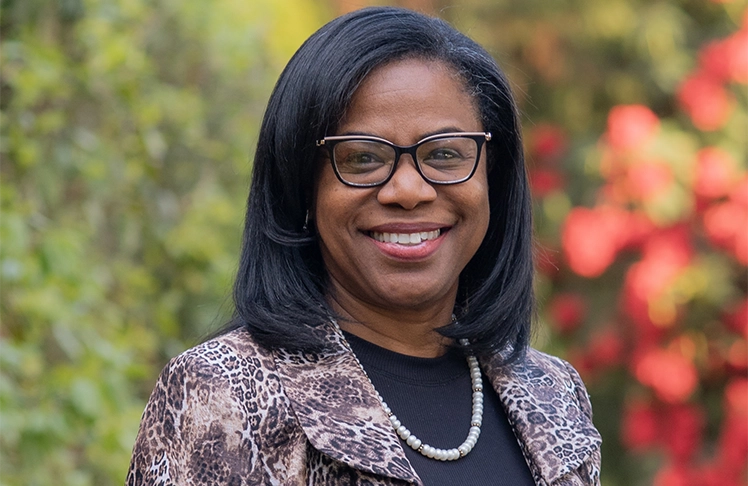
Thurston County Superior Court Judge Sharonda Amamilo, who is running for the Washington State Supreme Court, approaches the bench with a philosophy grounded in both legal precision and human understanding.
In the quiet, high-stakes environment of the courtroom, Amamilo operates under a framework she calls “FIRE”: Facts, Issues, Rules and Exceptions. But for Amamilo, the law is never just a technical exercise. It is a human story, often a fragile one, and a responsibility to ensure that every person who enters the courtroom is treated with dignity.
“I don’t know the life that people led, or the things they’ve had to deal with,” says Amamilo. “My number one job is not to inject any trauma into their story. I don’t get to be dismissive. I don’t get to be unkind.”
Amamilo’s campaign for the state’s highest court is rooted in that perspective, shaped by nearly two decades of legal work at what she describes as the “vulnerable edges of the fabric of society.” Her decision to seek a seat on the Washington State Supreme Court reflects a belief that meaningful change requires addressing systemic issues at a broader level.
Amamilo’s journey to the bench was not driven by a lifelong ambition to serve as a judge, but by a growing recognition that the systemic failures she encountered in school, medical and justice systems required intervention “upstream.”
Before being elected as the first African American judge in Thurston County, Amamilo built a career as a public defender and private practitioner, often representing parents in high-stakes child welfare cases. Those experiences exposed what she described as the “Goliath” nature of the justice system and the profound consequences of its decisions.
“It’s so profound a privilege to be able to stand in the gap when someone is getting ready to lose their identity as a parent,” said Amamilo, recalling years spent visiting clients in prisons across the state and advocating for families in court.
Amamilo’s transition from advocate to judge was shaped by what she calls “abuse of agency power.” In one case, she challenged the emergency removal of four children from grandparents, arguing the decision would have separated siblings across the state. In another, she identified what she described as a “spurious” attempt to arrest parents on the eve of a dependency trial.
“Those two things were the final straw,” said Amamilo. “I needed to get up higher to be able to say to a wrongdoer: ‘I see what you’re doing, and I see what’s going on.’”
That desire to operate at a higher level of influence now informs her campaign for the Supreme Court, where decisions shape legal standards and affect communities across Washington.
On the bench, Amamilo has developed a reputation for careful scrutiny and a refusal to simply affirm recommendations without question. She has been particularly vocal about disparities in bail and sentencing decisions.
She recalled a hearing in which a white defendant facing a third felony DUI was recommended for $10,000 bail, while a younger Black defendant with a less severe record faced a $50,000 recommendation.
“I just call it out in the courtroom,” said Amamilo. “I told counsel, ‘This young man has a much different picture that doesn’t sound equitable to me. That doesn’t sound reasoned.’ It is a good deterrent when they know a judicial officer is going to call them out on the record.”
With years of experience handling felony trials, administrative appeals and complex civil matters, Amamilo now regularly presides over cases with statewide implications. As a judge in the state capital, much of her work involves reviewing agency decisions that affect large segments of the population.
For Amamilo, whether a case involves a multi-million-dollar tax dispute or what she describes as a “little life thing” such as a consumer issue, the guiding principle remains consistent: clarity and fidelity to the law.
“Every perceived wrong doesn’t necessarily have a remedy in the law,” Amamilo said. “You have to be able to suss that out for folks and make sure they understand with clarity what you’re ruling on and why. I use the FIRE acronym to facilitate respect, respect to the people, the issues and the law.”
As she seeks a seat on the Washington State Supreme Court, Amamilo continues to frame the role of a judge not as an advocate, but as a decision-maker grounded in knowledge, preparation and accountability.
“The way you show that you care is that you make sure you’re informed and you’re involved,” says Amamilo. “You can’t just talk about it. You have to know it from an intimate level.”