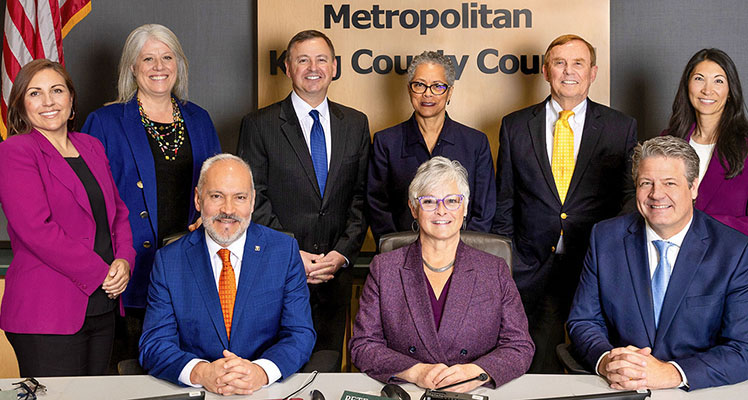
The King County Council unanimously approved a $793 million supplemental budget Tuesday that expands investments in affordable housing and homelessness services, reverses some proposed public health cuts and directs millions of dollars to community-based organizations serving some of the county’s most vulnerable residents.
Approved by a 9-0 vote, the supplemental budget represents a 3.8% increase to the county’s existing two-year budget and comes amid uncertainty surrounding federal funding and growing demands for essential services.
“Even in a challenging budget environment, we have a responsibility to make thoughtful investments in the urgent needs of our communities while ensuring every taxpayer dollar is being used efficiently. This budget moves us forward on both fronts by investing in more affordable housing, better transit and infrastructure, and climate resilience while also identifying savings and reductions,” said King County Executive Girmay Zahilay. “I want to thank Budget Chair Rod Dembowksi, the entire Council, and Council staff for their diligent review and collaboration on this budget. Now, it’s time to put these investments into action and deliver meaningful results for King County residents.”
The budget includes $23.7 million to create more than 500 units of shelter and affordable housing, advancing Zahilay’s commitment to fund, identify sites for and begin development of 500 units in 500 days.
Additional housing and homelessness investments include $3.5 million for Friends of Youth, $700,000 for Mother Nation, $425,000 for Mount Zion, $350,000 for Porchlight, $270,000 for Riverton Park Church, $230,000 for the REACH outreach team in South King County and $50,000 for Vision House.
Community-based investments include $2 million for African Community & Housing Development’s public market, $2 million for the Khmer Community and Cultural Center, $1 million for an Indian American Community Services community center and $100,000 for the Seattle Chinese Garden. Another $420,000 in previously contracted funding was reappropriated for La Plazita de Vashon.
“This year asked a great deal of local government, as federal cuts to food assistance and Medicaid placed additional strain on families and community organizations,” said King County Councilmember Rhonda Lewis. “Throughout our budget discussions, I am proud to have prioritized sustaining essential services that so many residents rely on. A strong local safety net depends not only on preserving critical services, but also on ensuring that the organizations closest to our communities have the resources and opportunities to contribute and expand that work.”
The budget includes $198 million in capital funding for the Seattle Crisis Care Center and new medical facilities and infrastructure at Harborview Medical Center.
The council also restored several proposed public health cuts, including $200,000 for the Adult Dental Program, $92,000 for parent-child health outreach contracts addressing infant mortality and $481,000 for communicable disease, epidemiology and immunization programs.
Additional investments include $2 million for mammography services at the Tubman Center for Health and Education, $250,000 for gun violence prevention programming through the YMCA of Greater Seattle and $8.5 million from hospital services tax funding associated with the Harborview bond to provide a location for expanded medical respite services.
“It’s been a privilege to lead our council budget deliberations and see a unanimous 9-0 vote in support of our work,” said Council Budget Chair Rod Dembowski. “I congratulate Executive Zahilay for his strong proposal that increased shelter capacity, invests in environmental protection and protects the county’s AAA credit rating. I thank my colleagues for their support in addressing transit service deficiencies in the SR 522 corridor, including Lake City. And I’m especially excited to have secured an $8.5 million investment to expand life-saving respite care, in partnership with Harborview Hospital.”
Funding for immigrant and refugee communities includes $250,000 for the Washington State Coalition of African Community Leaders to support individuals detained or arrested by U.S. Immigration and Customs Enforcement, $75,000 for Eastside for All’s Safe Haven/Rise immigrant and refugee protection initiative and $1 million to help lawfully present asylum seekers and refugees obtain health insurance through the insurance marketplace after losing federal coverage.
Workforce development investments include $300,000 for pre-apprenticeship programs in the Auburn and Federal Way school districts, $110,000 from the Crisis Care Levy for a health care employment and apprenticeship program and $800,000 to complete Washington Maritime Blue’s innovation center.
The budget also allocates $500,000 to establish an Office of Labor Standards to strengthen worker protections in unincorporated King County and provides funding for a prosecutor focused on organized retail crime.
Transportation investments include $64.4 million to expedite development of the RapidRide R Line between downtown Seattle and Rainier Beach and $68 million for maintenance, preservation and safety improvements to county-owned roads and bridges.
The county will also invest $100 million to preserve 1,500 acres of land, expand access to urban green spaces and protect natural habitats, forests and farmland. Another $4.6 million will support efforts to protect residents from extreme weather, reduce energy costs and pollution, and prepare workers for clean energy jobs.
The budget also requires agreements involving Marymoor Park to include commitments to preserve public access to cricket fields.
According to Zahilay’s office, the supplemental budget maintains general fund reserves, preserves $28 million in the county’s rainy-day fund and identifies $15.2 million in general fund savings and $24 million in capital savings.
“I’m grateful to have worked with my Council colleagues and staff to craft a supplemental budget that is both responsible and responsive to the needs of our districts and the county as a whole,” said King County Council Chair Sarah Perry. “It’s critical that we remain nimble as we face uncertain state and federal policy changes. With this in mind, we focused on maximizing the resources available to us, addressing urgent needs, and maintaining strong reserves to respond to future challenges.”
Another $18.2 million will support government accountability and service improvements, including stronger oversight of the Department of Community and Human Services, improved accessibility at county-owned buildings and additional public defense attorneys to meet caseload standards. The budget also requires a plan to complete the county’s return-to-office initiative.
The council also directed the allocation of revenue from the county’s Children and Families Tax, which is projected to generate $4.87 million in 2027.
The supplemental budget has been forwarded to Zahilay for his signature.
“I appreciate my colleagues’ support for priorities that matter to South King County families. We secured funding to keep the Church by the Side of the Road tiny house village operating, address organized retail crime, restore and expand public health investments, and support local organizations providing essential community services,” said King County Councilmember Steffanie Fain.
“We also strengthened financial oversight to improve accountability for public dollars,” added Fain. “I was pleased to co-sponsor the Council’s striking amendment, but our work isn’t over. As we confront significant budget challenges ahead, we need to take a harder look at existing spending, identify opportunities for savings, and protect essential services without asking families already struggling with rising costs to pay more.”