By Charlie Darnall, The Seattle Medium
In 1982, CNN released “Crossfire,” an impassioned political debate program. In 2004, John Stewart, comedian and then-host of “The Daily Show,” appeared on the show and called it “theater.”
Nearly 20 years later and our political media landscape remains a theatrical production. But while pundits attempt to solve systemic issues with talking points before commercial breaks, leaders in our communities work methodically.
And at the Othello-UW Commons, the “Louder Than Words” series proves these leaders aren’t actors.
These communal conversations are moderated by Sally Cark, interim vice president for campus community safety at the University of Washington, and Ed Taylor, vice provost and dean of undergraduate academic affairs at the UW. The duo co-founded the series.
“Louder Than Words,” which runs annually, started in 2021 and the format has remained the same since. Either Clark or Taylor moderates hour-long discussions six or seven times over the year with one or two highly involved community members. Every conversation is uploaded to YouTube.
In the past year, these guests ranged from Brent Jones, the superintendent of Seattle public schools, who spoke to Taylor about equity in education, to Chief Adrian Diaz, the current chief of the Seattle Police Department, who spoke to Clark about rethinking police accountability.
For the moderators, picking guests and topics is easy. Those invited are leaders in our communities and the topics are “what’s happening in our own backyards,” said Taylor.
The hard part, then, is the conversations. These issues aren’t to be hashed out in a five-minute segment and the moderators don’t treat them as such. Both Clark and Taylor have concerns over media polarization and wanted “Louder Than Words” to operate differently.
“The space isn’t compatible for a debate,” said Clark. “‘Louder Than Words’ is a mutual learning experience.”
Mutual learning is also the goal of the space that hosts the series: the Othello-UW Commons, which both Clark and Taylor helped create.
“We wanted to have a permanent space in southeast Seattle,” said Taylor. “We have students and faculty there and the topics we are discussing directly affect people in those communities.”
The Commons is collaborative space for UW faculty, staff and students as well as community partners in south Seattle. The space prioritizes learning from and with local communities.
The Commons serves as a commitment: the UW will listen, learn and serve. And, according to the Othello-UW Commons 2021-2022 Impact Report, this commitment is strong.
Within three years of operation, the Commons gained 80 community-based partners and affiliates. In 2021-2022, 200 community-based events, course offerings and workshops happened at the Commons.
For Nancy Huizar, a UW alum who commuted from Beacon Hill and current program manager for the Commons, this space would have made their undergraduate experience a lot easier.
“Commuting to campus was hard. I didn’t feel like I had access to the same resources,” said Huizar. “Having this space around for students, even if it is more of a decompression space, is really important.”
Huizar was responsible for bringing Conectándonos MÁS, a program teaching young kids about their ancestral roots, to the Commons.
“They bring youth from the area to talk about the Latino African diaspora and how to connect to their roots through art,” said Huizar. “They hosted an activity where they asked “What is the importance of place?” The kids ended up drawing pictures.”
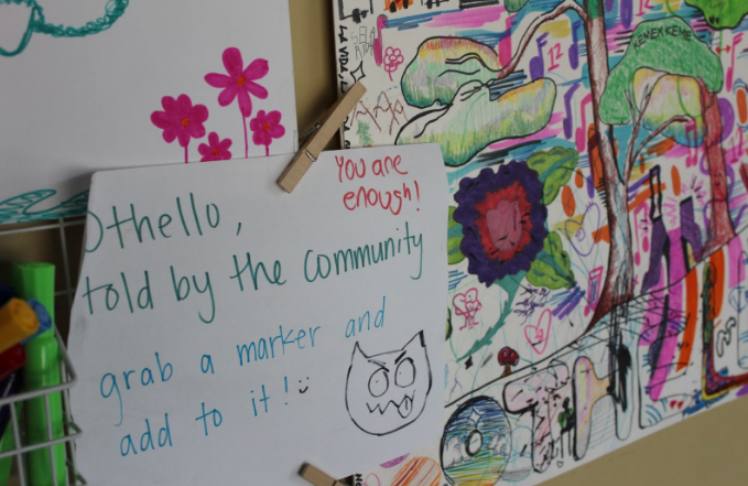
This shared goal of listening and learning from local communities creates meaningful overlap between the conversations and the Commons’ programming. Words become actions in one space.
In Jones’ conversation, the superintendent argued schools should improve access to technology. The Commons created Young Women Empowered Tech, a program encouraging women to explore technology in numerous fields.
The Commons also taught a Python class for south Seattle residents in hopes that understanding the programming language would provide a path to higher wage careers.
Through the “Louder Than Words” series, UW staff, students and faculty listen and learn about systemic issues within Seattle communities. Then the Othello-UW Commons, through their programming, works to serve those needs.
Nothing was “solved” during these conversations, but Clark and Taylor, as well as their guests, hope to inspire further action from those listening.
After all, “These aren’t easy fixes,” said Taylor.