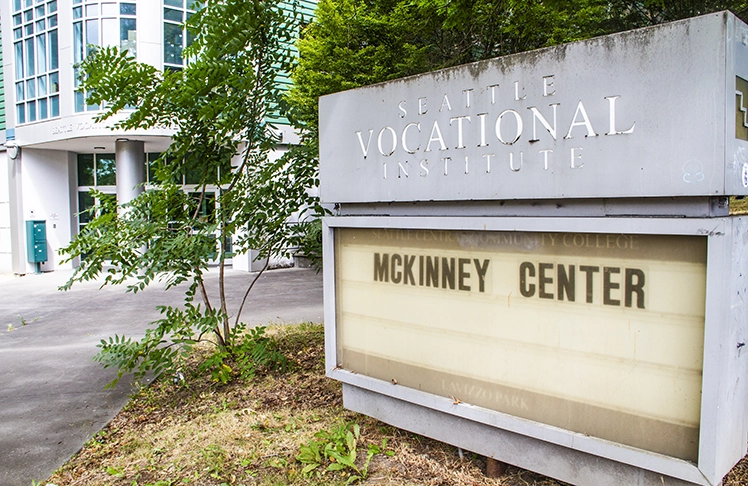
By Aaron Allen, The Seattle Medium
The Seattle Landmarks Preservation Board will consider whether to designate the McKinney Center for Community & Economic Development as an official Seattle landmark during its Aug. 5 meeting, a decision supporters say would preserve one of the Central District’s most significant Black-owned institutions and formally recognize its role in the neighborhood’s civil rights and economic history.
The nomination comes as the Central District continues to grapple with decades of displacement and gentrification that have transformed one of Seattle’s historically Black neighborhoods. According to the landmark nomination, preserving the McKinney Center represents more than protecting a historic building. It also recognizes a legacy of Black community ownership, economic development and self-determination in a neighborhood that has experienced significant demographic and economic change.
If approved, landmark designation would formally recognize the building’s historical and architectural significance while establishing a review process intended to help preserve its defining historic features. As part of the process, the nomination includes a physical description of the building, its history, current and historic photographs, site plans, maps, architectural drawings and other supporting documentation.
Located at 2120 S. Jackson St., the McKinney Center occupies a unique place in the Central District. According to the landmark nomination, it is the only community-owned building of its size in the neighborhood. Built in 1974 as the Seattle Opportunities Industrialization Center (SOIC), the facility was founded by the late Rev. Dr. Samuel B. McKinney to provide vocational training and employment opportunities for Black residents who faced systemic barriers to entering the region’s workforce.
According to the landmark nomination, the McKinney Center stands as a lasting example of the Black community’s investment in building institutions that expanded economic opportunity at a time when many residents faced barriers to employment, education and capital. As Black-owned businesses, churches and longtime residents have steadily disappeared from the Central District, the nomination argues that preserving the building has taken on added historical significance.
Naming the building after McKinney connects its current mission to the man whose vision made it possible. During his 40 years as pastor of Mount Zion Baptist Church, McKinney became one of the Pacific Northwest’s leading civil rights figures. He invited Dr. Martin Luther King Jr. to Seattle in 1961, marched in Selma, helped establish Liberty Bank, the first Black-owned bank in the Pacific Northwest, and co-founded SOIC to create employment and training opportunities for hundreds of local residents.
According to the nomination, honoring McKinney through the building reflects his decades-long work advancing fair housing, equal employment opportunities and educational equity throughout Seattle.
Today, the McKinney Center is owned by the Central District Community Preservation and Development Authority (CDCPDA), a public development authority established by the Washington State Legislature through House Bill 1918 to preserve and steward community assets in the Central District. The organization owns the building outright, a rare achievement in a neighborhood where Black ownership of land and commercial property has steadily declined.
“There is pride, and there is urgency. Pride because this building is back in the hands of the community it was built to serve. We own it outright. That is rare, especially in a neighborhood where Black ownership has been systematically eroded,” said Shaude Moore, executive director of the CDCPDA. “But there is urgency because ownership alone is not enough. We have to activate this space, grow it, and protect it. Every day this building operates is an act of resistance against the forces that have displaced Black families and institutions from this neighborhood for decades.”
While the building’s original mission centered on workforce development, today’s McKinney Center serves as a hub for small businesses, business incubator tenants and community organizations. Plans for the facility include expanding childcare services, increasing community programming and major capital improvements, including HVAC replacement, elevator modernization and decarbonization efforts.
Moore said the McKinney Center continues to evolve while remaining true to its founding mission of creating opportunity and strengthening the Central District community.
“The McKinney Center is more than a workforce development facility,” says Moore. “It is a hub for community self-determination. We house small businesses, incubator tenants, and community organizations delivering direct impact. This building is a living institution. It holds space for Black entrepreneurship, education, culture, and ownership in a neighborhood that has been told for 20 years that those things no longer belong here. They do. And this building proves it.”
Moore said landmark designation would provide another layer of protection for the building but emphasized that preserving the center will require continued investment and community partnerships.
“What we want the community to know is this: the CDCPDA is not a nonprofit,” said Moore. “Everything happening inside this building is happening because the community built it, fought for it, and continues to sustain it. Landmark designation is not the finish line. It is one more layer of protection for an asset that belongs to the people. We are asking the city and the community to recognize what exists here, protect it, and partner with us in growing it for the next generation.”
The nomination will be reviewed by the Seattle Department of Neighborhoods Landmarks Preservation Board, which oversees the designation and protection of more than 400 historic buildings, sites, objects, vessels and eight historic districts throughout Seattle.
The board will meet at 3:30 p.m. Wednesday, Aug. 5, in the Boards and Commissions Room at Seattle City Hall, 600 Fourth Ave. The meeting will also be available virtually through WebEx. Members of the public may attend in person or online, and written comments will be accepted through 3:30 p.m. Tuesday, Aug. 4. The landmark nomination and meeting agenda are available through the Seattle Department of Neighborhoods.