By Aaron Allen, The Seattle Medium
In Seattle, coffee is more than a morning caffeine fix. It is deeply woven into the culture and identity of a city known around the world for its coffee shops and espresso culture. Yet the story of coffee begins thousands of miles from the Pacific Northwest, with roots tracing back to East Africa.
For Black coffee shop owners like Solomon Dubie of Avole Coffee, Efrem Fesaha of Boon Boona Coffee and Michelle Lang-Raymond of The Scene, that connection between coffee, culture and community is taking shape in distinctly different ways across the Seattle area.
Their businesses are more than places to grab a cup of coffee on the way to work. They are places to meet, work, gather and connect, built around hospitality, culture and community.
As part of its Pack the House campaign, The Seattle Medium, along with the Urban League of Metropolitan Seattle, Byrd Barr Place and the Central Area Collaborative, is highlighting Avole Coffee, Boon Boona Coffee and The Scene throughout the 10-week initiative, encouraging the community to discover, support and return to local Black-owned businesses.
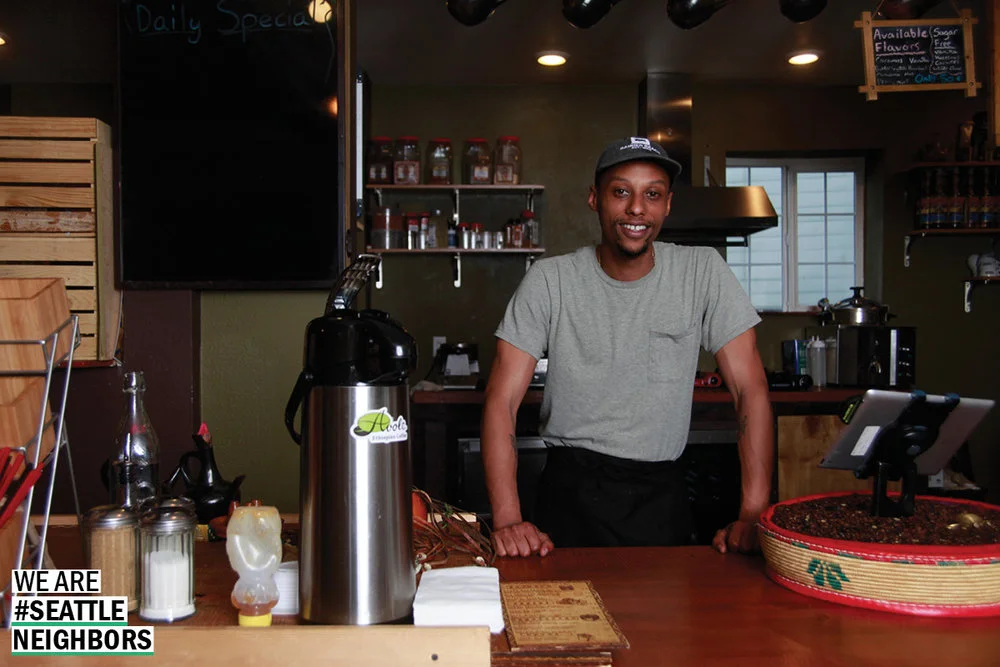
For Dubie, founder and co-owner of Avole Coffee, entering the coffee industry was not merely a business decision. It was rooted in his Ethiopian heritage and in something he felt was missing while growing up in Seattle.
“We’re an Ethiopian coffee shop, meaning we focus on Ethiopian coffee beans, and we try to spread the hospitality, the culture, and the ritual,” said Dubie. “I grew up in Seattle. In my community, I’ve never seen spaces that felt comfortable or felt like I could find familiar faces. This is a space that we try to curate.”
Dubie’s journey began around 2011, driven in part by memories of driving his mother to work and watching coffee stands pop up across the city while serving coffee made from beans native to her homeland.
In 2014, Dubie acquired a small corner store at Rainier Avenue and South Holly Street in South Seattle. After raising $8,000 through an Indiegogo campaign and bartering for equipment, he transformed a neighborhood store that had sold beer and cigarettes into a coffee shop centered around Ethiopian coffee and hospitality.
“Coffee is always something that’s being used to ignite conversation or ignite that holistic experience you’re going through,” said Dubie. “The engagement isn’t necessarily transactional; it’s more hospitable. It’s: ‘You’re a guest in my home, sit down, let’s drink coffee.’”
That sense of hospitality is reflected in the coffee itself. Avole focuses on sourcing green coffee beans, including Yirgacheffe, directly from Ethiopia and roasting them to a traditional medium profile.
“We don’t really do dark roast,” said Dubie. “That comes from the average Ethiopian coffee consumer. I’ve always seen my mom or my aunt trying to find consistency in that medium roast world. It’s about creating the environment through coffee.”
After navigating the pandemic, relocations and other challenges, Avole now operates locations in Seattle’s Central District at 23rd Avenue and East Union Street and in the University District near the University of Washington.
Gavin Amos-Lopez, Dubie’s business partner at Avole, joined the operation eight years ago after his own introduction to the history of coffee while working in the corporate coffee industry.
“My first job was with Starbucks, and I went through a coffee education. I learned that coffee is from Africa, which shocked me,” said Amos-Lopez. “It was such an intricate process that Ethiopians invented, it was like an African potion, an intellectual beverage. I was fascinated. I thought, ‘Wouldn’t it be great if there was a coffee shop where we just serve Ethiopian coffee and share this cultural history?’”
That connection between coffee and East African culture is also central to Boon Boona Coffee, where founder and CEO Efrem Fesaha has built a business around connecting coffee drinkers in the Pacific Northwest with African coffee growers and the cultures behind the coffee.
Growing up in Seattle, Fesaha experienced the city’s fast-paced, grab-and-go coffee culture while also being grounded in the traditional East African coffee ceremony practiced by his Eritrean family. A visit to Asmara, Eritrea, deepened his appreciation for a coffee culture centered not simply on the beverage, but on taking time to gather and connect with others.
According to Fesaha, Boon Boona uses coffee to create what he describes as “shared prosperity,” sourcing exclusively from Africa and working with smallholder farmer cooperatives and growers in Ethiopia, Rwanda, Burundi and Kenya, with an emphasis on supporting women coffee growers. Locally, the company also uses its cafes as gathering spaces while supporting artists, nonprofits and small businesses through events and pop-ups.
For Amos-Lopez, however, the cultural significance of coffee exists alongside the economic realities of operating an independent coffee business in Seattle.
“Coffee is a luxury good,” said Amos-Lopez. “It’s one of the first things you cut off your budget when times get hard. Business in Seattle is hard for everyone, and coffee is a competitive sport.”
For smaller Black-owned coffee businesses, Amos-Lopez said part of the challenge is navigating the industry without the networks available to more established operators.
“What’s hard is not having that built-in coffee community where you can exchange knowledge, so you’re taking lumps on the chin, figuring it out by yourself as pioneers,” said Amos-Lopez.
Despite those challenges, he said the communal nature of Ethiopian coffee remains one of the things that makes the work meaningful.
“When you’re talking Ethiopian coffee, it’s a very communal product,” said Amos-Lopez. “It’s word of mouth, people coming from the country with coffee behind them. It’s not over-industrialized or commodified; there’s still heart in it.”
That emphasis on creating a place where people feel comfortable gathering can also be found farther south in Seattle’s South Park neighborhood, where Michelle Lang-Raymond and her husband established The Scene more than three years ago.
From the beginning, Lang-Raymond, who also founded Acts on Stage theater in neighboring White Center, said the idea was to create the feeling of being welcomed into the home of someone you know.
“We wanted it to feel like you’re going over to your favorite cousin’s, your favorite auntie’s, or your favorite grandparent’s house,” said Lang-Raymond. “When you walk in the door, somebody knows your name, there’s food here that you like, and they’re going to listen to how you want your beverage made.”
Lang-Raymond and her husband were also intentional about creating a space that reflected Black culture while welcoming the broader South Park community.
“Our artwork is curated to feel like you’re celebrating Black culture,” said Lang-Raymond. “All of our food is intentionally curated from local Black caterers, restaurants, and bakers, like Classic Eats, Diocent Catering, and Love by the Slice. You can come to us and get a hand pie filled with collard greens and black-eyed peas, or fresh banana pudding driven in from Tacoma. We want room on our shelves for local caterers of color.”
Beyond coffee and food, The Scene has developed into a gathering place for book clubs, discussion groups, community leaders and local organizers.
For Lang-Raymond, the need for spaces like these has become increasingly important as Seattle’s Black population has become more geographically dispersed.
“Seattle’s Black community is no longer the same geographically,” said Lang-Raymond. “We’re not all going to be on 23rd & Union or Jackson anymore. We’re everywhere.”
That changing geography can make it more difficult for independent Black-owned businesses to rely on customers discovering them because they happen to be located in historically Black neighborhoods. Lang-Raymond said campaigns such as Pack the House can help small businesses reach customers without the marketing resources available to large corporations.
“Hats off to The Seattle Medium for this campaign,” said Lang-Raymond. “Small businesses don’t have the budget to be on every billboard like Starbucks. This campaign helps people remember that we’re out here, and it lets people know our story, a story centered entirely in serving our people.”
Organizers of Pack the House are encouraging people to make these businesses part of their regular routines, not simply places to occasionally buy coffee. That could mean meeting a friend there, scheduling a business meeting, working remotely for a few hours or choosing one when looking for a comfortable place to sit, connect and get some work done.
For Lang-Raymond, it begins with being willing to discover a new place and make it your own.
“My encouragement to the Black community is to drive down a new street, find a new place, and let that become your new spot,” said Lang-Raymond. “We have to show up, otherwise you look up in a year and those businesses are just not there.”
The Pack the House campaign is a 10-week community initiative presented by The Seattle Medium, the Urban League of Metropolitan Seattle, Byrd Barr Place and the Central Area Collaborative to encourage the community to intentionally support local Black-owned restaurants and coffee shops. For more information about the campaign, participating businesses and weekly schedule, visit PackTheHouseSeattle.com.