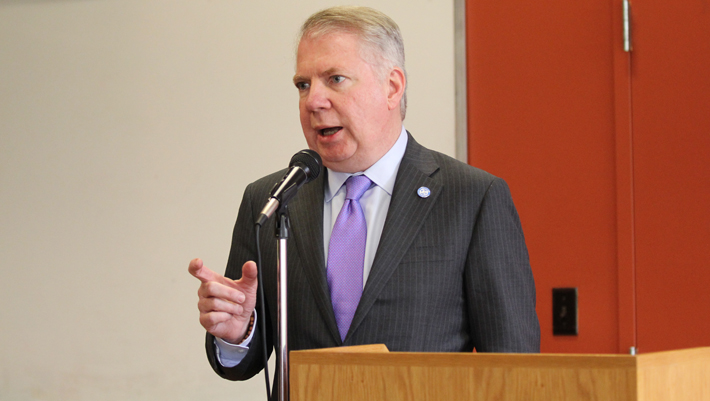
On Monday, Seattle Mayor Ed Murray presented his proposed 2016 budget to the City Council. Murray’s proposed budget increases the City investments to improve city planning and manage construction impacts, funds a mobile City Hall to bring services to more residents, reprioritizes human services to address homelessness, and provides funding for body-worn cameras for every police officer on patrol.
“Building a sustainable city means managing growth, reducing poverty, and creating an enduring economy,” said Murray. “This budget continues us on the path to build a sustainable Seattle that works for everyone.”
The 2016 Proposed Budget for the City of Seattle totals $5.1 billion, including $1.1 billion of General Fund spending. General fund spending increases 4.5 percent over last year to respond to the needs of a growing community. A summary can be found here.
According to Murray, more than 70,000 new residents have moved to Seattle in the past five years. A proposed Office of Planning and Community Development will improve integration of planning across City departments. The budget also adds new positions to support the development of policies to support affordable housing. The mayor proposes increased fees paid by developers to fund efforts that reduce construction-related impacts on cars, buses, bicycles and pedestrians.
“Too often residential growth is disconnected from planning for transportation, open space, economic development and the need for schools,” said Murray. “To create vibrant neighborhoods that promote walkability, access to efficient public transit, parks and the cultural amenities that enrich urban life, we need a new integrated approach to planning how we grow.”
As a result of the current construction boom, one-quarter of the City’s sales tax receipts are directly attributable to construction. The 2016 forecast for general fund revenue growth remains strong at 4.6 percent, but revenue growth is projected to slow as the pace of construction stabilizes. In anticipation, the mayor’s budget deposits an additional $7.3 million into the City’s financial reserves, increasing those reserves to a historic high of $106 million.
However, the rising tide of the growing economy has not lifted all boats. While the unemployment rate in Seattle is 3.5 percent, young people experience an unemployment rate of 13 percent. And for young people of color, the rate is 28 percent.
Murray spoke directly to the young people in the Chamber, saying, “The global crisis of growing income inequality and long-standing issues of racial inequity are also challenges that you and other young people throughout this city face as you enter the job market. These disparities are real, and our communities of color bear these burdens daily.”
Murray also proposed an additional $650,000 to support his Youth Employment Initiative, a partnership between City agencies and private and non-profit employers. The mayor’s budget also funds implementation of the Priority Hire law, which opens the door to careers in the construction trades for workers from neighborhoods with high unemployment and poverty.
The mayor’s proposed budget also reflects his pledge to improve police accountability and fully comply with the Department of Justice Settlement Agreement. The proposed budget includes $1.8 million to fund body worn cameras for every patrol officer. This City funding augments a $600,000 federal grant awarded earlier this month. Before the cameras can be deployed, the City will engage stakeholders including community groups and the Police Officer’s Guild to establish appropriate policies and protocols for their use.
“We know that body cameras improve interactions between officers and the public and reduce the likelihood that force will be used,” said Murray. “We will work carefully to get this right and adequately address privacy concerns.”
The budget also adds 30 new police officers in 2016, keeping the City on pace for 100 additional officers by 2018.
The Seattle Fire Department will recruit 60 new fire fighters in 2016 to serve the growing city. To help ensure greater diversity among recruits, the City will provide EMT training after recruits have been accepted, rather than requiring it before one can apply.
The 2016 budget includes $47 million in parks improvements in the first full year of investments made through the Seattle Park District approved by voters in August 2014.
As part of an ongoing effort to connect residents to City government, the mayor proposed a new Mobile City Service Center that will travel to neighborhoods throughout the city. At farmers’ markets, neighborhood festivals or other community events, residents will use this Mobile City Hall to access services, pay utility bills, register to vote and conduct other City business.
“This is one of the new ways the City will engage with residents, and broaden access for participation,” said Murray.
As a city of immigrants, Seattle will launch the Immigrant Family Institute to build trust between new immigrants and the Seattle Police Department, modeled on a successful program for immigrant women. The budget increases funding for the New Citizenship Program to help immigrants along the path toward citizenship and the Seattle Votes campaign will increase civic engagement and voting by new citizens.
“This budget continues and strengthens Seattle’s commitment to do our part and help our immigrant communities – not just to survive, but to thrive,” said Murray. “In Seattle, we realize that by opening our doors, not building walls, we are a stronger city.”