By Aaron Allen, The Seattle Medium
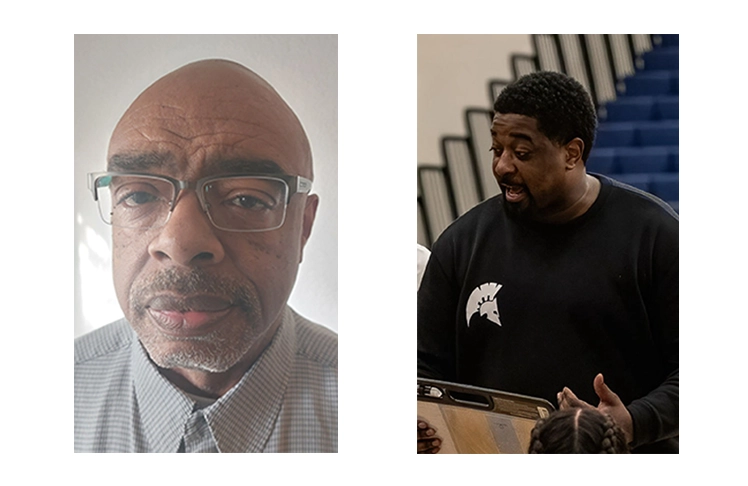
Last week, Garfield High School announced new head coaches for its boys and girls basketball programs, passing the reins of one of Washington’s most celebrated athletic legacies to new head boys basketball coach Kabre Keller and James Johnson, who will take over as the new head girls basketball coach.
For decades, Garfield basketball has been synonymous with excellence. The boys program, once led by legendary coaches like Al Hairston and more recently Brandon Roy, has long been a powerhouse in the state. The team has won 11 state championships and finished as runner-up five times since 1949. Standout alumni include Roy (2002), Tony Wroten Jr. (2011), and Will Conroy (2001), all of whom left a lasting mark on the program and beyond.
The girls program has built an equally impressive legacy under the guidance of figures like Joyce Walker, a Garfield alumna who returned as head coach and helped develop a championship-caliber team. The Lady Bulldogs have secured state titles in 1980, 1987, 2005, 2020, 2022, 2023, and 2024. The 2024 win marked their fourth consecutive state title, extending a remarkable run interrupted only by the cancellation of the 2021 season due to the pandemic.
The 2023 season was especially significant as both the boys and girls teams were crowned state champions for the fourth time in school history. Despite the success of both programs, both the boys and girls basketball teams made coaching changes this past offseason, with the untimely removal of boys head basketball coach Brandon Roy and girls head basketball coach Roydell Smiley, without explanation. Their departures came without public clarification, leaving families and alumni questioning the program’s direction.
With these abrupt changes, many in the Garfield basketball community were left wondering how the program would move forward. Stepping into this high-pressure moment are coaches Keller and Johnson, who now bear the responsibility of preserving and evolving a legacy that spans generations.
Keller, originally from Oakland, California, began a basketball journey in Tacoma at Curtis High School. At just 21 years old, Keller landed a first head coaching job at Annie Wright Schools, where he helped build the boys program and later took over the girls team full time.
“By the time I turned 21 I started coaching at Annie Wright School,” said Keller. “Started the boys’ program before going over to the girls’ program full time, my fourth year there.”
Johnson, a native of New York City, came to coaching through a different path. A multi-sport athlete with a strong background in football and swimming, Johnson eventually found a calling in basketball after a college injury shifted the focus.
“It started in Colorado at Arapahoe High School. I was the C team coach there,” said Johnson. “Then we moved a year later to Seattle, back to the Washington area, where I was the assistant coach at Kentridge and then the head coach at Kentridge. And then it just went on from there.”
Both coaches described the hiring process for Garfield as one of the most in-depth ever experienced. Garfield’s athletic program is not just known for its championship banners. It holds cultural and historical significance, particularly in Seattle’s Black community. With a high percentage of African American graduates and a legacy of excellence across sports, academics, and the arts, the school’s impact stretches far beyond the basketball court.
“I think it was probably one of the most intense processes I’ve gone through in a coaching position,” said Johnson.
“It all seems like a flash right now,” said Keller. “Because everything’s happening so fast, but I want to say about a month. The job opened up, I think, early October if I remember. So, about a month.”
Both Keller and Johnson bring distinct coaching philosophies but share a commitment to developing complete student-athletes on the court and in life.
“My coaching philosophy… the one thing I like to emphasize is pretty much I use the acronym F.I.G.H.T. – Faith In Going Hard Today,” said Keller. “My whole thing is controlled aggression. Knowing when to be aggressive, how to control it, and when to use it. The aggressor creates the most opportunities.”
“We’re going to be aggressive, we’re going to be in people’s faces, defensive first,” said Keller. “We’re going to get up and down the court, and we’re going to be authentic about ourselves.”
Johnson takes a holistic approach rooted in confidence, fundamentals, and adaptability.
“To develop confident, fundamentally sound student-athletes who play with effort and discipline and definitely teamwork,” said Johnson. “I believe in creating a positive and competitive environment where athletes can thrive and reach their potential.”
Johnson also emphasized the importance of tailoring coaching to the strengths of each team.
“To be honest with you, it would depend on the team,” said Johnson. “If you have a very quick team, you’re going to be an up-and-down kind of scenario. A team that’s not as quick, you’re more of a half-court scenario team. I pride myself on being able to work defense and offense. As a head coach, I also like to delegate my assistant coaches as to how we’re going to address this.”
While both coaches acknowledge the weight of expectation that comes with leading such high-profile programs, each expressed deep appreciation for the opportunity to contribute to Garfield’s enduring legacy.
“We’re ready,” said Keller. “And we’re excited to build something that lasts.”