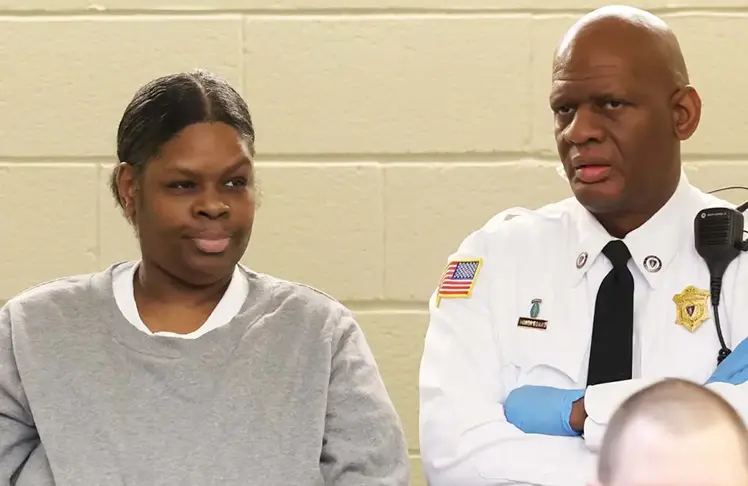
A Massachusetts appeals court ruling is drawing attention to how courts handle severe mental illness in cases where mothers kill their children — and to jury composition, after a racially lopsided jury deadlocked earlier this month in the high-profile murder trial of Lindsay Clancy.
In August, the Supreme Judicial Court of Massachusetts overturned the 2022 murder conviction of Latarsha Sanders, a Black woman who was convicted of fatally stabbing her sons, Marlon, 8, and La’Son, 5, in 2018 at their Brockton home. The state’s high court ordered a new trial for Sanders, who had not been diagnosed with a mental illness prior to her children’s deaths. During the trial, family members said they had noticed changes in Sanders’ behavior, including paranoid fears that a secret society was trying to kill her and her children. After her arrest, she was diagnosed with paranoid schizophrenia. An expert witness concluded she had been “grossly psychotic” during the killings.
While her attorneys argued that she lacked criminal responsibility because she was having a psychotic episode when she stabbed her two children, Sanders was convicted of two counts of first-degree murder on Dec. 27, 2022, and received two mandatory life sentences without the possibility of parole.
Four weeks later, on Jan. 24, 2023, Clancy, who is white, fatally strangled her three children –— Cora, 5; Dawson, 3; and Callan, who was 8 months old — in their home in Duxbury. Clancy had sought treatment for months due to worsening mental illness and mood disorder.
Judge William F. Sullivan, who presided over both cases, allowed jurors to see Clancy’s mental health records; her lawyers argued she was undergoing postpartum psychosis when she killed her children. Her case ended in a mistrial on Sept. 4, when a jury, splitting 11-1, could not unanimously agree to find her not guilty by reason of insanity.
The two cases, decided in the same Massachusetts courtroom, sit at the center of a debate over how courts weigh maternal mental illness, including postpartum illnesses, and race.
A Tale of Two Cases
Even the towns the women live in illustrate key differences in the backdrop of their cases. Although they’re just 25 miles apart, Brockton and Duxbury sit at opposite ends of Massachusetts’ racial and income spectrum.
Brockton’s population is around 106,000 people, with just over 34% Black, 12.6% Latino and about 28% white. Its median household income is $80,000, which is well below the state median, and its poverty rate is 13.5%.
Duxbury, is a coastal town of roughly 16,500 residents, is 93% white, with a Black population under 1%. Its median household income, hovering around $177,000, is more than double that of Brockton.
That wide social chasm also marked the trials of the women, although both were charged with killing their children while suffering from maternal mental illness.
The Center for Disease Control and Prevention estimates roughly 1 in 8 women report postpartum depression symptoms after delivery, with Black women being disproportionately affected. According to the Policy Center for Maternal Mental Health, postpartum depression and anxiety strikes Black women at rates more than double those of white women nationally, and up to 80% higher in smaller cities and rural areas.
Black women also report perinatal PTSD at roughly four times the rate of other groups, according to the research, and are twice as likely to report postpartum suicidal ideation, yet are only about half as likely as white women to start treatment. Other research finds that while depression, anxiety, obsessive-compulsive disorder, etc. does affects roughly 15% to -20% of women during pregnancy and postpartum,. But it’s only the roughly 4.5% who have depressive psychoses who are likely to harm or kill their children.
During Sanders’ trial, Judge Sullivan ruled that the defense could not introduce her post-arrest mental health records unless prosecutors first brought up the issue. Prosecutors didn’t bring it up, so jurors never heard that evidence before finding her guilty.
But the state’s highest court unanimously ruled last month that excluding those records “impermissibly stripped” Sanders’ defense “of the medical foundation that supported it.” The attorney handling Sanders’ appeal called the trial “a fundamentally unfair legal proceeding” for “a mother who was suffering from profound mental illness and experiencing a psychotic state completely untethered from reality.”
In Clancy’s case, attorneys used her mental health records to argue that she should not be held criminally responsible for killing her children, which proved to nearly shield Clancy from being found guilty, except for one holdout juror – a Black man.
The racial makeup of the jury caught fire as an issue in traditional and social media. Juror Paula Devlin, during an interview last Friday with Gayle King on “CBS Mornings,” described the panel of nine women and three men — 11 white jurors and one juror of color. Devlin, who said she favored finding Clancy not guilty, recounted the deliberations to King and replied “Yes” when asked if the holdout juror was a Black man. The jurors’ names remain sealed. The lone dissenting juror has not spoken publicly.
Clancy’s attorneys have asked the court to throw out the mistrial and acquit Clancy. A hearing is set for Sept. 29. Prosecutors haven’t said whether they will retry the case.
Meanwhile, if Sanders is retried, it is believed her attorneys will argue she was not criminally responsible for killing her children by reason of insanity — a verdict that would send her to a secure psychiatric facility instead of prison.