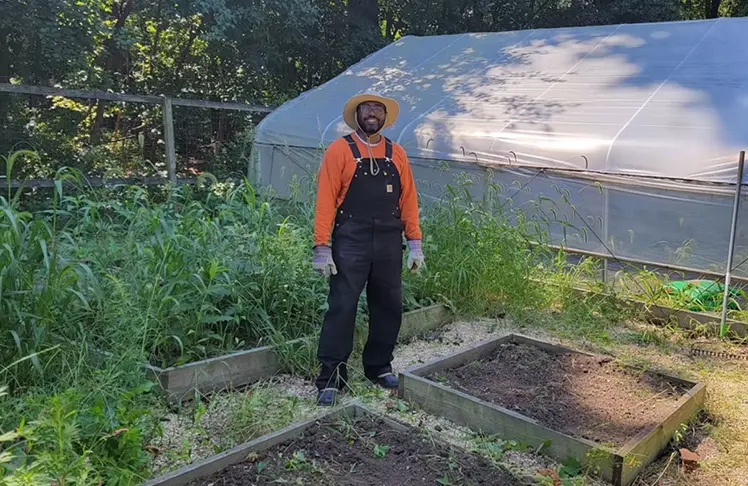

Years ago, Rev. Dr. Heber Brown III planted a garden on church grounds in Baltimore. At first glance, it seemed like a simple neighborhood outreach project, a way to engage the community through fresh, locally-grown produce.
But Brown was a young pastor with a vision: end food insecurity in his congregation and the surrounding community — one harvest at a time.
With help from the late Maxine Nicholas, an experienced church member with gardening know-how, the pair worked the small patch of church land, nurturing plants and steadily growing their ambitions for what the project could accomplish.
Now, that modest garden at Pleasant Hope Baptist Church in Baltimore has grown into the Black Church Food Security Network, a rapidly expanding nonprofit organization that feeds both body and spirit.
Beyond growing food for the hungry in his community, Brown’s project is a national movement helping congregations partner with Black farmers. It also strengthens local food systems and views food not simply as charity, but as an expression of justice, health and faithful stewardship.
Looking back, Brown credits Nichols with helping bring his idea to fruition.
“God gave me a vision, but God didn’t give me the know-how,” Brown said. “Maxine Nicholas had the know-how.”
Back then, Nicholas, a longtime church member, became the young pastor’s mentor and partner in fighting hunger in Baltimore. Together they cultivated gardens that soon became part of the congregation’s ministry.
Wednesday prayer services ended with fresh vegetables available for anyone who wanted them. Children attending Freedom School played nearby while volunteers harvested produce for families. It was a plan that would have been easier to pull off at a bigger church with more resources, including a larger pool of volunteers.
“We definitely were not a megachurch in terms of numbers and building,” he said during a recent conversation with Word In Black. “But definitely mega in ministry.”
Brown has stepped away from the pulpit to lead the Black Church Food Security Network full time, helping partner churches across the country launch gardens and food ministries of their own.
Word In Black’s interview with Brown has been edited for length and clarity.
Word in Black: The Black Church Food Security Network has grown so fast and so quickly from such a humble start. Looking back, what do you wish you had known in those early days?
Heber Brown: I initially thought that working at the denominational level and working down into the local churches would be the path. So I met with bishops, I met with denominational leaders, and I learned a few things. One is that there is just as much politics working in denominations as there is on Capitol Hill.
I had moments where I’m like, “Wait: but we all love Jesus. We all in church. Why does it have to be this way?” My bubble got popped a few times.
I also assumed that denominational leadership was in close lockstep with the rank and file of local churches, and that simply was not the case. I learned there is some disconnect between denominational leadership and the local church. Even if a bishop said, “We’re going to do this new food thing,” it didn’t necessarily mean local churches would embrace it sustainably.
We’ve gained much greater traction going local church to local church and really listening to the people in those congregations.
WIB: As you’ve traveled the country, what is one church model you’ve seen that made you stop and think, “This is the future?”
Brown: One of the things I just saw in Memphis that excited me was a ministry that has a farm but also bought an apartment complex right next to the farm. They are making housing available for college students who, in exchange for living there either free or greatly subsidized, help work on the farm.
I really like the vision that the pastor has because they’re meeting another human need besides food. Growing food is not interesting to everybody, but everybody needs a place to lay their heads at night. I’d seen churches build housing for seniors or assisted living before, but I’d never seen a church intentionally target young adults and college students and build programming around them living on church property. That is exciting to me.
WIB: Technology is rapidly changing ministry. How are you using it, and where do you see caution signs?
Brown: There was a time when I said, “I’m logging off all these platforms. I don’t need this in my life.” I still get those feelings every now and then. But I’ve developed a growing appreciation for the megaphone social media gives this work. We’re reaching people I never would have connected with on my own.
I just created a TikTok page. I don’t know how to use TikTok yet, but my twenty-something executive assistant promised she’ll teach me.
I’m also excited about using drones to help tell the stories of our gardens and farms. I’m working on getting my FAA drone license, and I’d love to create a program where young people earn their licenses, help document our farms and gardens, and maybe even keep the drone afterward. It combines food justice, youth development and technology.
At the same time, I have concerns about technology, especially AI and its impact on the environment. Technology has its pluses. Technology has its drawbacks. How do we honestly live in the tension of both?
WIB: You’ve become a resource for churches around the country. What does your work look like today?
Brown: Thankfully, we’re now at a stage where I don’t have to do as much of the personal hand-holding because we have three full-time staff members and several contractors helping churches. Every now and then I’m still doing that work personally, but more often I’m creating room for churches to see what’s possible.
I’m sharing what I’ve learned after crisscrossing the country and seeing what’s happening in different congregations. I’m a conversation partner for pastors who have a vision and are trying to figure out how to make it happen.
I’ve also become something of a clearinghouse. A pastor called me yesterday asking about heirs’ property, and I immediately sent him organizations and contacts around the country. After nearly twenty years doing this work, some of that information is just in my head now. The challenge is figuring out how to download it into systems, processes and other people so it doesn’t disappear with me.
WIB: Many seminaries invite you to speak. What do you hope future ministers learn from your story?
Brown: Seminaries recognize that fewer people are coming to seminary, and they’re trying to show students what ministry can look like beyond the pulpit.
My story helps color in the lines. I’ve done traditional pastoring, and now I’m doing parachurch ministry while still preaching and teaching. I tell students honestly that stepping away from a church after fourteen years wasn’t easy. I could have stayed there and retired. It wasn’t stress that made me leave. It was trying to be faithful to what I heard God calling me to do next.
There were costs. I wasn’t in preacher circles the same way anymore. I had to learn nonprofit fundraising. There were pressures on my family. There were plenty of struggles. But I’m doing the work that my soul must have, and even in the middle of the challenges, it makes me smile on the inside.
WIB: Are Black churches making a real difference in addressing food insecurity?
Brown: Absolutely. The pandemic accelerated that work even more. Churches have always understood food distribution as part of living out the Gospel, but now I see congregations buying refrigerated storage units, expanding kitchens and even opening grocery stores.
Pastors are calling because they have four acres, eighty acres or hundreds of acres and want to know how to use those assets to feed people.
I’m thankful for the critique churches sometimes receive because it pushes us. But I’m also thankful there are so many churches doing an incredible job and wanting to do even more to relieve human suffering, support Black farmers and promote health in our communities. That deserves to be celebrated too.
WIB: And your last word?
Brown: Maybe this is the next story. A dear sister friend recently started calling me “The Plant Pastor,” and it tickled me so much that I decided to embrace it. She even brought me her dying pineapple plant and said, “I’ve done all I can do. I’m bringing it to the Plant Pastor.”
I made a video trying to revive her pineapple plant, and I think I may do more videos like that—just talking about how to care for plants, whether they’re food plants or something else.
It’s another little sprout growing from the same passion. It gives another dimension of this work a place to grow. So the Plant Pastor is here, and I’m just going to keep watering that idea and see what blooms.