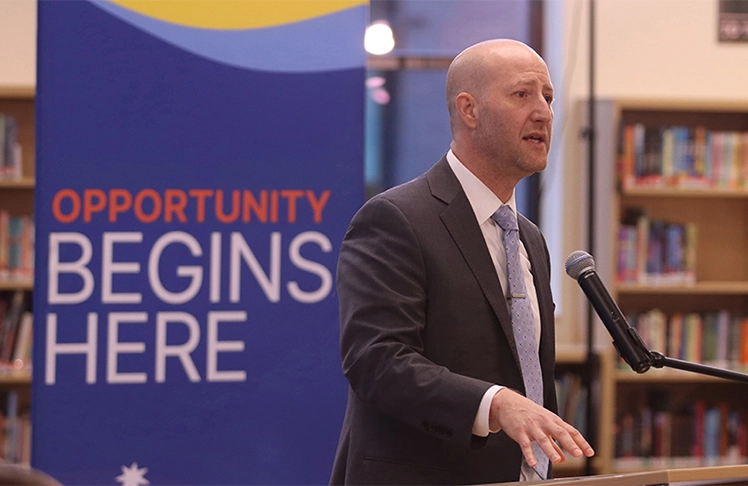
By Aaron Allen, The Seattle Medium
Seattle Public Schools is navigating a financial and staffing overhaul under new Superintendent Ben Shuldiner, who began his tenure Feb. 2, as district leaders weigh difficult decisions about resource allocation while working to prioritize student needs and rebuild public trust.
While the district has managed to keep schools open for the 2025-26 academic year, officials acknowledge that the financial outlook remains uncertain. Enrollment has declined from more than 52,000 students in 2020 to about 49,000 today, creating funding challenges under a state model that does not align with the district’s current structure.
According to Beverly Redmond, chief of staff to Superintendent Ben Shuldiner, district leadership is focused on addressing the budget deficit, supporting students and rebuilding trust in the community.
“[Superintendent Shuldiner’s] priorities are visiting schools and being present to listen to students, families and educators, re-establishing community trust, ensuring academic rigor, answering our structural deficit and reorganizing central office in a way that is best to serve students,” Redmond said. “Our goal is to be the best urban school district in America. Looking at our current data, Seattle Public Schools is doing well overall and is a strong district and a leader in the state. Where we continue to have work to do is with students experiencing poverty and systemic barriers connected to race.”
One of the central challenges facing the district is how to manage resources across a system with many small schools. The state funding model is based on an elementary school size of about 400 students, while Seattle has nearly 30 schools with fewer than 300 students. That gap makes it more expensive to maintain staffing and programming at current levels.
A proposal last year to close up to 21 elementary schools sparked widespread community backlash and was ultimately withdrawn. While no closures are planned for the 2025-26 school year, the district is still facing a projected $100 million shortfall.
Superintendent Ben Shuldiner said addressing that deficit will require a combination of cost reductions and strategic reallocation of resources.
“It’s both. We’re $100 million in deficit. We have to be thoughtful and critical about that, and we have to make sure that if we are going to reduce costs, we’re going to do that with as little effect on schools as possible,” Shuldiner said. “That’s not possible, but less effect in the schools and more effect in central office and then being thoughtful about taking the resources that are at central office and pushing them into schools.”
District leaders say one of the key strategies moving forward is shifting funding and staff from central office roles into school-based positions, with the goal of increasing direct support for students.
“The most important thing for a superintendent and a school district is to make sure that the most amount of money can be in schools,” Shuldiner said. “We want to make sure that our people are in schools, our staff are in schools, and the money is in schools. We are a school district in service of children, and I always want to make sure that we’re putting our students first.”
Redmond said the district is reviewing how central office functions are organized and whether those roles are effectively supporting schools.
“What the superintendent has asked us to do at this time is look carefully at how central office work is organized and whether it is truly serving schools as effectively as it should,” Redmond said. “We need to be present in schools in a greater way so our work is grounded in what students and educators experience every day. That includes looking for inefficiencies and considering whether some staff are better based in schools rather than downtown.”
As part of that shift, some central office staff and remote employees may be reassigned to work more directly in schools, where district leaders believe their impact will be greater.
“There’s twofold. One is certainly reducing the number of folks in central office because for every $1 saved in central office, first that has to make up the deficit. But then if we have extra money, all of it would go to the schools,” Shuldiner said. “The second, is to think critically about people that work in central office. Let’s say it’s a coach, let’s say it’s a curriculum manager. Let’s say it’s somebody that’s working with teachers or working with students rather than have them in a central office, we want them to be in schools. We want them there day to day. To be spending more and more time with students really moving them towards success.”
Redmond agreed with the district’s assessment for change and the importance of being more present in schools.
“We recognize this is a significant change. Different moments have called for different ways of working, and each has supported our district in important ways. At this time, working in-person offers the greatly needed opportunity to collaborate across departments, levels and buildings. We are also committed to being more present in schools. With nearly 50,000 students learning in schools each day, we must remain connected to their experiences,” Redmond said.
In addition to financial challenges, district leaders said improving outcomes for historically underserved students remains a top priority.
“Superintendent Shuldiner has reviewed our data and believes we have significant work ahead to ensure every student, including Black students, especially Black boys, is appropriately challenged, supported and prepared for success beyond Seattle Public Schools,” Redmond said.
Shuldiner acknowledged that the district has not consistently met the needs of all student groups.
“The first thing that I want to be very direct about is our student success needs to get better, and particularly we have populations that Seattle Public Schools has not served, and one of those populations is students of color,” Shuldiner said. “There is no question that when you look at our success criteria by any way you look at it, be it graduation, be it proficiency rates, be it attendance rates, we are not serving our Black students, particularly Black boys or all of our students of color well. We also are not serving our ELL students, so English language learners, we have to do a better job with our students.”
Looking ahead, the district’s long-term financial stability may depend on decisions made at the state level. The 2026 legislative session in Olympia is expected to play a key role in determining whether additional funding becomes available or if more difficult decisions, including potential school closures, return to the table.