By James ClingmanNNPA ColumnistBlackonomics Black folks have it all wrong; we reward our enemies and punish our friends. We complain, demonstrate, and protest the same people we give our money to, in what amounts to payment for our own oppression. Those who stand up, speak up, and sometimes make the ultimate sacrifice in support of Black people, we run away from, deny, castigate, and even participate in shutting them up and shutting them down. We must reverse this scenario if we are going to make it in this country. Many of us have experienced the negative aspects of standing up for Black people, and I am sure most of us have wondered why we have to fight against our own people in order to help save our race. But remember Harriet Tubman and Marcus Garvey, just to name two; they had the same problems. Remember Denmark Vesey, Gabriel Prosser, John Brown, and Nat Turner; Black folks told on them. So it is not surprising that we still do the same things to our warriors today. Thus, individually, we will continue to experience similar struggles among our people. But what about the collective? How can we reverse the very sick practice of further enriching those who would just as soon wipe us off the face of the earth, at least move us out of this country, rather than simply speak to us on the street? How can we come to the point where we are, at a minimum, considered an economic and political threat, rather than some monolithic voting bloc just waiting to be exploited? How can we be perceived as something more than a humongous ATM where merchants can come and withdraw all the cash they want, no questions asked and no reciprocity given? How can we reward our friends – politically and economically – with the resources we have at our disposal? And I do mean “disposal.” I say we begin using the power of leverage a lot more than we do now. You have read several of my articles on the Collective Banking Group (CBG) and how well leveraging has worked for their church members. You probably know about cooperative food buying programs, collective farming organizations, and efforts by various groups that have prospered through the use of fiat money, that is, printing their own scrip (e.g. Ithaca dollars) to empower themselves via bartering. The examples abound. I know you have heard about political groups that have swayed major political decisions in their favor simply because they banded together. Look at all the think-tanks in Washington, D.C. that lobby for what White folks want. Where are our think-tanks? Well, we have the Harvest Institute, but very few Black people support it. There is the Christian Coalition, the Moral Majority, the NRA, and all of those other groups that more times than not get what they want from politics. Where are our political institutions that bring home the bacon for Black people? All right, so where do we start? I will leave the political strategies to those who know more than I do about that area. As for the economic side, let’s start with banks and insurance companies. I noted the CBG, which has set the example of how we can leverage our collective monetary resources via churches. Now when it comes to insurance companies, automobile and homeowners insurance, virtually everyone who pays feels the pain caused by these companies raising their rates simply because they can. They continue to rip us off, canceling our policies simply because we use them, and it seems there is nothing we can do about it. Well, there is something we can do. Just like the CBG only “allows” certain banks to do business with them, the same thing can be done with insurance companies. Groups can be formed in various cities that only deal with one or two insurance companies. Covenant agreements can be written and, if violated, the group no longer does business with that company. Leverage brings lower rates, greater benefits, and better treatment. The big three insurance companies are steadily raising their rates, canceling homeowners’ policies and, as we see on the Gulf Coast, they are refusing to pay on those policies. What are we going to do? Shall we continue to give them our money and just “hope” they won’t cancel us whenever they feel the urge? We don’t HAVE to do business with any particular company, you know. I can hear the Black folks now saying, “But I work for one of those companies; I can’t participate in such an effort.” That’s fine. In that case, this is not for you. This is for those Black folks who know that there have been reports describing how we have been discriminated against by banks, insurance companies, and real estate companies, even as far back as slavery. If they have the nerve to tell the world they have mistreated us, and we stand by and do nothing about it, they have no incentive to change their ways. Again, this gets back to being willing to reward our friends and punish our enemies. These insurance companies have rolled out their catchy phrases and slick television commercials about whose hands we’re in, how good a neighbor they are, and whose side their on, and we lap it up like we’re their trained pets. We pay our premiums for years and have one claim, and they either raise that premium or cancel the policy. It makes no sense not to fight back, collectively, against this kind of treatment. The idea of Black folks forming groups to leverage good insurance rates is no different from teachers’ unions, the AARP, and other associations doing the same thing for their members. We had better take stock of our situation and realize that we are not liked by the folks who run this country and those who run major corporations (Sorry if I burst your bubble.). We must practice collective and cooperative economics and leverage what we have, before we lose everything we have. James E. Clingman, an adjunct professor at the University of Cincinnati’s African American Studies department, is former editor of the Cincinnati Herald newspaper and founder of the Greater Cincinnati African American Chamber of Commerce.
Must Read
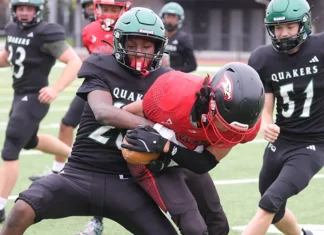
Explosive First Quarter Powers Franklin To Big Win Over Cleveland
By Kiara Doyal, The Seattle Medium
The Franklin Quakers used an explosive first quarter and a dominant defensive performance to take control early and never...