By Iseabel Nance, The Seattle Medium
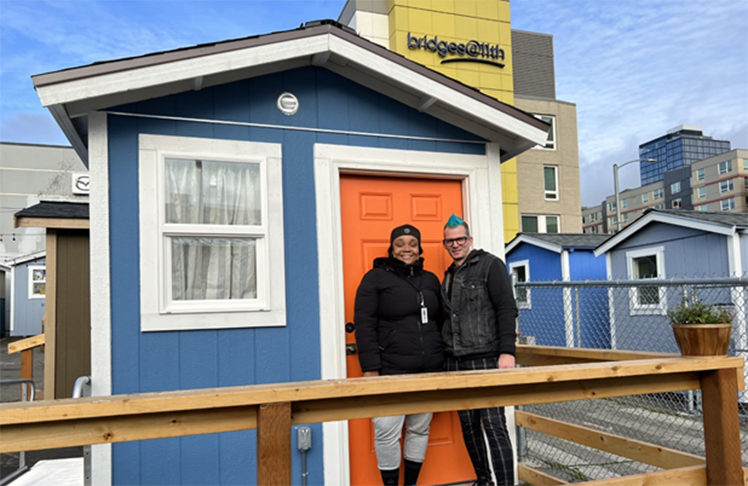
A village of brightly colored tiny homes in the heart of the U District is part of Seattle’s new shelter program, which will provide 350 shelter beds throughout Seattle through hotel programs, tiny house villages, and a new women’s shelter.
Located at 1000 NE 45th Street and named after nearby Roosevelt Avenue, Rosie’s Tiny House Village opened in October on land the City of Seattle is leasing from Sound Transit for free in a renewable agreement up to May 2024, according to the overseeing agency’s website.
The city partnered with the Low Income Housing Institute (LIHI) to offer short-term housing and resources to individuals, couples, and people with pets who are currently living unsheltered outside. These homeless populations are typically split up or not accepted in traditional shelter systems, but the tiny house villages are specifically for these groups.
According to LIHI, each tiny home is 8 feet by 12 feet, insulated and has a heater, a fan, electricity, a locking door, and furniture, including a bed and wardrobe. Each comes with a broom and a welcome kit with brand new towels and bedding.
The village provides communal bathrooms and kitchens, daily hot meals and social services, such as case management, housing search support, and employment and health resources. Residents must abide by a code of conduct, which includes working with the case manager to progress towards permanent housing.
According to Andrew Constantino, assistant program manager for tiny houses, the program has gone through many iterations, beginning with tent platforms and portable toilets, no running water, and no case management. But tents offer residents little privacy so LIHI began developing a plan for tiny houses, which are usually built by volunteer programs. In each village, of which there are currently 13 according to their website, they learn something new and adapt to better fit residents’ needs.
“We can have all the discussions in the world,” Constantino said. “But this is triage, right? We’re stabilizing people, making sure they’re safe, that they’re not in danger.”
Usually properties available for the village program are not as desirable for other kinds of construction; Rosie’s, for example, is built on broken concrete, slopes, and is divided almost in half by an alleyway that has to be accessible for cars.
The state of the lot, according to Constantino, means they had to be creative in designing the village. All community amenities are accessible by ramps, including the bathroom, laundry room, kitchen, community manager and case manager offices. Some tiny houses are also equipped with ramps.
The villages are on leased land, but they are built to mask their temporary state. The bathroom trailer is accessible from a small deck that hides the wheels, and the kitchen is a big shipping container with windows.
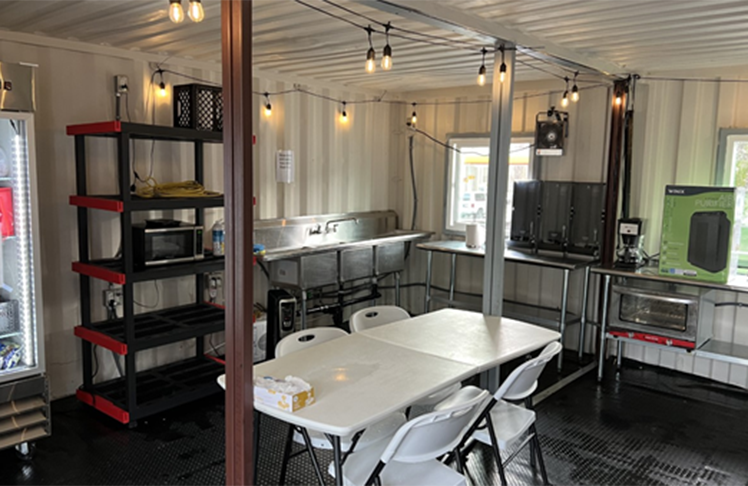
The kitchen in Rosie’s Tiny House Village is a large shipping container with string lights and two large windows. It contains two refrigerators, a microwave, toaster oven, coffee pot, self dispensing, single-use utensils, and pots and pans that are available for check out. (Photo by Iseabel Nance)
In accordance with the code of conduct, residents participate in a chore system for the community, helping with things like cleaning the bathroom, cleaning the kitchen, and taking out the trash.
“They know that we care about them and we care about the village and in return they care about us and they care about the village as well,” said Erica Henry, Rosie’s community manager. “It’s like a little family and we all take care of each other.”
Henry has been homeless and has worked in homeless shelters. She says the experiences make her a much stronger advocate for people because she knows what they actually need. This also helps the villagers trust her because they know she won’t steer them wrong because she’s been in their position.
The village is surrounded by a chain link fence that the 24-hour, on-site staff open for residents and visitors for the safety of the community. But residents can come and go as they please, according to Constantino, who referred to Rosie’s as a “little gated community.”
Residents are also asked to sign in at least twice a week, so staff know the residents are still living in the village and are safe.
“It’s that feeling of safety and community that people are so marginalized from, they’re so separated from that, that the village provides,” Constantino said.
The typical resident in the village stays for about four to six months, but they can stay as long as they’d like. Since the program began in 2015 with the tent camp Nickelsville in Ballard, LIHI has transitioned over 700 people into permanent housing and over 100 people into long-term housing, according to their website. The second half of Rosie’s is still under construction, across the alleyway. The plans include outfitting a second storage container as a community lounge, construction of a small outdoor space potentially with a barbeque, and more tiny houses.