By Kiara Doyal, The Seattle Medium
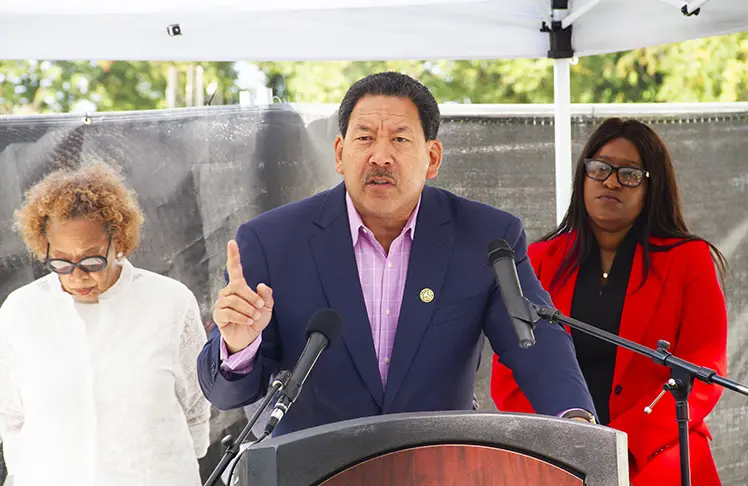
Today, Seattle Mayor Bruce Harrell unveiled a landmark $350 million affordable housing proposal—part of the city’s 2026 budget—that aims to address displacement and housing instability across Seattle. The housing package includes $80 million over the next four years specifically dedicated to supporting families most impacted by gentrification and historic housing discrimination.
The initiative, called the Anti-Gentrification and Reparations Housing Fund, is designed to help historically marginalized communities remain in their homes and neighborhoods. It will provide direct financial assistance for rent, down payments, and other housing-related costs.
“This fund will provide tangible support, such as down payments, rent, and housing costs that families can build stability and find the opportunity that they so justly deserve as a result of the redlining policies that are here in Seattle,” said Harrell. “This is the largest such investment in our city’s history, and despite a budget deficit, I am very proud to say that we didn’t just maintain housing investments with this proposal, we are expanding them because affordability and housing are our top priorities.”
Harrell described the fund as a targeted, data-driven response to the city’s housing challenges—one that prioritizes stability, dignity, and opportunity for all residents.
“We have to acknowledge the fact that we all understand how unaffordable Seattle has become, and that we are one of the fastest-growing cities in the country. But our growth means absolutely nothing if we don’t fight for what we say all the time about equity and racial justice,” said Harrell. “Every affordable home we build and every family we house means fewer people living in cars and tents or having to move out of our city.”
Seattle has a documented history of housing discrimination, particularly against communities of color. For Mayor Harrell, the issue is personal—his own family was directly impacted by policies that excluded Black residents from certain neighborhoods.
During his remarks, Harrell referenced a racial covenant once used in Seattle’s Capitol Hill neighborhood, which barred Black families from owning or occupying property in large sections of the area. He said his family experienced these forms of legalized housing discrimination firsthand and that the new initiative will prioritize support for those most harmed by these policies.
“There are actually some of the restrictive racial covenants found right here in Seattle, and I want to read you one… that no part of said premises shall ever be used or occupied by or sold, conveyed, leased, rented, or given to Negroes or any persons of Negro blood,” Harrell said. “And many don’t know that our family members were direct victims of this, so this first phase of work will focus on families who face legalized housing discrimination right here in Seattle to ensure the funding goes where it can make the most impact.”
Patience Malaba, executive director of the Housing Development Consortium of Seattle-King County, said the proposal represents the largest single-year affordable housing investment in the city’s history and reflects a bold commitment to both building new homes and preserving existing ones.
“This announcement is more than historic; it is transformational. It tackles housing from every angle, which is what we need in this moment,” said Malaba. “It is also investing in new production, which is needed as the housing crisis continues to accelerate right here in our own backyard. It is supporting families who are facing impossible choices between rent and groceries. It is investing meaningfully to make sure that we are thriving as a community in a meaningful way.”
“This is hope made tangible, and this is how we invest in community,” added Malaba.
Malaba emphasized that homes are more than just structures—they are central to well-being and opportunity.
“This is a critical point; homes are much more than that. They are the starting place for health outcomes for families, the starting path for education outcomes for our children, and they are the path for access to opportunity,” Malaba
said. “This commitment ensures that families and individuals across our city today and for generations to come will have a foundation.”
Roxanne Buchanan, board president of the First A.M.E. Housing Association, said that Bryant Manor South, which is currently under construction, will add 149 affordable housing units for families. Bryant Manor North, which is already completed, currently houses 101 families and is at full capacity.
“This shows that we are on track with providing affordable housing within the city of Seattle,” said Buchanan. “There is also an Early Learning Center in Bryant Manor North, which is housed right on site for parents who have wishes for their young ones and early learning.”
“This funding was made possible under Bruce Harrell’s administration, and I want to thank him for making all of this possible,” continued Buchanan.
Harrell said that, as a city, we must remember we’re here because of our dedication and the positive intentions driving our efforts to shape Seattle into the city we all envision, even during a time of challenging budgets.
“So, when we seize the past, it is only to find momentum in the future, and that is what this $350 million is about. We want to see diversity, equity, and inclusion in action,” said Harrell. “In my administration, we don’t complain, we work. And in an era where we have a president whom we must fight against, disseminating the rhetoric that is against who we are and what we stand for, this kind of housing investment is our weapon to succeed.”