By Aaron Allen, The Seattle Medium
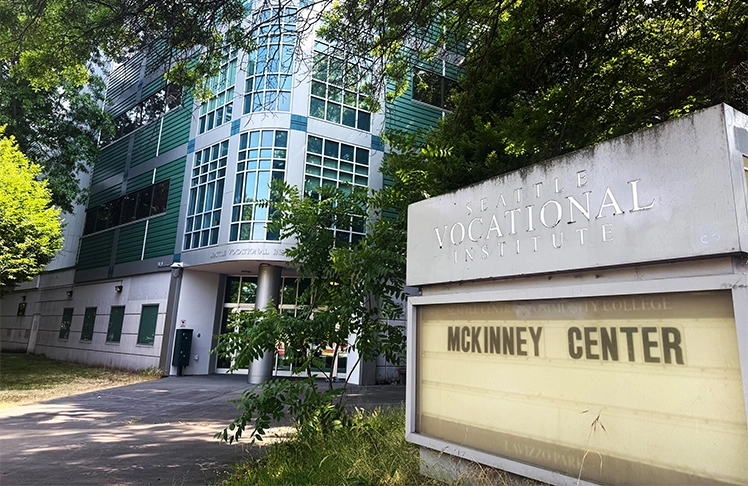
A proposal to demolish the historic building that once housed Seattle’s Opportunities Industrialization Center (SOIC) has sparked concern among community leaders and activists, who say the site represents a vital chapter in the city’s Black history.
The SOIC was established in 1966 as a community-based program designed to recruit, train, and place unemployed individuals—particularly African Americans—into the workforce. Modeled after the original OIC in Philadelphia, Seattle’s branch was spearheaded by the late Rev. Samuel B. McKinney, pastor of Mount Zion Baptist Church. It operated until 1986, when federal cutbacks forced its closure.
“In addition to the building being a Historic Landmark, it’s known as the McKinney Center for Community & Economic Development,” said community activist Eddie Rye. “As a historical landmark, just like the Black firefighter’s house, a lot of things happened around that building. A lot of African Americans and others got trained in that building. President Ronald Reagan took all the manpower training money out of the way. It’s almost like what’s happening with Trump right now—anything that was for African Americans was under assault and terminated to the best of their ability, but it’s very important because of what it represents.”
The original SOIC program began in the lower level of Mount Zion Baptist Church before expanding into a newly constructed four-story facility in Seattle’s Central District in 1974. The organization played a key role in workforce development and economic empowerment during the 1960s and 1970s, bolstered by a grant from the Office of Economic Opportunity as part of the federal War on Poverty initiative.
“First of all, the building was erected to house the Seattle Opportunities Industrialization Center (SOIC) and later SVI,” said Rye. “Reverend Dr. Samuel B. McKinney was responsible for bringing SOIC to Seattle. The programs trained a significant number of African Americans.”
Despite diversified funding and accreditation that allowed SOIC to endure financial challenges that shuttered similar programs, it ultimately closed in 1986. Later, the building was renamed the McKinney Center for Community and Economic Development, in honor of Rev. McKinney.
Today, concerns over the building’s future have reignited community debate. According to Rye, a member of the Central District Community Preservation and Development Authority (CDCPDA) board recommended the building be torn down—a recommendation he says ignores the intent behind the state legislation that designated the facility for preservation.
“It’s my understanding it was a recommendation of one of the board members of the Central District Community Preservation and Development Authority,” said Rye. “Preservation means maintaining the current status quo. The people on the board were not the people who got the legislation passed. It’s supposed to be representing the community, and for whatever reason, a lot of people are under the impression that the board does not represent the people that went and got the building and got the legislation passed to preserve that building.”
State Rep. Sharon Tomiko Santos, a key sponsor of House Bill 1918—the legislation that secured preservation of the building—expressed disappointment over the lack of funding and attention the site has received.
“Today, this noble neighborhood icon nearly fades into the background as development pressures bow to up-zoning over up-skilling. The CDCPDA is working hard to overcome the $26 million in deferred facility maintenance by the College which makes the building unsafe and, therefore, unusable,” Tomiko Santos said. “The 37th Legislative District delegation—State Senator Rebecca Saldaña, State Representative Chipalo Street, and I—requested full funding for the McKinney Center, but neither the Senate nor House capital budgets included funding for this project.”
“This is especially distressful to me,” she continued, “as we acknowledge our obligation as a state to remedy the effects of past historical discrimination with new programs supported with new funding but continue to overlook the very legacy of those who helped to open our collective eyes to discrimination and allow their hard-earned investments to deteriorate.”
Tomiko Santos also reflected on the broader historical context and the toll taken by decades of disinvestment.
“SOIC was the first community-based organization to receive federal designation as a Skills Center. The SOIC thrived throughout the heyday of the civil rights movement and the War on Poverty but, with the advent of deep and drastic federal cutbacks to economic empowerment and employment programs in the early 1980s, the SOIC fell into bankruptcy,” she said. “After a short-lived effort to sustain the job training programs through a public-private partnership called the Washington Institute for Applied Technology, the State inherited the building as the mortgage guarantor and custodially assigned it to the Seattle Central Community College.”