By Aaron Allen, The Seattle Medium
For decades, civil rights advocacy focused on access.
Access to housing.
Access to jobs.
Access to education.
Access to political power.
But a growing number of Black leaders in Seattle are asking a different question:
Who owns the land?
The answer, they argue, will determine whether future generations have a lasting stake in the city’s future.
As Seattle continues to grow and redevelop, community advocates are increasingly embracing a framework known as spatial justice, the belief that ownership of land, housing and community assets is fundamental to achieving lasting equity.
For these leaders, the issue is no longer simply whether Black residents are included in Seattle’s future.
The question is whether they will own a meaningful stake in it and share in its long-term prosperity.
Advocates of spatial justice argue that representation alone cannot create lasting equity. A community may be represented in government, celebrated for its cultural contributions or included in conversations about growth and development. But without ownership of land, businesses and community institutions, many leaders believe those gains remain vulnerable to forces beyond the community’s control.
Ownership, they argue, provides something different: permanence. It creates opportunities to build wealth, influence development decisions and ensure that future generations benefit from the value their communities help create.
“Spatial justice means we must have a stake in the land,” said K. Wyking Garrett, president and CEO of Africatown Community Land Trust. “Reclaiming our physical footprint is the only way to ensure our community’s future in the city we helped build.”
That philosophy has become the foundation for a growing movement focused on transforming cultural preservation into economic permanence.
For generations, many civil rights victories focused on securing access to institutions that had historically excluded Black Americans. Today, advocates of spatial justice argue that access alone is insufficient if communities lack ownership.
Without ownership, they contend, communities remain vulnerable to market forces, redevelopment pressures and economic displacement. The result is a growing focus on acquiring and controlling physical assets that can provide long-term stability, wealth creation and community influence.
Organizations such as Africatown Community Land Trust have emerged as leading examples of that strategy.
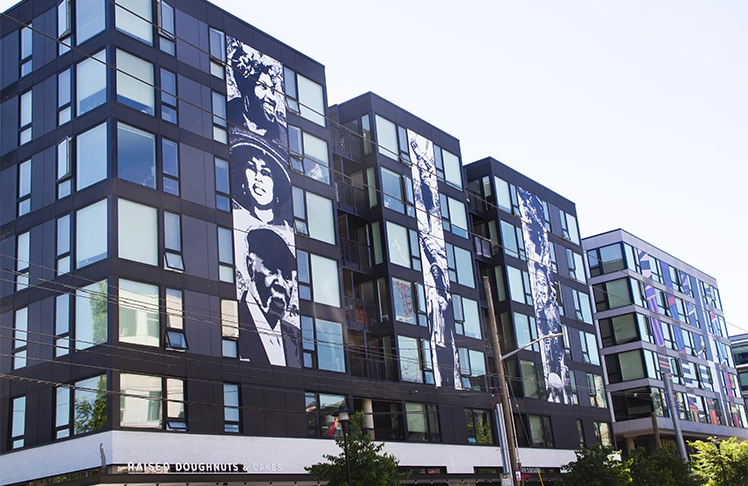
The Liberty Bank Building and Africatown Plaza represent more than housing developments.
They represent ownership.
For advocates of spatial justice, projects such as the Liberty Bank Building and Africatown Plaza are not simply real estate developments. They are examples of communities moving from participation to ownership.
The distinction matters. Communities often help create the culture, identity and economic vitality that make neighborhoods desirable. Yet without ownership of land and assets, they can find themselves excluded from the prosperity that follows.
Located in Seattle’s Central District, both projects were designed to create opportunities for Black residents, entrepreneurs and families to maintain a lasting presence in a neighborhood that has undergone dramatic change. The Liberty Bank Building sits on the site of the Pacific Northwest’s first Black-owned bank and combines affordable housing with commercial space. Africatown Plaza provides affordable housing and opportunities for Black-owned businesses while reinforcing a long-term community presence in one of Seattle’s most historically significant neighborhoods.
For advocates of spatial justice, these projects demonstrate what happens when communities move beyond reacting to development and begin shaping it.
Knowing that culture creates economic value is only part of the equation, Garrett and other advocates argue. The more important question is who benefits from that value. If communities help create a neighborhood’s cultural identity but do not own the underlying assets, they risk being displaced from the prosperity they helped generate.
The fight for ownership extends beyond large-scale developments. It also includes helping families retain the homes and assets they already possess.
Organizations such as Wa Na Wari have adopted that approach by combining arts programming with estate planning assistance and homeowner support services designed to help families preserve generational wealth. Operating from a fifth-generation Black-owned home in Seattle’s Central District, the organization views homeownership not simply as a housing issue, but as a tool for long-term economic security.
The home itself stands as one of the increasingly rare examples of multigenerational Black property ownership in a neighborhood where many longtime families have been priced out or displaced. For advocates, preserving those assets is essential to preserving pathways to wealth and opportunity for future generations.
“We are using Black radical imagination to look at a house not just as real estate, but as a site of cultural sovereignty,” organizers at Wa Na Wari have noted. “By anchoring Black art in a physical, community-owned home, we create an economic and cultural sanctuary.”
For advocates, protecting family-owned property is one of the most direct ways to prevent displacement from continuing across generations.
Spatial justice is often discussed in terms of land and development, but advocates say ownership of history is equally important.
The Black Heritage Society of Washington State has made that work central to its mission by preserving oral histories, photographs, archives and community records that document the experiences of Black Washingtonians.
“As we go about our mission at the Black Heritage Society of Washington State to preserve and uplift Black history and legacies, we find ourselves immersed in the knowledge of Black experiences that carry strong intention and are sometimes hidden in plain sight to influence the actions that would benefit our well-being,” said Stephanie Johnson-Toliver, president of the Black Heritage Society of Washington State. “Black people are not strangers to the attempts that are aimed and targeted to divide and harm us. History tells us that through it all, what sets out to destroy and displace us serves to heighten our resolve and fuels our resilient super power to thrive. Recognizing our self-worth is the path to tangible generational wealth.”
For community leaders, controlling the narrative is another form of ownership. It ensures that future generations understand not only where they came from, but also the contributions their communities made to the city around them.
Ed Prince, a longtime Renton City Councilmember and executive director of the Washington State Commission on African American Affairs, believes ownership remains one of the most important challenges facing Black communities throughout the region.
“It’s vitally important to make sure you have what they call that ‘third place’ where people are able to gather and create community,” Prince said. “We need places, even though we’re scattered out, to ensure we stay connected and maintain a true sense of place.”
Prince’s observation underscores a broader truth about spatial justice. Ownership is not solely about property values, development projects or real estate transactions. It is about creating permanent spaces where communities can gather, invest, build relationships and pass opportunities from one generation to the next.
In a rapidly changing Seattle, many Black leaders believe the next chapter of equity will not be measured solely by who has access to opportunity.
It will be measured by who owns a meaningful stake in the future being built.
For advocates of spatial justice, the goal is not simply to be present in Seattle’s future, but to help shape it. Through land ownership, community investment and the preservation of generational wealth, they are pursuing something they believe is essential to lasting equity: the ability to convert community contributions into long-term prosperity and self-determination.
The question is no longer whether Black communities will participate in Seattle’s future.
The question is whether they will own a meaningful share of it.