By Meteorologist Mary Gilbert, CNN
(CNN) — Fire crews in Washington state working tirelessly to contain destructive blazes in the Spokane area are preparing for a new bout of flame-fueling winds and intense heat that will arrive on Friday and continue through the weekend.
A short-lived reprieve from adverse weather over the past couple of days gave crews a chance to make considerable progress on taming the flames, but upcoming conditions threaten to undo some of that hard work or fan sparks into new blazes.
🌤️ Get your local forecast in the CNN Weather app
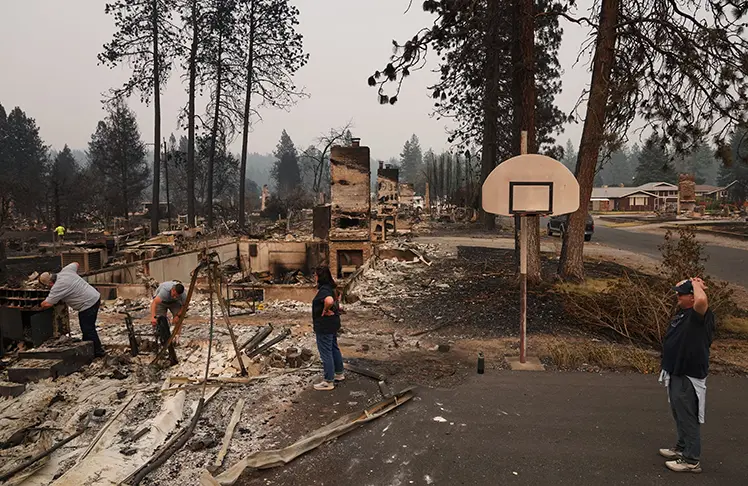
A complex of three fires near Spokane in the eastern portion of the state have scorched more than 10,000 acres of land and destroyed hundreds of homes and structures since igniting on Saturday. At one point, the fires forced tens of thousands of people to evacuate — some have since returned to find treasured memories turned to ashes.
Spokane County Sheriff John Nowels said evacuations will remain in place due to the incoming fire conditions, the Associated Press reported. “We are not going to be downgrading these zones in any large way for many, many more days to come,” said Nowels.
Authorities have arrested and charged a Spokane resident with first-degree arson in one of the fires. He has an arraignment scheduled for Thursday.
But fires aren’t just raging near Spokane: There are dozens of active blazes across Washington and Oregon. These are producing smoke that’s creating abysmal air quality in the Pacific Northwest at large. It’s the worst fire season in more than 30 years for both states, one fueled by human-caused climate change.
With no rain in the forecast, here’s what to expect from the wind and heat in the coming days.
Greater Spokane area
Thursday will be another day of relatively unremarkable conditions for fire crews, but temperatures will start to climb higher than recent days. Highs in the mid-90s are expected in the Spokane area, though smoke might block out enough warming sunlight to prevent temperatures from getting quite as hot as forecast.
Fire danger will begin to ramp up again on Friday, but the worst conditions are expected Saturday. A fire weather watch is now in effect for Spokane and the rest of eastern Washington on Saturday.
Winds will start to pick up again during the day Friday, when peak gusts of 15 to 20 mph are expected. These winds are strong enough to blow around embers and keep fire crews on their toes, but are nowhere close to the nearly 50 mph gusts that fueled the fires’ initial explosive spread last weekend.
High temperatures could reach the upper 90s on Friday, which is about 10 degrees hotter than normal during the area’s hottest time of the year.
Winds will ease overnight, but stronger winds will arrive Saturday afternoon. High temperatures in the mid-90s and gusts up to 25 mph could make Saturday another challenging day for fire crews.
A similar rhythm is expected heading into Sunday, with winds slowing overnight Saturday and speeding back up to gusts of 15 to 20 mph during the day.
Daytime winds could continue to pick up periodically into early next week, but high temperatures will start to come down into the upper 80s.
Pacific Northwest
The hot and windy trend will not be confined to eastern Washington. Central Washington will likely see even stronger winds, with gusts up to 30 mph possible starting Friday.
Winds of that strength start to present a greater risk of erratic wildfire behavior and spread, and a fire weather watch has been issued in central Washington for both Friday and Saturday.
Similar to Spokane, the windiest periods will be during the daytime from Friday through Sunday, with weaker winds each night.
Central and eastern Oregon will also deal with periods of gustier winds each day. Many areas where fires are already burning could see gusts up to 20 mph, while the lower Columbia River Basin in northern Oregon could get up to 35 mph.
Nearly 50 large fires are burning in Washington and Oregon — about half of the nationwide total, according to the National Interagency Fire Center.
Smoke and air quality issues
Smoke and its literal chokehold on air quality continue to be the most widespread impact of the ongoing fires.
Air quality in the Pacific Northwest has reached unhealthy or very unhealthy levels since the start of the week.
Extensive amounts of smoke are being trapped in place by an intense area of high pressure stuck over the West. High pressure limits winds near the surface, which prevents the smoke from clearing out.
Thursday will be another day of unhealthy air quality in the region before high pressure starts to lose its grip on the region, allowing winds to return.
The same winds that could challenge fire crews through the weekend could also start to move some of the most stagnant smoke.
Air quality west of the Cascades in Seattle and Portland, Oregon, should improve by Thursday night as winds shift out of the west and push smoke east. Those same winds will keep parts of Washington and Oregon east of the Cascades shrouded in smoke, with poor air quality through the weekend.
Smoke higher in the atmosphere will also start to spread farther east, especially this weekend.
But this smoke is forecast to stay high enough that it’s unlikely to cause a repeat of the widespread smoky conditions and poor air quality that affected many areas in the central and eastern US in July.
The-CNN-Wire
™ & © 2026 Cable News Network, Inc., a Warner Bros. Discovery Company. All rights reserved.