By Aaron Allen, The Seattle Medium
Garfield High School and Seattle Public Schools are prioritizing student mental health in the post-COVID education environment, partnering with community organizations to expand access to resources and address persistent disparities in care.
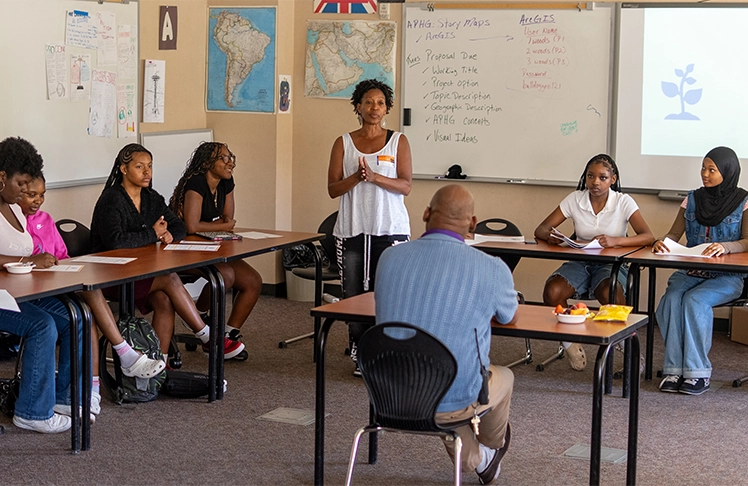
The Seattle Metropolitan Urban League and May I Make A Suggestion (MIMAS) have teamed up with Garfield and SPS to provide student cohorts with workshops in mental health and wellness, entrepreneurship, and holistic approaches that focus on the mind, body, and spirit.
Steven Akuffo, a mental health therapist at Garfield High School, said the initiative reflects the ‘it takes a village’ philosophy.
“So just the fact that we talk about reclaiming the village, right? This is a collaboration of outside organizations and partners and we’re just beginning,” said Akuffo. “We’re planning on having things like a student of color mental health symposium, where we’re bringing in outside providers, people who look like the students of color who could come and provide them with specific mental health related education.”
Akuffo said representation in mental health care is essential.
“We are opening the doors for outside providers and programs, but more importantly opening the doors to mentors that look like the very students who we’re trying to reach and provide access to these resources,” said Akuffo. “Because we can see that there’s a lot of work to be done to bridge that gap and reduce that disparity.”
National studies show that about 49.5% of U.S. adolescents live with a mental health disorder, yet only 20–50% receive services. Research also shows that African American adolescents between the ages of 12 and 18 are disproportionately affected, often facing misdiagnosis, overdiagnosis of certain conditions, and underdiagnosis of others. Limited access to treatment compounds the problem.
The National Institutes of Health reports that Black adolescents are less likely than their peers to receive care for a range of reasons. These include negative perceptions of providers, lack of culturally relevant services, and limited availability of mental health professionals.
Akuffo said stigma within the Black community continues to deter students from seeking support, even when services are available.
“I kind of look at this from a two-pronged perspective,” said Akuffo. “One is, systemically, how resources are made available to students of color and Black folks in general, and then the other prong is overcoming Black stigma around mental health. Even when there aren’t systemic barriers … the resources are there. So how do we overcome the stigma around mental health that has, I think, perpetuated the mental health crisis in Black America?”
For Jo Woods, CEO and co-founder of May I Make A Suggestion, the program grew out of personal experience.
“I was the caregiver for my mother who had dementia and in seeing what she was going through, I tried to figure out how do I not get this disease? And I went on a wellness journey,” said Woods.
Woods said her son noticed her growth and resilience. Soon, their dining room table became a safe space for him and his friends to talk about mental health and wellbeing.
“That was really the start,” said Woods. “My son and his friends wanted to know how to manage stress and apply what they learned to their dreams and goals. From there I realized this could become a program that helped more than just my family.”
In 2022, Woods formally launched May I Make A Suggestion and began partnering with the Urban League, the King County Public Library, and Seattle Public Schools.
Woods said the goal is to help students see possibilities beyond their struggles.
“So, one of the things that MIMAS is really trying to do is to make sure that our youth don’t stop dreaming. You don’t stop using your imagination,” said Woods. “The more that we find out how our bodies work and how our minds work and how we show up in our environment, the more that you are going to be able to not only keep those dreams alive, but move toward them.”
Woods said visibility in schools is equally important.
“I am not a teacher by trade. But I know the importance of them seeing us, of students seeing me in their hallways, is immeasurable,” said Woods. “These collaborations cannot be understated.”
Tarance Hart, principal of Garfield High School, said outside partnerships are critical at a time when school budgets are shrinking and enrollment is declining.
“We have mental health supports here at Garfield … but more importantly, we have community-based organizations who have agreements with Seattle Public Schools, and they come in and offer our students support,” said Hart.
Hart described the range of services now available on campus.
“Even beyond mental health, that daily life support, coaching and mentoring — we have quite a few programs here, and this year we’re lucky to have people such as Miss Woods and Mr. Akuffo to manage the mental health supports that we have at Garfield,” said Hart.
Hart said the partnerships have been vital in filling gaps left by budget cuts.
“It’s absolutely essential to what we do, and how we try to support students,” said Hart. “If it wasn’t for our community-based organizations, like the Urban League and MIMAS … we certainly couldn’t support students nearly as well as we do.”