By Aaron Allen, The Seattle Medium
The Breakfast Group celebrated 50 years of mentorship, community leadership and service to Seattle’s Black community Saturday, Oct. 17, bringing together civic leaders, business professionals and former program participants to recognize the organization’s history and its impact on generations of young people.
Incorporated in 1976, The Breakfast Group grew from informal gatherings of Black professionals seeking to support one another while navigating barriers in Seattle’s corporate world. Over the past five decades, the organization has expanded its mission to include youth mentorship, career development and community programs designed to help young people prepare for their futures.
The anniversary celebration provided an opportunity for members, supporters and program alumni to reflect on the organization’s contributions to the Pacific Northwest and the relationships that have sustained its work.
Judge Richard Jones, who attended the celebration, spoke about the organization’s importance to the community.
“It’s a fabulous event, and so many wonderful people here, and celebrating a powerful organization that’s so much for so many,” Jones said.
Former NFL player and University of Washington football standout Mario Bailey also reflected on the significance of a Black-led organization reaching its 50th anniversary while continuing to serve the community.
“It’s live as anytime a black organization can last 50 years, it’s always a wonderful thing. Especially if you’re giving back to the community and pouring into the community. I am just grateful to be here and have to witness these 50 years,” Bailey said.
The Breakfast Group’s origins date to the late 1960s and early 1970s, when Black professionals entering management and corporate positions often faced isolation and limited opportunities for advancement. Informal breakfast meetings provided a space to exchange information, build professional relationships and support one another in navigating those challenges.
As the gatherings continued, members began looking beyond their individual careers toward the needs of the broader community. Their efforts eventually developed into an organization focused on professional development, community service and creating opportunities for younger generations.
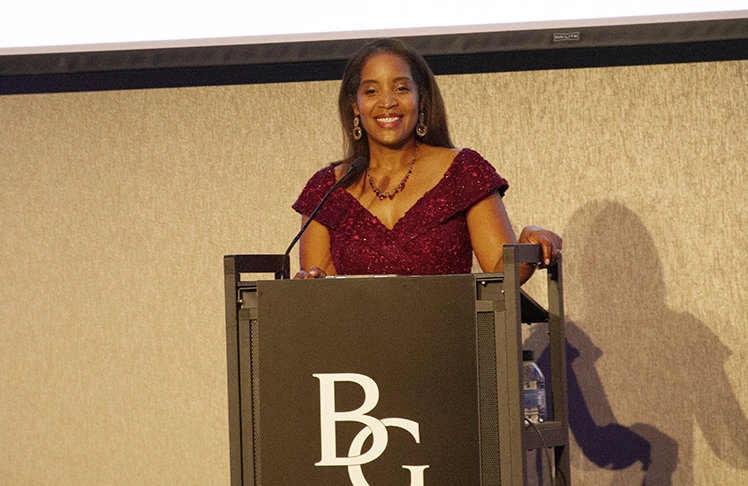
During the anniversary celebration, Angela Poe Russell, who served as emcee for the event, emphasized that the organization’s commitment to young people remains central to its mission, highlighting the role of Project M.I.S.T.E.R. in supporting students academically, socially and emotionally.
“I want to tell you about projects M.I.S.T.E.R which stands for Male Involvement and Service To Encourage Responsibility. The Breakfast Group nurtures the social, emotional wellbeing, and academic success of young man of color. Pairing them with instructors, mentors, and members that provide whole models to power success,” Poe Russell said.
She also pointed to the program’s reported graduation outcomes and its longstanding presence in Seattle schools.
“More than 95% of Project Mister Students graduate from high school and continue on to college or apprenticeships. For decades, your breakfast group has impacted thousands of students in the Seattle public school system,” Poe Russell said.
Project M.I.S.T.E.R. is one of The Breakfast Group’s central initiatives, connecting young men of color with adult mentors who provide encouragement, academic guidance and practical advice about education, careers and personal responsibility.
The program has worked with students at Seattle schools, including Franklin, Rainier Beach, Cleveland, Garfield and South Lake. Through relationships with professional mentors, participants receive support intended to help them remain engaged in school, develop life skills and make informed decisions about their futures.
For former participants, the program’s influence can extend well beyond graduation.
Dewan Parker, who spoke during the anniversary celebration, described the lasting relationship he developed with a mentor who helped him navigate difficult personal circumstances and find a more stable path forward.
“He’s still in my corner to this day, and it’s been 15 years prior from when I first met him,” Parker said.
Peter Fan, another program alumnus, described how mentorship helped change the direction of his life after he experienced significant difficulties in school.
Fan said he had been expelled from multiple middle and high schools before attending South Lake High School in Rainier Beach. Through Project M.I.S.T.E.R., he developed a relationship with a mentor named Kevin, who encouraged him to establish goals and believe in his ability to succeed.
“Every week, our mentor, Kevin, has us write down our goals. No goal was too small. He believed in us when we had a hard time believing in ourselves. I’m the only one in my friend’s group to graduate high school. That’s the difference this program makes,” Fan said.
Fan went on to become an engineer and spent approximately a decade working for major technology companies, including Microsoft, Amazon and TikTok. During the anniversary celebration, he announced plans to become a mentor himself, extending the support he received to another generation of young people.
His decision reflects one of the organization’s longstanding goals: encouraging those who have benefited from mentorship to return and help others.
Former Seattle City Council member Mark Solomon, a longtime Breakfast Group member, spoke about the responsibility of established leaders to help prepare those who will follow them.
“One of the reasons I got back involved with the group is because I wanted to help groom our next generation of leaders. We need to step up. We need to be the example for those who are going to come behind us. And rather than trying to hold on, it’s like reach back and pull them up with us,” Solomon said.
Solomon also pointed to the organization’s interest in expanding its mentorship efforts through Project S.I.S.T.E.R., an initiative intended to provide similar opportunities and support for young women.
In addition to Project M.I.S.T.E.R., The Breakfast Group hosts its annual Tie One On Rites of Passage luncheon, which brings high school students together with professional mentors.
During the event, students learn how to tie a necktie while participating in conversations about personal presentation, professional expectations and the transition into adulthood. The ties, sometimes designed by the students themselves, serve as symbols of preparation, confidence and the relationships formed through mentorship.
The organization also supports career exploration through opportunities such as job shadowing and programs focused on science, technology, engineering, mathematics and the arts.
Its community involvement extends beyond educational and professional development. The Breakfast Group has helped coordinate the annual ROOTS Family Picnic, an event at Jimi Hendrix Park that celebrates the history and contributions of Seattle’s early Black families and community pioneers.
For local business owner Theo Martin, proprietor of Island Soul, the anniversary celebration was an opportunity to reconnect with an organization whose members have long been part of his professional and personal community.
“I am here at the Breakfast Club for their 50th year anniversary or gala. And this is actually my first time joining. I came, not because I was invited, because my spirit says, why has it been 50 years that I haven’t been here? I share business with these brothers. We break bread together, and now I get to break bread and celebrate with them. So 50 years is here. It is never too late,” Martin said.
Martin’s reflections illustrated the relationships The Breakfast Group has built among Black professionals and business owners throughout the region, including people whose connections to the organization extend beyond formal membership.
The anniversary also highlighted the role of community partnerships and the continued involvement of members who have supported the organization’s mission over several decades.
As The Breakfast Group looks toward its next 50 years, its leadership is developing plans to expand mentorship and career development initiatives. The organization’s strategic planning efforts include strengthening connections between its alumni network and young people interested in technology, skilled trades and corporate leadership.
Those efforts are intended to build on the organization’s existing programs while responding to the changing educational and employment opportunities facing younger generations.
For an organization that began as an informal gathering of Black professionals seeking mutual support, the 50th anniversary represents both a recognition of its history and a commitment to continuing that work.