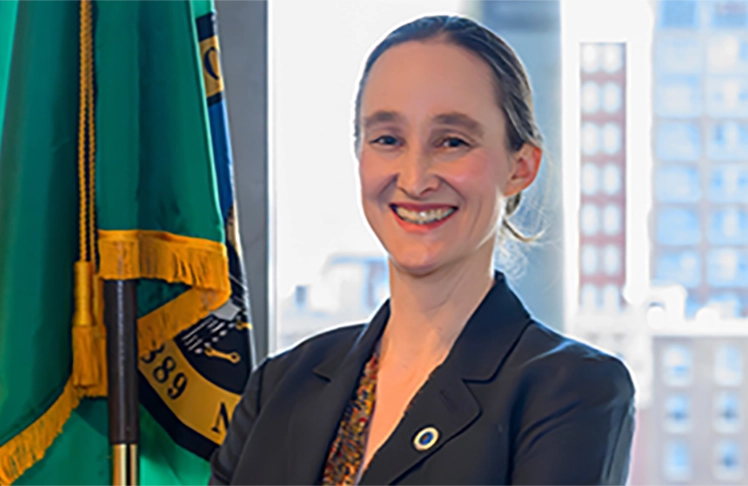
By Aaron Allen, The Seattle Medium
More than 100 days into her tenure as Seattle mayor, Katie Wilson says the city’s biggest challenges, from housing affordability and youth violence to economic displacement and downtown recovery, cannot be solved through quick fixes or politics as usual.
Instead, Wilson believes Seattle’s future will depend on long-term investment, stronger community partnerships, and a willingness to confront the interconnected pressures reshaping neighborhoods across the city.
In a one-on-one interview with The Seattle Medium, Wilson reflected on the realities of governing one of the country’s most dynamic yet deeply challenged cities, while discussing issues ranging from Black business growth and legacy homeownership to public safety, housing, and the future of downtown Seattle.
“I’ve heard it said that being the mayor of a big city is the best political job and also the hardest political job,” Wilson said. “That definitely resonates with me. It’s really an honor to be in a position to make decisions that can move the needle for people’s quality of life.”
As Wilson settles into office, her administration is attempting to balance urgent public safety and affordability concerns with broader questions about how Seattle grows without further displacing longtime residents and communities already struggling to remain in the city.
Those concerns have become especially pronounced in Seattle’s Black community, where rising costs, redevelopment, and generational displacement continue reshaping neighborhoods like the Central District, Rainier Beach, and Southeast Seattle.
Wilson recently hosted a roundtable at City Hall with more than 50 Black business owners, an experience she described as “enlightening” as city leaders work to better understand the barriers entrepreneurs face navigating Seattle’s increasingly expensive and complex economic environment.
Among the ideas under consideration is the creation of a centralized “one-stop shop” designed to help small business owners better navigate government programs, nonprofit resources, permitting processes, and technical assistance opportunities.
The mayor also pointed to neighborhoods like Rainier Beach, where she believes the city must do more to ensure that increased foot traffic generated by light rail expansion translates into economic opportunity for local businesses and residents rather than accelerating displacement.
On the residential front, Wilson expressed deep concern about elderly homeowners in the Central District and Southeast Seattle who are increasingly being priced out of neighborhoods where many families have lived for generations.
She pointed to what she described as a troubling gap in participation in existing property tax relief programs for seniors and lower-income homeowners.
“A lot of lower-income and senior homeowners are eligible for property tax reduction,” Wilson said. “But I believe only about 30% are actually signed up for it. We need to partner effectively with Black Legacy Homeowners and other organizations to try to sign more people up for that exemption.”
For Wilson, many of Seattle’s challenges are deeply interconnected, particularly when discussing youth violence, economic instability, housing insecurity, and community trust.
Following several tragic incidents involving gun violence in Rainier Beach earlier this year, Wilson said her administration has increasingly embraced a more holistic approach to youth safety, one that goes beyond enforcement alone.
“One thing I heard really clearly from youth in Rainier Beach was, we need places to be in the evening that are not places where you’re going to get into trouble, but places where there are trusted adults,” Wilson said.
The administration is currently evaluating the feasibility of creating a Teen Life Center in Rainier Beach while also working with the Seattle Police Department to maintain what Wilson described as a “consistent but positive police presence” in areas experiencing higher levels of violence.
As Seattle continues to grapple with soaring housing costs, Wilson said the city must focus more intentionally on developing “missing middle” housing options designed for families rather than primarily catering to individuals or couples.
Wilson, who noted that she is also a renter, acknowledged that the dramatic “price jump” associated with family-sized housing is something she personally understands.
The mayor said she believes Seattle must find ways to increase housing availability while preserving the cultural identity and stability of neighborhoods already vulnerable to displacement pressures.
Meanwhile, Wilson remains cautiously optimistic about Seattle’s downtown core despite persistent office vacancies and the recent departure of major retailers like Ross Dress for Less.
She pointed to the opening of a new Barnes & Noble bookstore and the upcoming FIFA World Cup as opportunities to generate new energy and activity downtown.
“How can we make downtown into more of a residential 24/7 neighborhood where people want to come at all hours because there’s great things going on in the evening?” Wilson asked.
Converting vacant office buildings into residential housing remains one of the administration’s long-term priorities as city leaders continue exploring ways to reshape downtown into a more active mixed-use neighborhood.
Throughout the interview, Wilson repeatedly acknowledged the scale and complexity of the issues facing Seattle, from homelessness and public safety concerns to affordability pressures and broader economic uncertainty.
Still, she said she remains encouraged by the willingness of communities across Seattle to engage directly with city leadership and work collaboratively toward solutions.
“I feel really heartened by the spirit of collaboration that I’ve felt from neighborhoods and communities around the city so far,” Wilson said. “I hope that people continue to reach out to my office to open up lines of communication if we don’t already have a relationship.”