By Olivia Oppegard , The Seattle Medium
The scent of sea salt, coconut and sandalwood drifts through the air as students slow their pace near a pop-up table in Seattle’s University District. Some walk by without a second glance. Others stop and ask a question:
“What inspired this scent?”
For the four University of Washington students behind Lumiére, those conversations matter just as much as the candles themselves because Lumiére is not simply a candle company. It is a company built around memories, culture and identity.
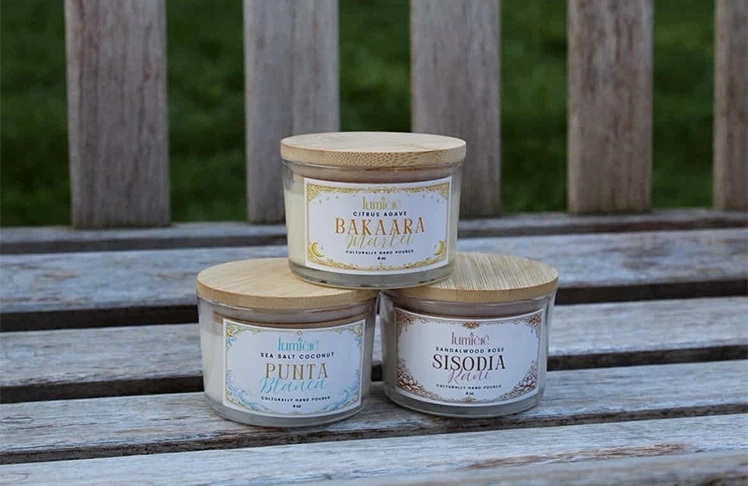
Created through a Foster School of business entrepreneurship course, Lumiére was founded by four women of color from different cultural backgrounds who transformed personal stories into products. Through hand-poured candles inspired by their own heritage and experiences, the team discovered that customers are often buying more than fragrance, they are buying connection.
Their mission is simple: “A story in every scent.”
For Chief Executive Officer Mia Pino, an international student from Ecuador majoring in marketing and entrepreneurship, Lumiére did not begin with candles. Originally, the team planned to create skincare products. “There were too many regulations and complications,” Pino said.
The group pivoted into juices, then to tote bags, before finally landing on candles. Along the way, they discovered they all shared something bigger than a business idea. The founders wanted to create something rooted in identity, and as women of color from different backgrounds, they saw it as an opportunity to make culture part of the company itself. Suddenly, the business became more personal.
Today, every candle reflects the culture and memories of its founders.
Chief Marketing Officer Jehan Hashi, a first-generation Somali American raised in Seattle, found inspiration in childhood memories of Somali markets and community gatherings.
“When I was younger, we would go to Halal markets that were filled with members of the Somali community gathering, enjoying coffee and chatting,” Hashi said.
She remembers markets crowded with families reconnecting, fresh produce lining the aisles and one memory in particular stood out. Those moments inspired her Citrus Agave candle, but for Hashi, it represents much more than scent. “It was a memory of the community,” she said.
Pino’s inspiration similarly came from childhood memories. Growing up on Ecuador’s coast consisted of many beach days, and often ended with coconut ice cream shared with family. “I wanted to capture the essence of an Ecuadorian beach in a candle,” she said, a memory that became Sea Salt Coconut.
For Chief Operations Manager Rhea Wanga, who moved from India to Seattle about ten years ago, familiar scents from childhood shaped her product.
“If you were to ask any Indian person the two staples in the house, it would be sandalwood and rose,” she said.
She remembers temple visits filled with sandalwood incense and afternoons spent playing in the rose gardens. The result became the Sandalwood Rose candle.
For Chief Financial Officer Aditi Rana, the Sandalwood Rose scent carried a different but equally personal meaning. Rana said she has always felt closely connected to her Indian heritage through family traditions and experiences. While Wanga associated sandalwood with specific nostalgic memories, Rana viewed it as a symbol of a broader connection to identity and spirituality.
“Sandalwood is the smell of the temple and places of worship,” Rana said.
Their scent revealed that even amongst founders with similar cultural roots, the same fragrance could carry different personal meanings. For Rana, Lumiére reflected the opportunity to express a part of herself through something she was genuinely connected with, making the work feel more personal.
“It makes it easier to sell because it is actually something I believe in,” Rana said.
That authenticity quickly became one of the company’s greatest strengths. At pop-ups events across Seattle and the University District, the founders noticed customers were interested in more than candles. They wanted stories. As they spoke to customers, the conversations often became just as important as the product itself.
“We have to storytell,” Wanga said. “We have to have a conversation with them to have the motivation to buy.”
Those conversations often translate directly into trust. Wanga recalled customers connecting not only with the cultural inspiration behind the candles, but also with the intention behind how they were made. “We had a customer be like, ‘I trust you guys. I know a lot of candles are synthetic, but I trust the culture behind it and trust you guys use clean ingredients, so I’m gonna buy it.’ So we have earned trust in that way.”
For the team, selling often feels less like a transaction and more like relationship building. In a city as diverse as Seattle, customers frequently recognize pieces of themselves in Lumiére’s products. Some customers stop to share memories sparked by scents, while others become excited to see aspects of their own culture reflected in a product sitting on a table in front of them. The conversation often becomes personal.
Pino admitted that she was originally hesitant to enter such a saturated market. Candles are everywhere. How would they make theirs stand out? She eventually realized the answer was not in the product itself, but in the meaning behind it.
“We are already successful not because we are selling the most,” Pino said, “but because we are sharing a piece of our culture.”
For the team, success is not defined purely by sales numbers, but by how customers respond to their products, and whether people connect with them and choose to buy into that meaning.
That mission shapes the identity of the company internally as well. Though the founders come from different backgrounds and are studying different majors, they believe those differences became one of their greatest strengths.
Hashi said the founders’ different perspectives help shape how they approach challenges and decisions. “Team variety adds value with multiple interdisciplinary perspectives,” Hashi said.
Together, they discovered entrepreneurship is far more complex than lectures and assignments, but their greatest lesson has involved identity.
“Culture can be a taboo topic, especially in business settings,” Hashi said. “We are resisting that narrative of having to hide who you are and where you come from.”
Lumiére represents something larger than a student business venture. It represents what can happen when young entrepreneurs turn personal experiences into strengths. For customers who stop by Lumiére’s table, the candle may be what first catches their attention, but the story is often what stays with them.