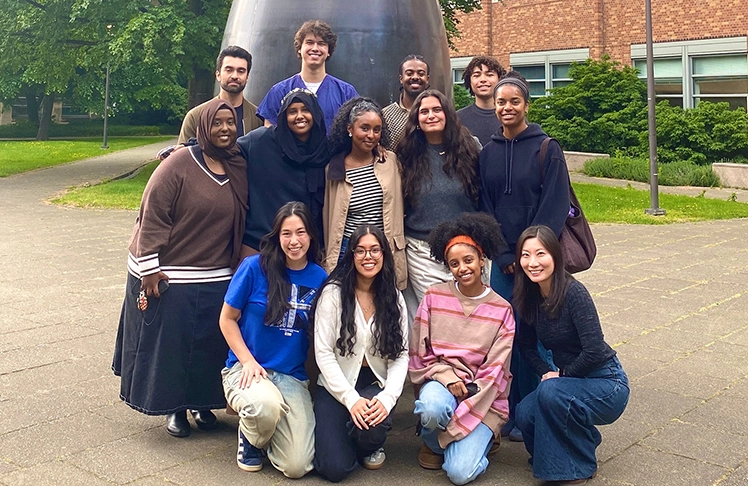
By Kiara Doyal, The Seattle Medium
After nearly two years of engaging Black young adults through culturally grounded research and community conversations, the Black Adult Resilience Study (BARS) has reached a major milestone. The National Institutes of Health-funded initiative has achieved its participant enrollment goal in Seattle and is nearing completion in the Dallas-Fort Worth area.
The community-based study examines how racialized experiences influence the mental health, resilience and alcohol and cannabis use of Black young adults while centering their voices, lived experiences and strengths.
Led by Dr. Priscilla Lui in collaboration with a multidisciplinary team of researchers, BARS was developed to ensure Black voices remain at the center of research aimed at improving mental health outcomes.
“I am intentional about representing and contextualizing Black experiences and perspectives through scientific research and other efforts for the community to bond and build capacity,” said Lui. “Even if prior research worked with the Black community, young people in the current times may have different experiences.”
Lui, who has spent more than a decade studying the relationship between racial discrimination, culturally relevant stress and mental health among communities of color, said the research was designed to work alongside the Black community rather than simply study it.
“It has been well documented that Black young adults face disproportionate burden from cannabis and other substance use, have distinct racialized experiences, and hence navigate life challenges with culturally distinct personal and social capital,” said Lui. “It is important for us to understand these specific experiences and work closely with the Black community on the research and dissemination.”
The response from the community exceeded expectations. Across the Seattle and Dallas-Fort Worth study sites, the project received nearly 10,000 eligibility screeners in less than two years, including close to 4,000 completed screeners in Seattle alone.
For Lui, that level of participation sends a powerful message.
“It is humbling to me for several reasons. First, most research has not centered on Black community’s experiences, concerns, and strengths,” said Lui. “Sometimes Black participants and other groups that face marginalization are characterized as not interested in research or hard to reach. Our participants showed up for the study. This response challenges the notion that the Black community is disinterested in research.”
Nia Jones, the study’s research coordinator and a graduate of the University of Washington’s psychology program, said creating opportunities for Black young adults to connect with one another became especially meaningful in Seattle, where decades of gentrification have displaced many longtime Black residents.
“Seattle in particular has seen increasing gentrification and displacement of the Black population over the past decades, making it harder to access built environments and community networks to promote thriving and a sense of connections,” said Jones. “Our study intentionally creates such a space for Black young adults to ‘see’ each other and to foster a sense of belongingness.”
That sense of connection extended beyond the research itself through BARS’ “Learn. Connect. Build Community.” series, which brought conversations about healing, Black fatigue, trust, equity and mental health directly into community spaces.
“Over the years, most of what I have seen is that scientific research doesn’t reach the people it’s meant to serve,” said Lui. “By creating the series, I was hoping to showcase research and engage with the diverse segments of the world in the Greater Seattle area, by sharing and seeking feedback on our ongoing research, learning from the community members, and holding space for Black young people to come and build community.”
The initiative also partnered with Black-owned businesses and organizations, including Fat’s Chicken & Waffles and ARTE NOIR, while working alongside a Black community advisory board and a diverse team of predominantly Black student researchers.
“Being able to collaborate with these trusted organizations and spaces highlights that the community is eager to make research relevant and beneficial to the people it’s meant to serve,” said Lui. “Academic research can seem ‘sterile’ and unapproachable at times, and holding community events can help humanize psychological research and destigmatize mental health conversations.”
Rather than treating Black residents simply as research participants, the project sought to make them active partners in the research process. The conversations intentionally focused on healing, storytelling and cultural connection, recognizing that these experiences are just as important as scientific findings when discussing Black mental health.
“It is clear to us that healing, storytelling, and connection are essential to discussing Black mental health,” said Jones. “Even if Black young adults may not consider explicitly these as their way of coping or resilience, they nonetheless practice many of these in their everyday lives. We want to be able to highlight these through dialogues and create the space for mutual and collective reflections.”
Now that participant enrollment is nearly complete, the research team is entering its next phase: analyzing the data and sharing the findings with the communities that helped make the study possible.
Lui hopes the research will demonstrate not only the harmful effects of racialized stress but also the many strengths that help Black young adults thrive.
“Our research should challenge longstanding negative stereotypes about the Black community and show the many dimensions of Black individuals,” said Lui. “We also want to identify personal and social capital that can be promoted through clinical interventions and community support.”
She also hopes the findings will help inform more culturally responsive mental health care while providing individuals, families, educators, health professionals and policymakers with practical knowledge that supports Black resilience and well-being.
For Lui, however, the work does not end with the completion of the current study.
“I hope that this is just the start of ‘Black Adult Resilience Study’ and there will be a BARS-2, a BARS-3, etc,” said Lui. “At the minimum, we hope people will follow us to read about results directly from the study as we analyze the rich data and share the resources with the community.”