 By Adrienne Bailey
Special to The Medium
Growing up in the Central Area, my friends and I would run through the woods into Washington Park Arboretum, creating our own special paths. These green spaces were our little rural oases in the middle of the city and they still remain pretty special for me.
But these days, the Central Area is a very different place. The full story of how it has changed from a community that was at the center of African-American life in Seattle to one where Black people are rapidly disappearing and being displaced is still being told.
Many Central Area institutions and landmarks are disappearing, too, being tossed to the wayside. One example is the name change on the historic structure that housed the Central Area Motivation Program (CAMP), renamed Centerstone.
CAMP was one of the last surviving programs from the “War on Poverty,” which was first introduced by President Lyndon B. Johnson in 1964. But now when you go into Fire Station No. 23, there’s no evidence that CAMP ever existed.
 As we lose the voices of elders in the Central Area, we are also losing institutional knowledge of our community. And new residents to the Central Area seem to have no respect for those who were here before they arrived and little regard for our rich culture.
It is this cavalier attitude and a concern that over time any vestige of the Central Area’s past could be lost forever, that prompted a new multi-year project by the Central Area Cultural Arts Commission.
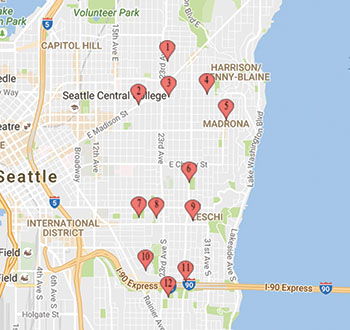
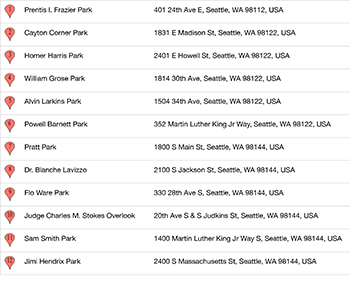
The Central Area Parks African-American Legacy project will allow us to tell our story in a lasting and meaningful way through the dozen or so named public parks scattered across the Central Area.
The Arts Commission will continue a “museum without walls” concept that originated with creation of the Homer Harris Park on Howell Street and 24th Avenue.
The project will provide each park with its own unique interactive learning wall and artwork designed and built by young people and artists primarily from the Central Area.
The project will recognize the African-American men and women that the Central Area parks are named for – doctors, musicians, entrepreneurs – trailblazers who either lived here, contributed to the Central Area, the city or county or were national figures whose lives inspired and impacted us all.
The walls and artwork will tell the stories of each park’s namesake and the contributions he or she made to the community. Their stories will be collected in a myriad of ways, utilizing technology and, when possible, taking oral histories from community elders and the namesakes’ family members.
This inter-generational project will serve as an educational tool for all of us – newcomers as well as lifelong residents.
The Art Commission’s goal is to work on two to three projects a year, starting with Blanche Lavizzo Park on South Jackson Street and William Grose Park in the Madison Valley along East Howell Street.
The first African-American pediatrician in the state, Lavizzo was born in Atlanta and was a friend and schoolmate of Dr. Martin Luther King, according to BlackPast.org.
Moving to Seattle in the 1950s with her husband, a surgeon, she was in private practice until 1970 when she became the first medical director of the Odessa Brown Children’s Clinic in the Central Area.
Meanwhile, Grose, one of the city’s wealthiest men by the time of his death, had enlisted in the U.S. Navy and traveled across the world before moving to Seattle in 1860, according to the website.
Grose was a pioneer and landowner, who by the late 1800s operated a successful restaurant, a three-story hotel and a 12-acre ranch in the Madison Valley. Ironically, the Homer Harris Park sits on land he purchased from Henry Yesler.
Among the others are:
Flo Ware Park, on South Jackson Street, a small neighborhood park with a children’s play area named for the Texas transplant who was an unrelenting activist on behalf of children.
Al Larkins Park, on 34th Avenue in Madrona, named for the brilliant musician and teacher who devoted time and energy to Madrona, where he lived from 1949 until he died in 1977.
Cayton Corner Park, a triangular-shaped lot on E. Madison and 19th Ave, named for Horace R. Cayton, Jr., a prominent sociologist, newspaper columnist and author who specialized in studies of working-class Black Americans.
Judge Charles M. Stokes Overlook, at 20th Avenue S. and South Judkins Street, named for the gifted orator and civil rights activist who became the first African-American district judge when he was appointed to the King County District Court in 1968.
Powell Barnett Park, a sprawling, multi-purpose park at 352 Martin Luther King Jr. Way, is named for the musician, civil rights activist, and African-American community leader.
Pratt Park on South Main Street, is named for Edwin Pratt, a community leader and civil rights activist who was executive director of the Seattle Urban League when he was assassinated in the doorway of his home in 1969.
We have a rich history in this community and I am committed to preserving and sharing it. It is my hope – and that of the Central Area Cultural Arts Commission –that through our parks, the Central Area will maintain a connection to its past.
And that it will continue to tell its stories, taking Black History beyond just one month a year, to continuously breathing life into African-Americans stories and history, making them visual, interactive and fun.
This project should help all to understand and appreciate the pride and love we have for the Central Area and make going to Central Area parks an educational and family-oriented experience.