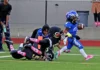
By Kiara Doyal, The Seattle Medium
For Tyron Harris, his involvement with the CD Panthers Youth Football program began as a father wanting to learn the game alongside his son. More than a decade later, that journey has taken him from coaching to serving as the organization’s athletic director.
“I started as a coach, and then evolved to athletic director,” said Harris. “I have been with CD for a while, I want to say it has been at least 10 years.”
Harris first became involved when his son began playing for the Panthers at 5U. His son continued through the program up to 14U, giving Harris an opportunity to grow alongside him and become increasingly involved with the organization.
“The coaching role came more on the side of just trying to understand how to teach the game versus play it, because I always played it as a kid with my friends in the street,” said Harris. “I really wanted to show my son how the ins and outs of me learning, we would learn together. It was like a proud dad moment; I just wanted to be able to learn with my son and see him flourish at the same time.”
That desire to be involved eventually led Harris into a larger role with the Panthers. Before becoming athletic director, he was already contributing behind the scenes, including refurbishing and painting helmets.
“The role came from the president seeing some of the stuff I was already doing. Before I was an athletic director, I was painting and refurbishing helmets,” said Harris. “And the president was like, ‘Hey, you know, you might be a good candidate for athletic director.’ So we talked about it and looked over what it took, and I said, ‘Okay, I can do it.’ And here I am here.”
Today, Harris’ responsibilities stretch well beyond game day. He helps prepare equipment for practices, works on the field, organizes games and handles setup and teardown. He also serves as the voice of the Panthers on game days.
“I suit the kids up, get their helmets ready for practices, so they have their practice gear. I run around the field fixing everything. I am also on the microphone every game, so if anybody goes to a CD game, nine out of ten times it is me,” said Harris. “I help out in concessions and any outside events. We go to other practices, maybe scrimmage, but I am the lead person.”
For Harris, however, the time and effort are about more than football. One of the most rewarding parts of his involvement has been watching young players develop and seeing where their experiences with the Panthers take them later in life.
“Especially from the baby’s point of view, I just like seeing them come up and understanding the game a lot more than when they were babies,” said Harris. “So that developmental side of it, and then the recognition later on in life.”
Harris recalled one encounter with a former player’s parent that illustrated the lasting impact youth football can have. Years after Harris had worked with the player, the parent approached him and thanked him for his role in helping his son reach college.
“I got a bunch of kids that are in California in college that were on my son’s team that I coached, and a couple of kids over on the East Coast playing football,” said Harris. “Just to see them doing really good in life and enjoying it, that strength came from us.”
Those moments help keep Harris committed to the Panthers and the community surrounding the program. That commitment has taken on added significance as Seattle’s youth football landscape has changed. Over roughly the past decade, other inner-city programs have folded, leaving the CD Panthers as the city’s last remaining inner-city youth football team.
“It is the kids, but also just the community. We are the last inner-city team, and just trying to keep it going and having something for kids to return to, to play or to coach is important,” said Harris. “Being a community presence is one of my main things. Being there and saying, hey, you know, I may not be doing a lot, but I’m doing something with the youth, involved and out of the streets.”
For Harris, the lessons the Panthers provide extend beyond football. He wants young players to carry the structure, relationships and experiences they gain through the game into the rest of their lives.
“Sometimes people may grow up and realize that football may not be it, but they have a lot of structure and understanding from the game, and the people that have been around them understand that there is a good way to live life, and there is a bad way to live life,” said Harris. “We all know that, but we want to pick a good way just for the sake of communities and being able to have joy out here, even if we’re not a legacy. Because I’m following a legacy of someone else who’s done the same thing I’ve done.”