By Aaron Allen, The Seattle Medium
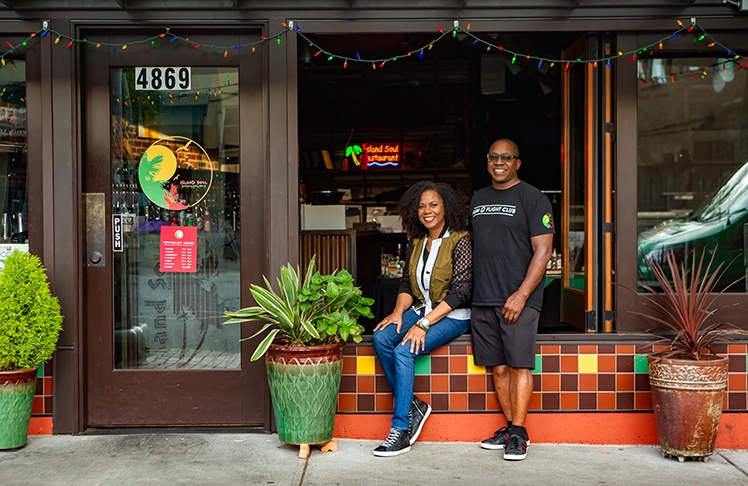
It’s 6 a.m. in Columbia City, and the rhythmic sound of a broom scraping across the sidewalk breaks the morning silence as Theo Martin, owner of Island Soul Restaurant, clears spiderwebs from the awning and sweeps the sidewalk outside his Rainier Avenue South restaurant.
It is a quiet, deliberate morning ritual, one rooted in an uncompromising work ethic passed down through generations of Martin’s family growing up in Seattle’s Central District. It takes place hours before the first order of catfish sizzles in the oil or the day’s pot of gumbo comes to a slow simmer. For Martin, there is a sense of pride and love in taking care of even the smallest details, setting the tone for what people experience when they walk through the doors of his family-run restaurant.
“My attitude of what I do is just I watched my parents do it,” Martin says. “There was no option to slack off. My father raised us to honor, respect, and work hard.”
The roots of Island Soul Rum Bar & Soul Shack stretch back more than five decades through Martin’s family tradition of entrepreneurship.
Martin entered the family at age six as a foster child, brought into a household filled with upward of a dozen children. His mother ran a neighborhood daycare in Seattle’s Central District to support Black nurses working overnight shifts, a business his sister still operates today. His father was a serial entrepreneur who ran a construction company, a grocery store, a German Shepherd breeding operation and Judkins Barbecue at 26th and Judkins.
“I make the joke that if my parents had a farm, we would have been milking cows,” Martin laughs. “In this case, they had restaurants, daycares, grocery stores, and construction companies, so we just worked.”
By age 10, Martin was washing and cutting collard greens, bussing tables and learning the kitchen line at Judkins Barbecue. By his early teens, Martin was working across Seattle’s restaurant scene.
Though he eventually earned a business degree and spent 20 years ascending to a corporate buyer position at Nordstrom, family duty called him back. When his father fell ill in the late 1990s, Martin stepped in to run Judkins Barbecue. Following his father’s death, Martin committed himself fully to entrepreneurship, taking over the family restaurant business in 2001 and eventually transforming it into what would become Island Soul.
For Martin, the decision also reflected something his father had taught him about the value of ownership and the ability to build something that could benefit the entire family. It was a lesson that Martin would eventually pass along to his own children.
“My father told me, ‘That’s why I work for myself. I’m the boss. I control my future, I control my family’s future, and together we can grow,’” Martin recalls. “That’s why today my son [Bryce] works with me at the restaurant, and my daughter works with my wife at our staffing service.”
As Martin began shaping a new identity for the family restaurant business in a city that once boasted several traditional soul food institutions, he partnered with his longtime friend Richard Dwyer and Jamaican-born Chef Bobby Laing. The seeds of the collaboration were planted around 2003 while Laing was working at a small eatery in the area.
“He started talking about opening a restaurant, saying he needed help and someone good,” Laing recalls. “His friend said, ‘No problem, you can go help him.’ So on the first of April 2005, we opened at the Judkins Park location.”
In the beginning, building a customer base for Caribbean flavors in the neighborhood took persistence.
“He is really a go-getter because he was actually begging people to buy the food,” Laing laughs. “Nobody knew much about Caribbean food, rice and peas; there were a lot of questions. We started out with jerk chicken, rice and peas, and cabbage before eventually changing to collard greens. After about three months, we started building good traction.”
Together, Martin and Laing began shaping Island Soul’s culinary identity around a fusion of traditional Southern dishes and the Caribbean flavors Laing brought with him from Jamaica. The approach also reflected Martin’s upbringing as a Seventh-day Adventist, incorporating healthier, non-meat preparation methods into some traditional comfort foods.
“I grew up vegetarian,” Martin explains. “We wanted to bring that same awareness that you can eat healthy and eat good, but still fellowship. Our collard greens are vegan. I don’t put pig feet or neck bones in the vegetables. Everything is kept as clean and healthy as possible.”
As the menu expanded, popular additions like catfish, oxtail, curry goat, seafood gumbo and coconut corn muffins helped solidify the restaurant’s identity.
“At first, in our minds, it was a Jamaican restaurant,” Laing explains. “Eventually, Theo started interjecting some Southern stuff on the menu. He really listens to customer feedback, he’s not stuck in his ways. It turned into a true fusion of Southern and Caribbean cuisine.”
Today, that fusion plays out daily in a busy kitchen. On any given day, Island Soul can move through 100 pounds of catfish, fileted and marinated, while pots of oxtails simmer and seafood gumbo comes together with shrimp, crab and beef hot links.
Laing’s culinary journey began long before he arrived in Seattle in November 2002. Raised in Ocho Rios, Jamaica, Laing was introduced to kitchen operations at age 12, taking over meal preparation for his large family when his older siblings moved out.
“In our culture back home, parents watch to see what you’re good at,” Laing says. “Cooking literally fell on me. I started cooking for a paycheck around 18 or 19, and from then until now, I never stopped.”
After leaving Jamaica to work seasonally at a resort in French Lick, Indiana, Laing eventually relocated to Washington state to stay with family in Bellevue, connecting with Dwyer before teaming up with Martin to launch Island Soul.
For Laing, the secret behind the restaurant’s long-standing success is a mix of intuition, family tradition and genuine passion for his work.
“The flavor is something I have in my two hands. I can’t teach anybody to do it like I do,” Laing says. “The secret is really love. I put a lot of love into what I do. I don’t just think about it like getting a paycheck; I want every customer to feel good. My advice to anyone is to keep loving what you do, put passion into it, and put your best foot forward. Never give up, because one day it will pay off.”
For Martin and Laing, however, Island Soul is about more than food. The restaurant has become a gathering place in a city where many Black families, churches and institutions have moved away from neighborhoods they once called home. As the surrounding community has changed, Island Soul has remained a place where longtime residents and those who have moved farther south can return, reconnect and still find a sense of home.
“Theo is the type of guy who listens to customers and always tries to meet people halfway,” Laing says. “He’s great at welcoming people: ‘glad to see you, my sister; glad to see you, my brother.’ People come there feeling comfortable, like they’re at home.”
That sense of home extends across generations, bringing together longtime neighborhood residents, families and visitors over shared meals.
“There’s a lot of churches no longer in the city because their congregation moved further south, but you maintain that house so they can come back home to celebrate,” Martin says. “That’s what I feel about the restaurant. It needs to be here, and we have to make sure it stays here.”
As the morning preparation wraps up, Martin hands off operations to Laing and Bryce before heading to his afternoon shift at the family’s staffing agency. He returns in the evening to greet dinner guests, continuing a cycle of work and service that began generations earlier and now includes another generation of his own family.
“If you’re in Seattle and want to take a friend to a place that feels like home, where you know they’re going to walk away smiling, this is the place,” Martin says. “We’re here to serve, to make amazing food, and to keep this tradition going.”
Island Soul is a participating restaurant in the Pack The House campaign, a 10-week community initiative presented by The Seattle Medium, the Urban League of Metropolitan Seattle and Byrd Barr Place to encourage the community to intentionally support local Black-owned restaurants. For more information about the campaign, participating restaurants and weekly schedule, visit PackTheHouseSeattle.com.