By Aaron Allen
The Seattle Medium
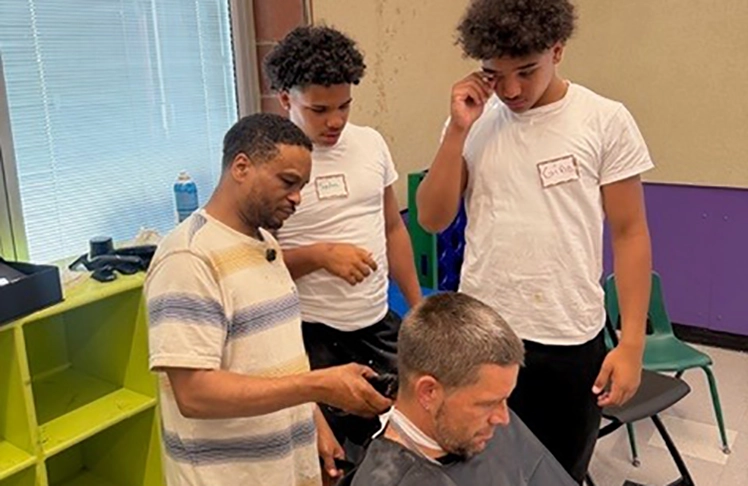
Every Tuesday evening, the sound of clippers and trimmers fills Garfield Community Center as young people learn how to cut hair, develop professional skills and explore opportunities in the barbering industry.
From 5 to 7 p.m., veteran Seattle barbers Jabari Hayes and Jameel Shabazz lead Fades of the Future, a free training program designed to introduce young men and women to barbering while providing mentorship, life skills and guidance toward future careers.
For Hayes and Shabazz, the program is about more than teaching students how to give a clean fade or line up a haircut. It is about passing along skills that can help young people earn a living, develop confidence and build a foundation for financial independence.
The initiative began taking shape in 2025 after Dana Tate, a mutual friend who worked for the city, approached Hayes about expanding his community involvement.
Hayes, owner of Mo’Stylez Barbershop and Salon and co-owner of Legacy Beauty Supply, had already been thinking about opening a barber school. Growing up in Seattle’s Rainier Beach neighborhood and spending 15 years in the industry helped shape his belief that barbering can create opportunities beyond the shop.
“I’ve been wanting to open a school,” recalled Jabari Hayes, owner of Mo’Stylez Barbershop and Salon and co-owner of Legacy Beauty Supply. “I tell every class… this is how I have everything that I have. Without this, I don’t know where I’d be right now. So that’s what inspired me to really do it. It’s a way to give back.”
For Hayes, learning a trade offers young people a skill they can use throughout their lives, whether they pursue barbering as a career or use it to support themselves while attending college.
When Hayes began organizing Fades of the Future, he reached out to Shabazz, founder of J Styles Barbershop and the nonprofit organization Project Impact. The two had known each other for years and shared similar ideas about mentoring young people through the barbering profession.
“I’ve been knowing Jabari pretty much all of our lives,” Shabazz explained. “When he decided that he wanted to put something together, he reached out. The irony of it is that I had the same ideas that he had, but just not the time. I don’t need to recreate the wheel or be in competition. You already have the platform, so I can just hop on board.”
At Garfield Community Center, students receive hands-on instruction in cutting, fading, lining up and styling hair. But the training also emphasizes the habits and responsibilities needed to succeed in a workplace.
“We try to give them experience on how to cut hair, line up, professionalism, and the importance of being a responsible adult,” Hayes said.
Shabazz uses the sessions to discuss the connection between everyday habits and long-term success. Paying attention, following instructions and treating others professionally are lessons he believes can carry into any occupation.
“The word was professionalism,” Shabazz noted. “What that means starts with the small things like paying very close attention and how that resonates and how far that’ll go in terms of their success.”
The program has already produced an example of what its founders hope to accomplish.
According to Hayes and Shabazz, one participant who completed the training now works at J Styles Barbershop and has returned to help teach younger students. For the founders, that progression from student to working in a barbershop and mentoring others demonstrates how one opportunity can lead to another.
“You change the world one life at a time,” Hayes reflected. “If you change one person’s life… that’s one life that we changed already.”
The work happening at Garfield Community Center is only the first step in a broader vision, as Fades of the Future serves as an essential pre-apprenticeship pipeline.
Hayes and Shabazz hope to open a fully accredited, Black-owned barber and cosmetology school in Seattle, helping fill a void left by the closure of the city’s historic GP Institute of Cosmetology.
The two have already secured a location: a historic building formerly owned by De Charlene Dozier, a pioneering entrepreneur in Seattle’s Central District.
For Hayes, the location carries significance beyond its potential as a training facility. He views the project as an opportunity to continue Dozier’s legacy of entrepreneurship and service to the community.
“We’re basically going to be fulfilling the dream that she had before she left,” Hayes shared.
The proposed school is not yet operating. The founders are raising money to complete the building’s interior and purchase the equipment needed for instruction. Their goal is to eventually offer formal barbering and cosmetology training once the facility is equipped and the necessary approvals are secured.
In the meantime, Fades of the Future gives young people an opportunity to explore the profession, develop basic skills and learn from barbers with experience running businesses.
For both men, committing their time and resources to local youth is a natural obligation to the city that raised them.
“This same community that we’re serving now is the same community that raised the both of us,” said Shabazz. “Growing up, there was times where I wouldn’t have a meal if it wasn’t for the community centers, and the after-school programs. So I feel like I’m obligated to return those same resources and pour back into the same community that raised me.”
Hayes shares that sense of responsibility and sees the weekly classes as another way to invest in the neighborhoods that helped shape his life.
“I try to be a staple in the community,” added Hayes. “I’ve spent my life doing that.”
As Hayes and Shabazz work toward opening the school and expanding Fades of the Future into additional nonprofits and neighborhood spaces, the Tuesday evening sessions at Garfield Community Center remain the starting point, where young people can learn a trade, connect with mentors and begin exploring opportunities for their futures.