In an effort to reaffirm the institution of maarriage in the Black community, pastors and lay leaders in the Black church are extolling the benefits — and challenges — of marriage. That includes couples like Voncille and Melvin Greene, members of First Baptist Church of Glenarden International in Upper Marlboro, Maryland. Credit: Melvin and Voncille Greene
In an effort to reaffirm the institution of maarriage in the Black community, pastors and lay leaders in the Black church are extolling the benefits — and challenges — of marriage. That includes couples like Voncille and Melvin Greene, members of First Baptist Church of Glenarden International in Upper Marlboro, Maryland. Credit: Melvin and Voncille Greene
Whenever I say I’ve been married 57 years, I always get this question: “To the same person?”
Yes: Mr. Boulware and I tied the knot when I was 18, and he was 19. Four children, five grandchildren, and two great-grandchildren later, my husband and I still like each other. Most days.
Though it’s usually said in jest, the reaction to the length of our long-term marriage specifically — disbelief, surprise, even curiosity — is also indicative of society’s evolving attitudes towards marriage in general. That’s especially true in the Black community, where only around 3 in 10 people are married, and Black women are significantly less likely than white women to jump the broom.
In past decades, marriage used to be almost always a foregone conclusion or a rite of passage. Now, it’s more of an object for contemplation: a maybe. A possibility. Or not.
Now, Black clergy who preside over the matrimonial ceremony are working to overcome that hesitancy.
‘Marriage is Better’
More Black faith leaders are talking to their congregants about marriage: why they should consider it, the personal and spiritual value Christians can gain from it, and what they should know before heading to the altar. The benefits, they say, range from personal happiness and better health to strengthened faith.
”If you take church out of it altogether, and you look financially, marriage is better,” says Rev. LatDoir Glasper, founding pastor of Kingdom Life Church in Olive Branch, Mississippi, ticking off a list of ways marriage improves lives. “Health? Marriage is better. Relationally, marriage is better. Companionship? Marriage is better.”
For the Black church, marriage has long been a tool for building stability socially and economically, in communities shaped by inequality. Many pastors see marriage as a pathway to stronger finances, shared caregiving, and the kind of resilience families need to weather crises.
When we get to a certain age, it ain’t about chicks and sex. It’s about somebody who can lay their head on your shoulder and cry with [you] and watch a movie with and laugh with.
Rev. LatDoir Glasper, Kingdom Life Church, Olive Branch, Mississippi
One important touchstone in the ongoing movement promoting Black marriage is the May 2, 2021, sermon from the Rev. Dr. Charlie E. Dates, senior pastor of sister churches Salem and Progressive Baptist, in Chicago. He believes marriage in Christianity is part of discipleship and covenant life rather than simply a social milestone.
But he had a specific message for Black men: honor your romantic partner with marriage.
“Don’t ask a woman to give you the privileges of a wife when you won’t give her the promise,” he said. “A Godly man is willing to stand before God and people and say, ‘This is my wife. If God has given you a woman to love, honor her with marriage.”
Setbacks and Challenges
Still, couples don’t always get marriage right on the first go-round. That was the case with Voncille and Melvin Greene, lay marriage counselors and members of First Baptist Church of Glenarden International in Upper Marlboro, Maryland.
The couple found one another after Voncille Greene’s first marriage had failed, and after Greene had become a widower during his second marriage. The couple dispenses marital advice in their online show, “Living a Godly Marriage.”
Their approach is grounded in life experience; both were older singles who rebuilt their lives after devastating personal setbacks. A bacterial infection left Voncille Greene a double amputee, and Mel Greene became a single dad to two young children after his wife died of a terminal illness.
The foundation of marriage is simple, Melvin Greene says.
“God is the architect,” he says. “The Bible is his blueprint, and Jesus must be the cornerstone.” But emotions, Voncelle Greene says, are just as important: couples must keep romance, connection, and friendship alive.
Before saying, “I do,” the couple took classes to learn what they consider the blueprints for successful marriage. It included tutorials on handling hard times, overcoming challenges, and working through disagreements.
“God has been faithful to bless us,” Melvin Greene says. “Again, all marriages will have storms and winter seasons. But I think that’s when you find out” if a union was built on solid ground, or quicksand.
Commitment and Compromise
Glasper, the Mississippi pastor, says that when he got married, “I focused on being a spouse, not just having one.” That meant forming a durable, intentional partnership with his wife, something that people admire, even if they struggle to emulate.
Rev. LatDoir Glasper
“When I say I’ve been faithful to my wife for 31 years, people applaud,” he says, incredulous. “Why? That’s my reasonable service.”
Marriage has gotten a bad rap because too many couples set bad examples, looking “depressed, not joy-filled or excited,” Glasper says. “Young people look at them and say, ‘I don’t want that. I don’t want a ball and chain around my neck.’”
Bishop Michael Smith, senior pastor of New Bethel House of Prayer in Baltimore, says couples must see their union as a three-way relationship: between husband and wife, and the couple’s relationship with God. Almost as important, he says, is understanding that marriage requires commitment and compromise.
“If you go to get a driver’s license, you have to learn the rules of the road,” he says. “But people jump up and get married with no type of training or information. While I won’t say it won’t work, it’s probably going to be difficult.”
‘Why Do You Wanna Be Married?’
For those who don’t ascribe to faith-based marriage instruction, Smith, who’s been married for 35 years, gives principles of marriage without scripture or verse.
“What’s your blueprint? What’s your plan?” he says. “When you get mad at her, what are you going to do? You know, if everybody is supposedly in love. But after you have sex and you calm down, now y’all gotta live with each other.”
But a more fundamental question must be answered, he says: “Why do you wanna be married? What is it that you’re attempting to accomplish?”
Glasper, the Mississippi pastor, says he takes a “return-on-investment” approach when coaching secular couples.
“What is the return you want on your investment?” he says. “What happens when you get sick? What happens when you get old? What happens when you’re 45, and your body doesn’t function like it used to?”
For men, ”when we get to a certain age, it ain’t about chicks and sex,” says Glasper. “It’s about somebody who can lay their head on your shoulder and cry with [you] and watch a movie with and laugh with. I think we do a disservice to throw scriptures at people, instead of throwing ourselves at them.”
A new study links a multi-pronged dietary approach for Black and Hispanic adults to significant reductions in blood pressure. (Credit: David Malan / Getty Images)
A new study links a multi-pronged dietary approach for Black and Hispanic adults to significant reductions in blood pressure. (Credit: David Malan / Getty Images)
There’s some evidence that healthy recipes tailored to cultural tastes, combined with a dietitian’s guidance, can help adults managing high blood pressure see significant improvements.
That’s the finding of a study presented Monday at the American College of Cardiology conference held in New Orleans. It found that a cohort of Black and Hispanic adults who stuck to the tailored Dietary Approaches to Stop Hypertension regimen saw a drop in blood pressure that was double the rate of those who used other methods.
The DASH diet program is centered on fruits and vegetables, nuts, whole grains and lean proteins, and limiting salt, sugar, saturated fats and processed foods.
“It’s not enough to just tell people to change their dietary behaviors,” said Dr. Oluwabunmi Ogungbe, assistant professor in the Johns Hopkins School of Nursing and Johns Hopkins Bloomberg School of Public Health in Baltimore and the study’s lead author.
“We asked, ‘What if we actually prescribe what they should eat, give it to them, coach them on how to prepare those foods in ways that reflect their culture and taste preferences, and then see whether they will be more likely to sustain the change going forward?’”
The participants who followed the DASH program were compared with individuals who received an equal amount of fresh produce — but no guidance on how to cook or eat it. Researchers found that those who got both the fresh produce and the guidance had the greatest benefit.
Appealing to the Taste Buds Helps
Nearly half of all U.S. adults have hypertension, which leads to heart disease, stroke, and other cardiovascular diseases. Heart disease is still the leading cause of death in the U.S. and stroke is the fourth-leading cause of death.
Both heart disease and stroke have been linked to more than one-in-four deaths in the U.S. in 2023. Almost 60% of Black American adults have high blood pressure, a rate which the American Heart Association says “is among the highest in the world.”
Black adults are also more likely to have severe cases of the disease, and it can develop when they’re younger than other populations do.
Controlling one’s diet is a well-recognized method for reducing heart disease risk, but many Americans with hypertension struggle to stick to a heart-healthy, low-sodium diet. Recently, “food-is-medicine” strategies have gained popularity but the best way to implement them have been unclear.
“We already know there is efficacy; we’re not testing something completely new. But we’re trying to see how we can situate this within clinics and the community,” Ogungbe said. “Our study demonstrates that this is feasible; we can find ways to integrate this into the health system, and we can do it in a way that truly meets people where they are.”
Having Guidance Led to Better Results
The researchers conducted a pilot trial with 80 Maryland adults who have hypertension, were aged 55 on average, and live in areas where it’s hard to buy fresh produce. Sixty-two percent of participants were Black. Before the trial began, researchers worked with members of the target communities to design the program and create cultural recipes that followed DASH diet guidelines.
Half of the participants were randomly assigned to participate in the food intervention portion of the study, plus a $30 bag of produce. The remaining participants received the fresh produce and general messages about nutrition, but no additional guidance.
People in the intervention group met with a dietitian every other week for one-on-one sessions to discuss meal planning and strategies to support a heart-healthy diet. The sessions were adapted to participants’ individual needs, and when possible, participants were matched with a dietitian from their own cultural background.
At the end of the 24-week trial, participants who got both the counseling and the fresh produce saw double the decrease in their systolic blood pressure, the top number in a blood pressure reading, than the other participants.
The improvement was even better for those who wove the DASH diet into their routine, which the researchers said is even greater improvement than with some blood pressure-lowering medications. But they also said a larger study would be needed to help confirm these findings.
“This information is really actionable for clinicians, because they can tell patients, your blood pressure is more likely to be lowered if you have the right support in place—the ability to access and afford healthy foods, the confidence to cook with them, culturally aligned guidance from someone who understands your background, and consistent encouragement along the way,” Ogungbe said.
Demonstrators hold letters making up the slogan "Born in the USA = citizen!" outside the US Supreme Court building on Wednesday, as the Court hears oral arguments on the legality of the Trump administration's effort to limit birthright citizenship. (Kylie Cooper/Reuters via CNN Newsource)
Demonstrators hold letters making up the slogan “Born in the USA = citizen!” outside the US Supreme Court building on Wednesday, as the Court hears oral arguments on the legality of the Trump administration’s effort to limit birthright citizenship. (Kylie Cooper/Reuters via CNN Newsource)
By John Fritze, Tierney Sneed, Devan Cole, CNN
(CNN) — President Donald Trump’s push to end automatic birthright citizenship was met by a suspicious Supreme Court on Wednesday, with liberal and conservative justices raising tough questions about reimagining the way citizenship has been understood in the United States for more than a century.
Over the course of more than two hours, with Trump himself in attendance for roughly 75 minutes, the justices picked away at the arguments raised by the administration’s attorney – Solicitor General D. John Sauer – about whether the framers of the 14th Amendment intended to exclude children born to a wide swath of illegal and legal immigrants from the promise of citizenship by virtue of being born on US soil.
If Trump hoped his presence might influence the justices, it didn’t seem to work.
Should the decision reflect the arguments, it will mark the second major Trump administration policy to fall at the hands of a conservative Supreme Court on which three of nine justices were appointed by the president himself. The court also struck down Trump’s sweeping emergency global tariffs this year.
Here are takeaways from the court’s historic arguments:
Justices were dubious of Trump’s take on history
Chief Justice John Roberts set the tone for the rough arguments for Trump when he asked Sauer how the “quirky” and “idiosyncratic” examples of who everyone agrees was excluded from birthright citizenship could be applied to a much larger class of individuals born on US soil as Trump is arguing now.
Trump and Sauer said the order is intended to end “birth tourism,” but Roberts questioned how the framers of the 14th Amendment could possibly have foreseen their words being used that way given that no such concept existed at the time.
“We’re in a new world now,” Sauer said. Eight billion people, he added, “are one plane ride away from having a child who’s a US citizen.”
“Well, it’s a new world,” Roberts fired back. “It’s the same Constitution.”
Liberal Justice Elena Kagan accused the administration of relying on “pretty obscure sources” to make its arguments. Justice Neil Gorsuch, whom Trump nominated to the court, pressed Sauer on whether Trump’s interpretation of “domicile” – and its supposed application in deciding who qualifies for birthright citizenship – would have made sense in the 19th century when the amendment was framed, especially since the current restrictions on immigration didn’t exist at the time.
Justice Amy Coney Barrett, another Trump appointee, meanwhile, questioned how the administration’s embrace of a theory of a parent’s allegiance would have applied to children of newly freed slaves. Some of those children would have had slave parents who were only recently brought from Africa and thus might still have felt allegiance to the lands from which they were trafficked, she said. How can it be, she asked Sauer, that the amendment applied to all slaves and their children, if the Trump-proposed exceptions around a theory of parents’ allegiance existed?
Sauer suggested that, at the time, slaves were widely understood to have domicile in the United States.
“If you look at the 19th-century sources, what you see is that even though their entry may have been unlawful, 19th-century antebellum law never treated their presence as unlawful,” Sauer said.
Gorsuch, Kavanaugh suggest narrow loss for Trump
Several of the court’s conservatives, including Gorsuch and Brett Kavanaugh, another Trump nominee, suggested the case could be decided without even reaching the broad constitutional arguments the Trump administration is raising. That is because Congress, decades after the 14th Amendment was ratified, passed laws mirroring the Reconstruction-era amendment’s language.
The argument goes like this: By the mid-20th century, Congress understood that the 14th Amendment’s citizenship clause was being interpreted to sweep in virtually everyone born in the country. If lawmakers wanted a different interpretation then it wouldn’t make sense for lawmakers to include identical language to the amendment in the law.
“If you’re in Congress in 1940 and 1952 and you want … to eliminate ambiguity, why do you repeat the same language rather than choosing something different,” Kavanaugh asked in a particularly notable exchange during the arguments.
Sauer responded by arguing that Congress was only putting into law a “baseline” for who would be entitled to birthright citizenship, not addressing all of the potential exceptions.
But the back-and-forth on the point was notable because Kavanaugh’s question mirrored a key argument the American Civil Liberties Union was making. If Congress didn’t intend to cover immigrants, the ACLU attorney Cecillia Wang has argued, it would have said so.
Gorsuch, at one point, seemed to agree.
“There was a lot of water over the dam” between the amendment and the law, he said.
Gorsuch seemed, subtly, to offer Sauer to lose the case on the law rather than the Constitution. Such an outcome would still strike down Trump’s order, but it would give the administration an opportunity to try to push through a change in the law. A ruling that says the 14th Amendment barred Trump’s order would have far more permanence.
Sauer seemed to decline the offer for a narrow loss by denying that the court could read a difference between the statute and the Constitution.
“This is a straight-up constitutional ruling you want from this court — win, lose or draw?” Gorsuch asked.
“We think that the statute and the Constitution mean the same thing,” Sauer said. “If the court disagrees, obviously, we’d prefer an adverse ruling – if the court’s going to do that – on a statutory basis (rather) than a constitutional basis.”
Plaintiffs face tough question on ‘domicile’
As Wang, who was arguing for a group of immigrants challenging Trump’s order, began fielding questions from the nine, it became clear that her arguments in defense of the US’ long-held tradition of birthright citizenship faced a less skeptical bench.
“Ask any American what our citizenship rule is and they’ll tell you, everyone born here is a citizen alike,” Wang said during her opening statement.
Still, Wang was nonetheless hit with some difficult inquiries from justices on both ends of the ideological spectrum. They pressed her on the fact that the landmark 19th-century precedent she believes should decide the current case in her favor raises some problems for her position.
One of the government’s leading arguments is that US v. Wong Kim Ark, which granted citizenship to a man of Chinese descent in the 19th century, repeatedly stressed the idea that in order to be entitled to birthright citizenship, a person must intend to permanently live in the country — in other words, to be domiciled.
The Trump administration and the ACLU fought bitterly over whether a domicile requirement applied and who would qualify.
“You dismiss the use of the word of ‘domicile,’” Roberts told Wang. “It appears in the opinion 20 different times.”
“Isn’t it at least something to be concerned about?” he said.
Later, Gorsuch asked what the court should do with the fact that after Wong Kim Ark was decided, the legal community in the country was sharply divided on what being domiciled meant in the context of citizenship. Gorsuch described that disagreement as a “mess.”
“I know you’ve got a lot of good stuff on your side too. But what do we do with the fact that many, many sound legal authorities thought it remained an open question?” he asked.
Even Justice Elena Kagan, a member the court’s liberal wing, asked at one point of the 1898 decision: “What are those 20 domicile words doing there?”
Wang stuck with her contention that those words were not central to the holding in that case and therefore not an issue for today’s court to worry about.
Trump makes history by showing up to arguments
Just weeks after he derided several members of the court – calling those who voted against his global tariffs an “embarrassment to their families” – Trump made history by showing up in person to stare down the justices who hold the fate of his birthright citizenship policy in their hands.
Though presidents have sometimes appeared at the Supreme Court for ceremonies, no sitting president has previously attended an argument, according to the Supreme Court Historical Society.
Trump repeatedly floated that he might attend past arguments, only to back out when the time came. The rules and traditions of the Supreme Court – including that neither cameras nor modern technology are permitted – present logistical hurdles to a presidential visit.
But Trump indicated to reporters on the eve of the arguments that he felt the issue was important enough to come in person. The president complained about the “STUPID” judiciary in a social media post earlier in the week, and he offered a preview of Sauer’s arguments with reporters in the Oval Office.
The president sat in the front row of the public section, an area usually reserved for members of Congress and other special guests. He left at 11:20 a.m. ET, after Sauer’s presentation to the court was over.
“We are the only Country in the World STUPID enough to allow ‘Birthright’ Citizenship!” Trump posted on social media after leaving the Supreme Court.
Real-world impacts of Trump’s order receive little attention
Most of the debate dealt with history and the meaning of the 14th Amendment. Far less attention was paid to the practical impacts of allowing Trump’s order to take effect.
Over the next 50 years, an average of roughly 255,000 children born in the US every year would start life without US citizenship based on their parents’ status, according to an estimate from the Migration Policy Institute. The order would affect not only immigrants in the country illegally but also people like DACA recipients or those who benefit from other humanitarian programs and who are lawfully present.
Even US citizens would have to jump through additional hoops to verify the citizenship of their newborns.
The justices did not seem particularly concerned about any of those consequences, or at least did not discuss them at length. Only Justice Ketanji Brown Jackson, a member of the court’s liberal wing, grilled Sauer about those practical issues, asking him if pregnant women would need to sit for depositions to attest to their desire to stay in the US permanently.
“Are you suggesting that when a baby is born, people have to have documents, present documents? Is this happening in the delivery room? How are we determining when or whether a newborn child is citizen of the United States under your rule?” Jackson said.
When other justices brought up the mechanics of determining one’s qualification for birthright citizenship, they usually were doing so in the context of teasing out how those mechanics would have played out in the 19th century, as the justices tried to decipher what the framers of the 14th Amendment had in mind.
Barrett said resolving disputes over who would be entitled to citizenship under Trump’s order could be “messy in some applications.”
She specifically asked about “foundlings,” children of unknown parentage or who were abandoned by their parents. Sauer pointed to federal law to suggest they would be covered.
“Yeah, yeah, yeah,” Barrett shot back. “But what about the Constitution?”
“How would you adjudicate these cases?” Barrett continued. “You’re not going to know at the time of birth for some people whether they have the intent to stay or not, including US citizens, by the way.”
Sauer said that practically it wouldn’t be an issue because Trump’s order turns on an “objectively verifiable thing, which is immigration status.”
Every court to consider the legality of Trump’s order has rejected it. In the case at hand, a US District Court in New Hampshire barred enforcement of Trump’s order against any babies who would be impacted by the policy in a class-action lawsuit. Trump appealed the ruling to the Supreme Court before an appeals court had a chance to review the matter.
The Supreme Court is expected to hand down its decision in the case by the end of June.
CNN’s Austin Culpepper contributed to this report.
You’ve worked hard all year. The last thing you want is to lose thousands to easily avoidable tax mistakes when filing your 2025 return this April.
Whether you’re a high earner navigating equity compensation or just starting your career, W-2 employees are often told there’s not much they can do to lower their tax bill. The good news? This isn’t the whole story, and there are strategic steps you can take to manage your tax obligations, especially in the long term.
Domain Money breaks down the most common tax mistakes W-2 earners make and the smart moves that can help you keep more of what you’ve earned.
Understanding Your W-2 Tax Situation
As a W-2 employee, your employer withholds taxes from each paycheck and reports your earnings to the IRS. But your actual tax liability depends on far more than your salary. Bonuses, equity compensation, investment income, and deductions all play a role in determining what you owe or what you’re owed back.
The problem? Many professionals discover they’ve been overpaying (or worse, underpaying) only after the tax year ends. By then, opportunities to optimize have passed.
Tax Trap #1: Ignoring the New OBBBA Tax Breaks
The One Big Beautiful Bill Act (OBBBA) introduced several game-changing deductions for 2025 that many W-2 employees are leaving on the table.
The No Tax on Tips Deduction allows eligible workers to deduct up to $25,000 in tips from their taxable income. If you work in a role where tipping is customary, whether you’re in hospitality, food service, or another tipping industry, this could mean impactful money back in your pocket. Your employer must designate these tips on your W-2 for you to qualify.
The No Tax on Overtime Deduction lets you deduct qualified overtime pay up to $12,500 (single filers) or $25,000 (married filing jointly). However, both deductions phase out at higher incomes, starting at $150,000 for single filers and $300,000 for joint filers.
The Enhanced Senior Deduction offers an additional $6,000 deduction for taxpayers 65 and older (on top of your standard deduction), though it also phases out above certain income thresholds.
These deductions expire after 2028, so don’t wait to take advantage.
Tax Trap #2: Leaving Pre-Tax Retirement Contributions on the Table
One of the biggest missed opportunities is not maxing out your 401(k) or 403(b) contributions.
For the 2025 tax year, contribution limits were:
$23,500 for employer-sponsored retirement plans
$31,000 catch-up contributions for people 50 or older
$34,750 for people 60-63
For 2026, these limits have increased to:
$24,500 for employer-sponsored retirement plans
$32,500 catch-up contributions for people 50 or older
$34,750 for people 60-63
Every dollar you contribute on a pre-tax basis reduces your taxable income dollar-for-dollar. That means if you’re in the 24% tax bracket, a $23,500 contribution could save you $5,640 in federal taxes alone.
Even if you can’t max out completely, aim to contribute at least enough to capture your full employer match. Leaving that match on the table is like turning down part of your salary.
Tax Trap #3: Forgetting About Traditional IRA Deductions
If you didn’t max out your 401(k) for 2025, the deadline has passed. But, you can fund a Traditional IRA for tax year 2025 until April 15th of this year.
You can contribute to a Traditional IRA even if you have an employer plan. For tax year 2025, the limit is $7,000 ($8,000 if you’re 50 or older). The catch? Whether you can deduct those contributions depends on your income and whether you’re covered by an employer plan.
If you’re covered by a workplace retirement plan and your modified adjusted gross income exceeds $79,000 (single) or $126,000 (married filing jointly with a retirement plan at work), your IRA deduction is reduced. But if you’re not covered or your spouse isn’t, different, more generous rules apply.
This gives you extra time to lower last year’s tax bill, but it is a strategy that comes with some restrictions, so it may be worth consulting with a tax or financial advisor.
Tax Trap #4: Missing HSA Triple Tax Advantages
If you have a high-deductible health plan, a Health Savings Account (HSA) might be the most powerful tax tool you’re not using.
HSAs offer a rare triple tax benefit:
Contributions are tax-deductible.
Growth is tax-free.
Withdrawals for qualified medical expenses are tax-free.
For 2025, you can contribute up to $4,300 as an individual or $8,550 for family coverage. If you’re 55 or older, add another $1,000.
For 2026, those limits have increased to $4,400 for individual and $8,750 for family coverage, with the catch-up contribution remaining $1,000.
Like an IRA, an HSA can be funded for the previous tax year through April 15th of the following year, giving more opportunity to max out your contributions.
Unlike Flexible Spending Accounts (FSAs), HSA funds roll over year after year. Many people use their HSA as a stealth retirement account, paying medical expenses out-of-pocket now and letting their HSA grow tax-free for decades, intending to use it for medical costs later in life.
Tax Trap #5: Not Taking Advantage of Dependent Care FSAs
Childcare is a huge cost. If you’re paying for it, you should be reducing your taxes for it.
A Dependent Care FSA lets you contribute up to $5,000 in pre-tax dollars (for 2025) to cover childcare costs for children under 13. That’s $5,000 that isn’t touched by federal income tax, Social Security tax, or Medicare tax, but the plan does have to be offered by an employer.
The catch is, it’s use-it-or-lose-it, much like a medical FSA. Any money left at year-end disappears. Plan carefully based on your anticipated childcare expenses.
Important note: You can’t double-dip. If you use a Dependent Care FSA, it reduces the amount you can claim for the Child and Dependent Care Credit. Run the numbers both ways to see which approach saves you more, or have a pro do it for you.
Tax Trap #6: Equity Compensation Tax Surprises
If you receive stock options, Restricted Stock Units (RSU), or other equity compensation, you’re facing one of the most complex and expensive tax traps for W-2 employees.
RSUs are taxed as ordinary income when they vest. That income hits your W-2 and can push you into a higher tax bracket. Worse, the typical 22% federal withholding often isn’t enough. High earners can face effective tax rates above 40% when you factor in federal, state, Social Security, and Medicare taxes.
Many professionals don’t realize they can face a massive tax bill on equity that’s still restricted due to company trading windows or that hasn’t been sold yet. Planning ahead, whether through setting aside cash for taxes, doing tax-loss harvesting elsewhere, or coordinating RSU vesting with other income, makes all the difference.
Stock options (ISOs and NSOs) create their own challenges. Non-qualified stock options are taxed as ordinary income when exercised. Incentive stock options seem better, with potential long-term capital gains treatment, until you trigger the Alternative Minimum Tax (AMT).
Tax Trap #7: Overlooking the Expanded SALT Deduction
For years, the $10,000 cap on the State and Local Tax (SALT) deduction left high earners in high-tax states paying federal taxes on money they’d already sent to state and local governments.
The OBBBA changed that, temporarily. For 2025 through 2029, the SALT deduction cap increases to $40,000 for taxpayers with modified adjusted gross income under $500,000 ($250,000 if married filing separately).
Understanding the SALT phaseout: If your Modified Adjusted Gross Income (MAGI) is above the threshold, your deduction starts to decrease. The phaseout begins when your MAGI reaches $500,000 in 2025 (or $250,000 for those married filing separately), reducing the deduction by 30% of your excess MAGI.
Here’s how it works:
Example: A married couple’s MAGI is $540,000 in 2025. Since they are $40,000 over the MAGI limit, their SALT cap is reduced by $12,000 ($40,000 x 30%), resulting in a maximum SALT deduction of $28,000 ($40,000 minus $12,000).
The cap cannot go below $10,000, no matter how high your income. So, taxpayers who fully phase out will still be able to deduct up to $10,000, just like before.
Just like the SALT cap, the MAGI phaseout threshold increases by 1% annually through tax year 2029. This means phaseout will begin at $505,000 MAGI in 2026, $510,050 MAGI in 2027, and so on.
Here’s the thing: whether you should itemize depends on comparing your total itemized deductions against the standard deduction ($15,750 for single filers, $31,500 for married filing jointly in 2025). With the higher SALT cap, more people will find itemizing worthwhile, but you need to run the math.
Tax Trap #8: Charitable Donations Without a Strategy
Love giving to charity? You can be generous and strategic at the same time.
Starting in 2026, even taxpayers who claim the standard deduction can deduct up to $1,000 ($2,000 for joint filers) in charitable contributions, as long as those donations were made in cash, rather than donating clothes, services or other forms of donations. That’s a new benefit from the OBBBA.
But for 2025 taxes, you must itemize to deduct charitable donations. If you’re close to the itemization threshold, consider “bunching” donations, giving two or three years’ worth of contributions in one year to itemize, then taking the standard deduction in other years.
Another strategy for high earners: donor-advised funds. You get an immediate tax deduction for the full amount contributed, but you can spread the actual donations to charities over multiple years.
Don’t forget: You need receipts for all donations, and special rules apply for non-cash gifts over certain amounts.
Tax Trap #9: The New Car Loan Interest Deduction You Might Miss
Here’s a brand-new opportunity from the OBBBA: the car loan interest deduction.
For 2025 through 2028, if you purchased a new, U.S.-assembled vehicle in 2025, you can deduct up to $10,000 in loan interest paid on that purchase.
The vehicle must have been manufactured in the U.S. (you’ll need the VIN on your tax return). And like many OBBBA benefits, this deduction phases out above certain income levels, starting at $100,000 for single filers and $200,000 for joint filers.
Bought a qualifying vehicle in 2025? Don’t leave this deduction on the table.
Tax Trap #10: Withholding That Doesn’t Match Your Actual Tax Situation
Here’s the mistake that catches even financially savvy professionals: assuming your paycheck withholding is correct.
Your W-4 form tells your employer how much tax to withhold. But it’s based on estimates. If you got married, had a child, bought a home, or had a major income change, your withholding might be way off.
Too much withheld? You’re giving the IRS an interest-free loan all year. Too little? You’ll owe a big bill in April, possibly with penalties.
Many people enjoy the feeling of a big tax refund, but that money is coming directly from your paychecks, year-round.
The IRS withholding estimator can help, but this is where professional guidance really pays off. A financial advisor can model your full tax situation (salary, bonuses, equity compensation, investment income, deductions) and tell you exactly what you should be withholding.
Tax Trap #11: Not Understanding Itemizing vs. Standard Deduction
Should you itemize or take the standard deduction? It’s one of the most important questions at tax time, yet many people just accept whatever their tax software suggests without understanding why.
The standard deduction for 2025 is $15,750 (single) or $31,500 (married filing jointly). If your itemized deductions (mortgage interest, state and local taxes, charitable donations, medical expenses above 7.5% of AGI) don’t exceed those amounts, you’re better off with the standard deduction.
But here’s what’s changed: With the expanded SALT deduction cap at $40,000, more high earners, especially those living in high-tax states, will benefit from itemizing. Run the numbers both ways.
And remember: Some deductions are “above the line,” meaning you get them regardless of whether you itemize. These include retirement contributions, HSA contributions, student loan interest (if you qualify), and several of the new OBBBA deductions.
Tax Trap #12: Waiting Until April to Think About Taxes
The biggest tax mistake? Treating taxes as an April event instead of a year-round strategy.
Most opportunities to reduce your 2025 tax bill closed on December 31, 2025. The time to maximize retirement contributions, harvest investment losses, and bunch charitable donations has passed.
The exceptions (IRA contributions and HSA contributions) give you until April 15, 2026, to reduce your 2025 taxes. Take advantage while you can.
More importantly, start thinking about 2026 now. If you got a big refund, adjust your withholding so you’re not overpaying throughout the year. If you owed money, increase withholding to avoid penalties next year.
Tax Planning vs. Tax Preparation: Understanding the Difference
Tax preparation is filing your return. Tax planning is making strategic decisions throughout the year to minimize what you’ll owe.
Most people only do tax preparation. They gather documents in March, plug numbers into software or hand everything to an accountant, and file by the deadline. They’re playing defense.
Tax planning is offense. It’s understanding how your income, deductions, and credits interact. It’s making smart moves with your retirement accounts, charitable giving, and investment strategy to reduce your lifetime tax burden.
Research shows that Vanguard’s comprehensive analysis found professional financial guidance adds approximately 3% in net returns annually through optimized decisions, strategic tax planning, and behavioral coaching. For a $500,000 portfolio, that could mean $1.3 million more over 30 years.
When to Get Professional Help
Not everyone needs a financial advisor for taxes. If your situation is straightforward (W-2 income, standard deduction, no equity compensation), quality tax software probably works fine.
But consider professional help if you:
Have equity compensation (RSUs, stock options, ESPP)
Earning in or above the 24% federal tax bracket who wants to maximize deductions
Own rental property or have complex investment income
Are navigating major life changes (marriage, divorce, home purchase)
Want integrated financial planning, not just tax filing
Have been surprised by large tax bills or refunds in the past
Your Next Smart Move
You’ve worked too hard this year to leave money on the table at tax time.
Whether you’re filing your 2025 return in the coming weeks or planning for 2026, the strategies above can help you avoid costly mistakes and keep more of what you’ve earned.
Start by reviewing your 2024 tax return. What deductions did you take? What opportunities did you miss? How did your actual tax compare to what was withheld from your paychecks?
Then think about 2026. If you haven’t maxed out retirement contributions, set up automatic increases. Review whether you should open an HSA. Check if your withholding matches your actual tax situation. Small adjustments now compound into significant savings over time.
Most importantly, stop treating taxes as something you deal with once a year in a panic. Your financial strategy and your tax strategy should work together, not in isolation.
This information is for educational purposes only and should not be considered personalized financial advice. Every financial situation is unique, and strategies should be tailored to individual circumstances, goals, and risk tolerance. Consider consulting with a qualified financial advisor before making significant financial decisions.
President Donald Trump speaks during the signing ceremony for an executive order on mail ballots, in the Oval Office of the White House in Washington DC., on March 31. (Evan Vucci/Reuters via CNN Newsource)
President Donald Trump speaks during the signing ceremony for an executive order on mail ballots, in the Oval Office of the White House in Washington DC., on March 31. (Evan Vucci/Reuters via CNN Newsource)
By Tierney Sneed, Kit Maher, Fredreka Schouten, CNN
(CNN) — President Donald Trump signed an executive order Tuesday that seeks to task the federal government – through the US Postal Service – with determining who receives a mail ballot.
The executive order is Trump’s latest attempt to unilaterallyshape how elections are run. It comes as legislation he’s championed requiring new citizenship verification measuresto register to vote has floundered in the Senate, and as courts have pushed back on other aggressive attempts by the administration to inject itself in the voting process – a job the Constitution largely gives to the states.
“It’s about voter integrity, we want to have honest voting in our country because if you don’t have honest voting, you can’t have really a nation,” Trump said after signing the order in the Oval Office.
Election experts told CNN the order is likely to be blocked in court, and that it would trample over the procedures set by states for absentee voting. Voter advocates and state election chiefs have already signaled they plan to sue over the directive.
The order directs the Department of Homeland Security, with the assistance of the Social Security Administration, to use various federal databases to assemble a list of adult citizens that states can then compare to their voter roles. The US Postal Service, in the meantime, is instructed only to transmit ballots for states that have provided the federal government a list of its eligible mail voters 60 days before the election and that have met several requirements for making their mail ballots compatible with USPS’ automated tracking service.
Commerce Secretary Howard Lutnick, who joined Trump at the order’s signing Tuesday, said states will be required to receive a bar code from the USPS that will be placed on mail-in ballot envelopes.
“The states run these elections – if they want to use the US mail, the US Postal Service, they’re going to get a code, a bar code, from the US Postal Service and they’re going to put that on the envelope and we will have one envelope per vote,” Lutnick said, standing behind Trump in the Oval Office.
The order purports to be invoking a constitutional authority for the “federal government” to “guarantee a republican form of Government to every State in the Union.”
But as federal courts that have struck down a previous Trump executive order seeking to implement new election rules have noted, the Constitution delegates that authority to Congress, not the president by himself.
Trump acknowledged the order could be legally challenged by a “rogue” federal judge, but he added, “I don’t see how anybody can challenge it.”
Tammy Patrick, the chief programs officer at the National Association of Election Officials, told CNN the order negates how each state individually decides to offer mail-in voting to its residents.
“At the highest level, it is taking the conduct of the election and the channel with which millions of Americans vote – voting absentee by mail – out of the hands of state and local officials, and into the hands of the federal government,” she said.
Threats of lawsuits
Trump has repeatedly and baselessly argued that US elections are rife with fraud. A previous executive order he issued about a year ago that sought to boost proof of citizenship requirements for voting was struck down by multiple courts. They concluded that the Constitution did not give the president authority to issue that provision or others in the 2025 election overhaul order on his own, and that he lacked any such authority under the laws passed by Congress that regulate some aspects of federal elections.
David Becker, a former Justice Department lawyer who now advises state and local election officials, said that this latest order will quickly meet the same fate.
“It is very clear that the president is trying to dictate policy to the states, and it’s also very clear that the United States Constitution prevents that,” Becker told CNN’s Jake Tapper. “His power is limited only to that which Congress has expressly authorized.”
Several of the Democratic state officials who successfully sued over Trump’s last executive order have already previewed plans to push back against this one.
“While Trump says mail ballots are illegitimate, he has voted by mail ballot for years. The Constitution is clear: states oversee elections, not Trump. We look forward to this unconstitutional overreach being stopped in court,” Colorado Secretary of State Jena Griswold said in a statement.
“President Trump can sign all the executive orders he wants. It won’t change the United States Constitution,” sad Kris Mayes, the Democratic attorney general of Arizona, where 80% of voters cast ballots by mail.
“We will use every legal tool available to defend Arizona’s elections, Arizona’s voters, and Arizona’s constitutional right to run its own elections,” she said.
Among the practical challenges the order would pose, if not blocked by courts, is how it would work for states that allow voters to apply for mail ballots up to a few weeks or just days before an election, Patrick said. It would also be impossible for smaller jurisdictions to make the changes it requires to make mail ballot envelopes compatible with USPS’ automated tracking service.
“If anyone believes in states’ rights and federalism, this is a real affront to the way in which our states and localities have gotten to where they are now, with how they serve their voters,” she said.
This story has been updated with additional details.
Eli Lilly's GLP-1 pill, Foundayo, is getting FDA approval on Wednesday. (Mike Blake/Reuters via CNN Newsource)
Eli Lilly’s GLP-1 pill, Foundayo, is getting FDA approval on Wednesday. (Mike Blake/Reuters via CNN Newsource)
By Meg Tirrell, CNN
(CNN) — The US Food and Drug Administration on Wednesdayapproved the second GLP-1 pill for weight loss, adding another option to a rapidly growing arsenal of obesity therapies.
The orforglipron pill, called Foundayo, is made by Eli Lilly, which also sells the GLP-1 drugs Zepbound for obesity and Mounjaro for diabetes. Those are given as weekly injections and, along with rival drugs Wegovy and Ozempic, have transformed weight-loss and diabetes treatment, with millions of people taking the medicines.
Foundayo is coming to market just months after the FDA approved the pill form of Novo Nordisk’s injectable obesity drug Wegovy. Both pills offer a new way to take GLP-1 medicines, so named for the hormone they mimic that’s important for appetite, digestion and insulin regulation. But Lilly says Foundayo represents an advance because, unlike the Wegovy pill, it can be taken at any time of day and without restrictions on food and water.
“We’ve really designed this to fit into people’s lives as easily as possible,” Dr. Dan Skovronsky, Lilly’s chief scientific and product officer, told CNN.
The Wegovy pill must be taken first thing in the morning, 30 minutes before food or drink, which can interfere with its absorption. That restriction hasn’t appeared to affect its popularity, though: It’s already being used by as many as 400,000 people in the US, according to estimates from Wall Street firm Mizuho.
The pills also represent a major change in pricing of and access to GLP-1 drugs; in a deal struck with the Trump administration in November, the pills start at $149 a month at the lowest doses for patients paying out of pocket, a much lower price than had previously been available.
Lilly’s medicine will cost as much as $349 out of pocket for the highest doses, still a hefty monthly sum for a medicine designed to be taken long-term. Lilly said Wednesday that if patients refill their prescription within a 45-day window, the highest out-of-pocket price would be $299 a month.
Patients whose insurance covers the medicines will probably have much lower copays, and Lilly said Wednesday it will offer a coupon for people with commercial insurance so they may pay $25 a month.
As part of the Trump administration deal, Lilly said Medicare would also cover the pill for some patients, with a monthly copay of no more than $50, starting as soon as July 1.
“We really want to democratize treatment of obesity and overweight for the millions of Americans that need it,” Skovronsky said.
He noted that Lilly estimates that fewer than 1 in 10 people who could benefit from a weight-loss medicine are taking one of the injectable drugs and said the pills might appeal to people who “have less severe obesity” who haven’t wanted to try a weekly shot.
Similar to the other GLP-1 weight loss drugs, Foundayo was approved for people with obesity or who are overweight and have “weight-related medical problems,” such as high blood pressure.
In a trial supporting approval, people on the highest dose of Foundayo lost an average of 12% of their body weight over 72 weeks, compared with 0.9% for people taking a placebo. The injectable drugs have produced weight loss in trials of more than 20%, while Novo Nordisk said the Wegovy pill showed average weight loss of up to 17% on the highest dose in trials.
Lilly has also tested what happens when people who’ve lost weight with an injectable medicine switch to Foundayo, finding that it helped with weight maintenance. The study showed that patients who switched to the pill from injectable Wegovy regained an average of 0.9 kilograms, or 2 pounds, while those who switched from Zepbound, which produced greater weight loss, regained an average of 5 kilograms, or 11 pounds.
The most common side effects for Foundayo are similar to those for other GLP-1 drugs: nausea, constipation and other gastrointestinal effects. Some people also experience hair loss.
Foundayo was approved for adults only and its safety and efficacy haven’t been established in children. Lilly also noted the drug’s safety hasn’t been established during pregnancy, and that people taking birth control pills should talk with their doctors about potentially starting another prevention method as birth control pills may not work as well while patients are taking Foundayo.
Lilly said the drug will be available for free home shipping via its LillyDirect platform starting April 6, with broader availability via pharmacies and telehealth providers shortly after.
Novo Nordisk has also explored new pricing and access structures for Wegovy, on Tuesday unveiling a subscription offering for between $249 and $329 a month out of pocket. It also offers the $149 price for the lowest doses of the Wegovy pill, but — as for all GLP-1 drugs — most patients move to higher doses over time.
The FDA said Wednesday it reviewed the Foundayo application in just 50 days under a Commissioner’s National Priority Voucher pilot program, making it the fastest approval of a new molecular entity since 2002. Typically, new drug approvals take at least six to 10 months.
A blood sample for an erythrocyte sedimentation rate (ESR) test.
A blood sample for an erythrocyte sedimentation rate (ESR) test.
Megan McCutcheon for ALCOR Scientific
Efforts to reduce unnecessary medical testing have led some hospitals to scale back the use of a decades-old inflammation test known as the erythrocyte sedimentation rate, or ESR. But new research suggests that the decision may come with unexpected clinical and financial trade-offs.
A peer-reviewed study published in February 2026 in ClinicoEconomics and Outcomes Research, conducted by researchers working with diagnostic technology company ALCOR Scientific, examined the potential economic and diagnostic impact of using ESR testing alongside another common inflammation marker, C-reactive protein (CRP), when evaluating patients with inflammatory conditions.
The analysis found that combining ESR with CRP may reduce misdiagnoses and associated follow-up costs compared with ordering CRP alone.
For a representative 739-bed academic medical center in the United States, the model estimated potential annual savings of approximately $9.95 million tied to reduced downstream costs associated with diagnostic errors. Much of the projected savings was linked to avoiding additional diagnostic workups associated with false-positive CRP results.
Clinicians often use these tests as part of a broader diagnostic process to help determine whether inflammation is present and how it may be changing over time.
The two tests measure different biological processes. CRP levels typically rise rapidly within hours of acute inflammation and return to normal within a few days. ESR levels tend to increase more gradually over 24-48 hours and may remain elevated longer.
Because of these differences, the study authors note that the tests may provide complementary information in certain clinical scenarios, including inflammatory conditions such as polymyalgia rheumatica, giant cell arteritis, lupus, and some malignancies.
“The kinetics of CRP and ESR are fundamentally different,” the researchers write.
Why Hospitals Started Cutting ESR Tests
In recent years, some health systems have reviewed ESR testing as part of broader efforts to reduce potentially unnecessary laboratory testing.
Initiatives such as the “Choosing Wisely” campaign encouraged hospitals and clinicians to evaluate tests that might provide overlapping information. Because CRP responds more quickly to acute inflammation, ESR has sometimes been viewed as redundant when both tests are ordered together.
At the time many of these recommendations were introduced, ESR testing was often performed manually and required more laboratory resources than today’s automated systems.
Today, ESR testing is typically automated in modern clinical laboratories. In the United States, the test is reimbursed at approximately $2.70, according to Centers for Medicare & Medicaid Services reimbursement data.
How the Study Modeled ESR and CRP Testing
The researchers used a decision-tree economic model to simulate cohorts of 100 patients evaluated from the perspective of the U.S. healthcare system payer.
Sensitivity and specificity estimates were drawn from published clinical literature. Cost inputs were based on Centers for Medicare & Medicaid Services reimbursement rates (ESR: $2.70; CRP: $5.18). Follow-up costs associated with misdiagnoses were based on U.S. clinical guidelines and reviewed by clinicians.
The study also included scenario analyses that varied test costs, follow-up costs, and diagnostic performance assumptions.
What This Could Mean for Hospital Diagnostic Strategy
The researchers say the results highlight potential trade-offs health systems may face when evaluating laboratory testing strategies. In particular, the study found that ordering ESR alongside CRP — versus ordering CRP alone — could reduce misdiagnoses and the follow-up costs associated with diagnostic errors.
Efforts to reduce unnecessary testing remain a key part of value-based healthcare initiatives. At the same time, the analysis suggests that diagnostic accuracy and downstream healthcare utilization may also influence decisions about which tests are used in clinical practice.
For health systems evaluating their lab menus under value-based care frameworks, the relevant question may not be whether ESR costs too much, but whether its absence costs more.
When Easter and Passover arrive, shopping carts transform — filling up with chocolate bunnies, fresh florals, and time-honored holiday staples.
This past year, Easter and Passover overlapped, creating one of the busiest and most festive shopping periods of the spring season. Instacart took a look at what customers in Washington and across the country added to their carts during Easter week (April 14-20, 2025) and the week leading up to Passover (April 7-13, 2025) to see how Americans celebrated.
Here’s an overview from Instacart of what hopped to the top.
Key Takeaways:
Reese’s Peanut Butter Eggs are the undisputed basket MVP. They ranked as the top-selling Easter candy nationwide for the fourth year in a row, leading Instacart’s Top 10 list.
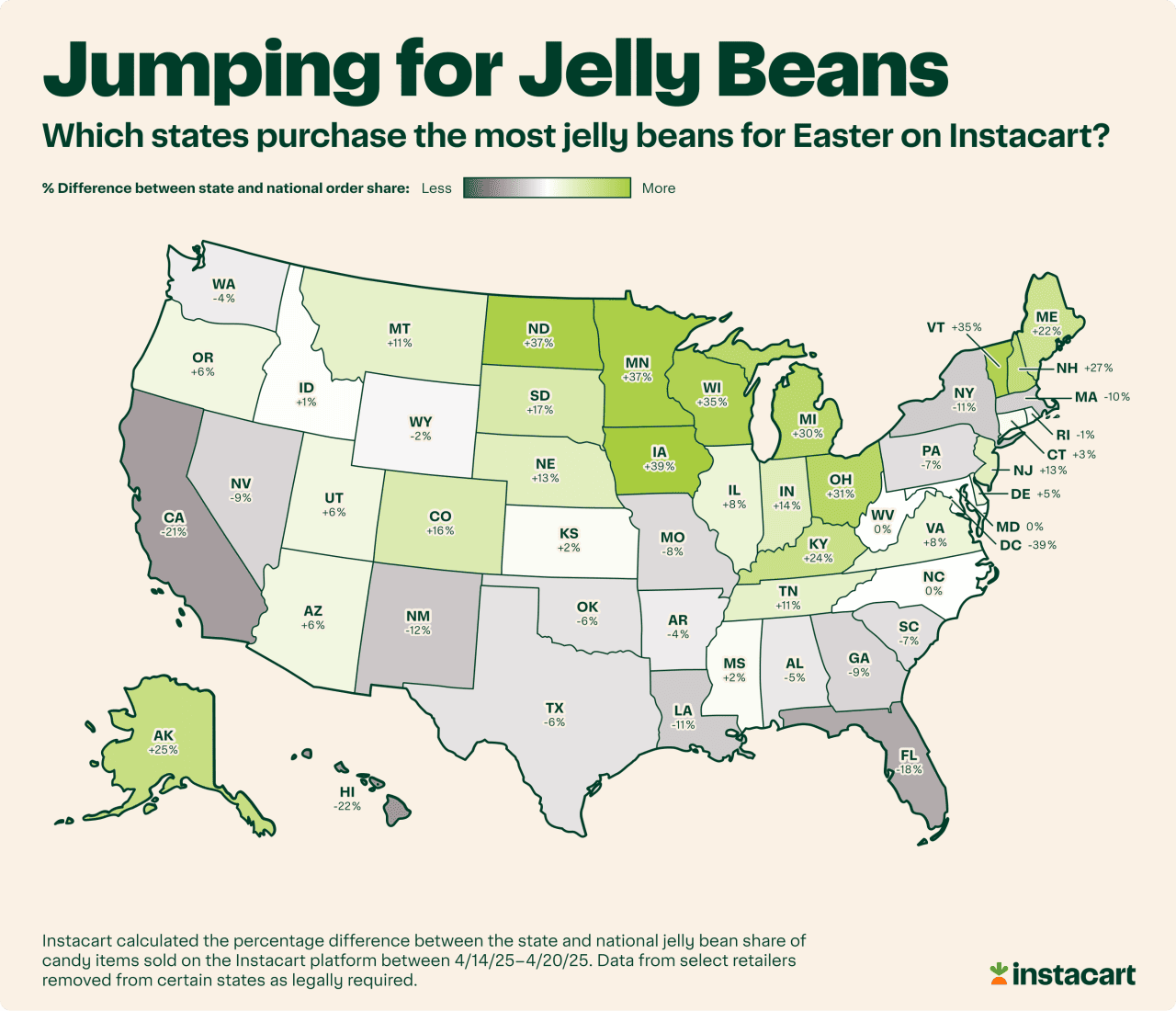
Jelly beans have their Easter moment. Jelly beans surged 863% above their yearly average during Easter week — one of the largest candy spikes of the season.
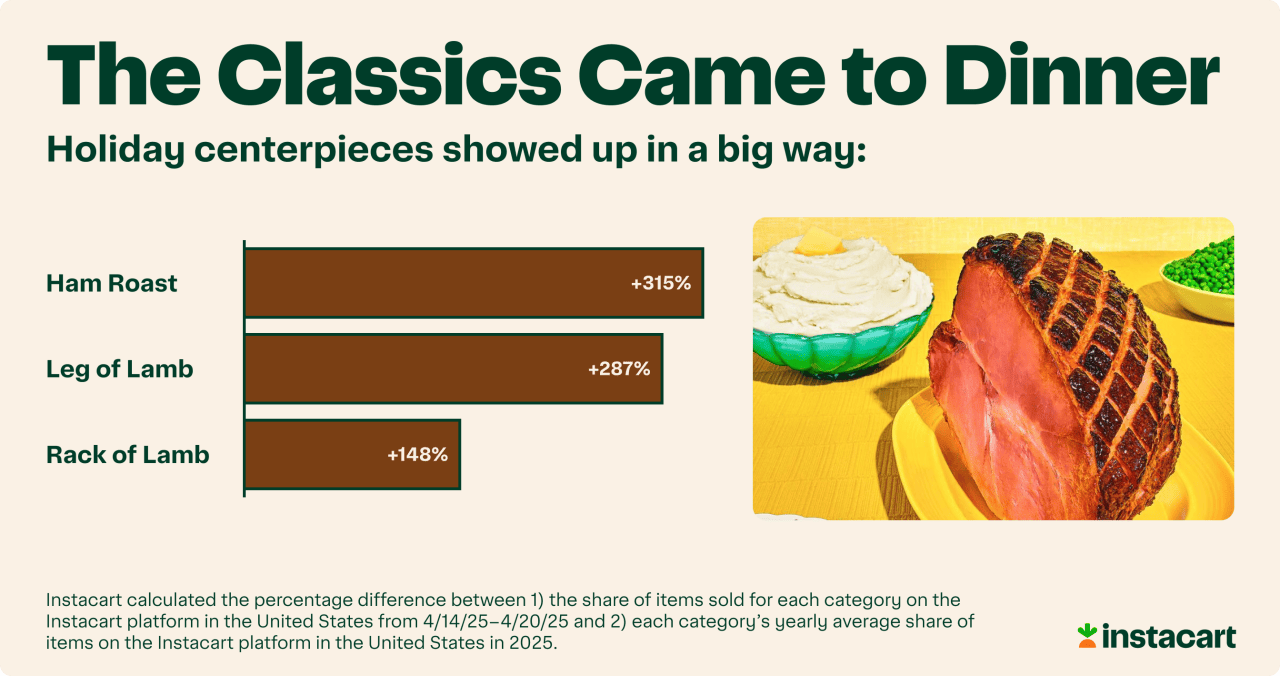
Easter weekend doubles as a spring reset. Gardening categories like soil (up 128%), mulch (133%), annual plants (157%), and fertilizer (124%) all saw significant lifts, showing that many people use the holiday as a launchpad for spring refresh projects.
Easter décor dominates the holiday surge. Easter décor, including items like Easter baskets, grass, and plastic eggs, skyrocketed 2,742% above its yearly average during Easter week, making it the single biggest seasonal spike.
Passover prep is rooted in tradition. In the week leading up to Passover, matzah jumped 1,239% above its yearly average, while gefilte fish (742%), and matzo ball mixes (673%) also surged.
Instacart
Easter Week: Candy, Lamb — and a Side of Mulch
During the seven-day period ending on Easter Sunday, several categories surged far beyond their typical share of sales throughout the year.
Easter dinner centerpieces had a major moment, alongside candy-filled baskets and playful toys. As families headed outdoors for egg hunts after a long winter, gardening supplies also surged, signaling the unofficial kickoff to green thumb season.
Instacart
Easter baskets went big
It’s good news for the kiddos. The spike in sidewalk chalk and bubble wands signals that backyard season has officially begun.
Instacart
The Top 10 Easter Candies in America
When it comes to Easter basket-building, one candy reigned supreme.
During Easter week, Reese’s Peanut Butter Eggs ranked as the top-selling Easter candy by item share for the fourth year in a row.
Chocolate clearly dominates carts, but the presence of Sour Patch Kids, Starburst Jelly Beans, and Nerds shows that sour and fruity favorites still hold their own.
Instacart
Reese’s Dominates — But Not Every State Agrees
Perhaps unsurprisingly, when we mapped the top-selling Easter candy by item share in each state, Reese’s Peanut Butter Eggs topped the charts in 38 states, including Washington, reinforcing its status as the undisputed MVP of Easter baskets.
However, 11 states (plus Washington, D.C.) opted for something else.
The Milk Chocolate Loyalists
States along both coasts as well as the Dakotas showed their love for Hershey’s Milk Chocolate as their top candy:
California
Connecticut
Delaware
Maryland
Nevada
New Jersey
North Carolina
North Dakota
South Dakota
The Bunny Believers
In Hawai’i and Maine, customers favored the seasonal classic Lindt Gold Bunny Milk Chocolate.
The Cup Crowd
And in Washington, D.C. and South Carolina, customers preferred Reese’s Peanut Butter Cups over the popular Easter egg-shaped version. Either way, it’s clear Reese’s peanut butter perfection is key for holiday enjoyment.
Where Jelly Beans and Chocolate Bunnies Shine
Beyond overall top candies, we also looked at how strongly certain Easter staples over-indexed in each state compared to the national average, and two classics stood out: jelly beans and chocolate bunnies.
Instacart
The Jelly Bean Belt
Jelly beans surged nationally during Easter week, up 863% above their yearly average, but some states embraced them even more enthusiastically.
Washington ordered 4% less jelly beans as a share of candy items compared to the national average, ranking as the #17 least among all states.
The biggest jelly bean fans were concentrated in the Midwest and Upper Plains:
Iowa (39% over national average)
North Dakota (37%)
Minnesota (37%)
Vermont (35%)
Wisconsin (35%)
Ohio (31%)
Michigan (30%)
In these states, jelly beans made up a significantly larger share of candy purchases than the national average, reinforcing their status as an Easter essential.
Meanwhile, states like California (21% below the national average), Hawai’i (22%), and D.C. (39%) purchased jelly beans at notably lower rates than the national average.
Instacart
Chocolate Bunny Strongholds
Chocolate bunnies also saw clear regional differences. Washington ordered 0% more chocolate bunnies as a share of candy items compared to the national average, ranking as the #28 most among all states. The biggest chocolate bunny enthusiasts included:
Hawai’i (68% above national average)
Vermont (55%)
Rhode Island (50%)
Maine (50%)
New Hampshire (31%)
In these states, chocolate bunnies made up a significantly higher share of candy purchases compared to the national average.
One of the more surprising findings was Hawai’i topping the country for chocolate bunny purchases. The state typically under-indexes on highly seasonal purchases, so seeing it lead on such an iconic Easter item really stands out. What makes the trend even more interesting is that Hawai’i ordered jelly beans less often than average — suggesting that in the Aloha State, chocolate bunnies are in and jelly beans are out.
On the other end of the spectrum, Utah (31% below the national average), D.C. (30%), and Nevada (25%) ordered chocolate bunnies the least often, showing that while bunnies may be iconic, they are not equally beloved everywhere.
Utah’s chocolate bunny demand also caught attention. The state is usually at the forefront of seasonal shopping trends, so its lower-than-average demand for chocolate bunnies is a notable departure. For a state that often embraces holiday moments, the inverse this year stands out.
Instacart
Passover Prep: Seder Staples Surge
Looking at the week leading up to Passover (April 7-13, 2025), traditional Seder essentials rose sharply compared to their typical yearly share with matzah (+1,239%), matzo ball mixes (+673%), gefilte fish (+742%), and horseradish root (+1,120%).
Purchases of these key Passover staples follow a sharply seasonal pattern, with their most significant surge of the year occurring in the week leading up to Passover. Compared to their typical baseline, demand for these items skyrockets during the holiday, far outpacing any other point in the calendar year. While smaller lifts appear again around Rosh Hashanah and Hanukkah, those increases are modest in comparison, underscoring Passover as the clear peak moment for these traditional foods.
Baskets, Blooms and Seder Tables Await
With both holidays fast approaching, customers are leaning into the traditions and seasonal favorites that define spring.
The glitz and glam of Hollywood captures the attention of Americans starting from an early age. Beyond celebrities’ Instagram Stories and red carpet poses, there are actors out there paying their dues and honing their craft in pursuit of a sustainable career or a fulfilling sideline. Submitting to casting calls is a big part of that journey.
Whether you’re a working actor or an aspiring one, you might be curious to know which movies and TV shows are casting roles near you. Backstage compiled a list of projects casting right now in Washington and nationwide, and which roles they’re looking to fill.
Grusho Anna // Shutterstock
‘Bilateral’
– Project type: short film – Roles: — Jacob (supporting, male, 20-30) — Abigail’s Dad’s Friend (background / extra, male, 40-65) – Roles pay up to: $200 – Casting locations: Olympia, WA; Tacoma, WA; Portland, OR – Learn more about the short film here
Media_Photos // Shutterstock
‘One-way Train’
– Project type: student film – Roles: — Elderly Arthur (lead, male, 50+) — Middle-Aged Arthur (supporting, male, 25-45) — Young Arthur (supporting, male, 8-12) – Roles pay up to: $400 – Casting locations: Seattle, WA; Tacoma, WA; Bellingham, WA; Kirkland, WA; Bothell, WA – Learn more about the student film here
guruXOX // Shutterstock
‘Villainy’
– Project type: student film – Roles: — John Evillmann AKA ‘Evil Man’ (lead, male, 18-35) – Roles pay up to: $800 – Casting locations: Seattle, WA; Tacoma, WA; Olympia, WA; Portland, OR – Learn more about the student film here
Dpongvit // Shutterstock
‘Open’
– Project type: feature film – Roles: — Ally (Alejandra) (supporting, female, 18-24) – Roles pay up to: $964 – Casting locations: Auburn, WA; Seattle, WA; Tacoma, WA; Aberdeen, WA; Kent, WA – Learn more about the feature film here
Gorodenkoff // Shutterstock
Untitled Coming of Age Feature Horror Film
– Project type: feature film – Roles: — Madison (lead, female, 18-33) — Katy (lead, female, 18-33) – Casting locations: Los Angeles, CA; San Jose, CA; San Francisco, CA; New Orleans, LA; Austin, TX – Learn more about the feature film here
muratart // Shutterstock
‘Mike Is The Worst’ Episode 2.5
– Project type: scripted show – Roles: — Blue Beattle (supporting, male, 18+) — Black Panther (lead, male, 18+) — Plumber 1 (lead, male, 18+) – Roles pay up to: $100 – Casting locations: Seattle, WA – Learn more about the scripted show here
Grusho Anna // Shutterstock
‘Project Redmond’
– Project type: student film – Roles: — Nathan (lead, male, 18-40) — Karina (lead, female, 18-50) – Casting locations: Redmond, WA; Seattle, WA – Learn more about the student film here
Tikkyshop // Shutterstock
‘Carson & Joshua’
– Project type: scripted show – Roles: — Pastor Fare (supporting, 45-65) — Rolan’s Crew (lead, male, 20-35) — Frank (supporting, male, 20-30) – Casting locations: Seattle, WA – Learn more about the scripted show here
Media_Photos // Shutterstock
‘A Wanderer’
– Project type: feature film – Roles: — Amber Di Marco (supporting, female, 25-40) — Pete Di Marco (supporting, male, 30-40) — Isabel (supporting, female, 18-25) – Roles pay up to: $1,250 – Casting locations: Seattle, WA – Learn more about the feature film here
KinoMasterskaya // Shutterstock
Coming of Age Horror Feature Film
– Project type: feature film – Roles: — Jay (lead, male, 18-33) — Hannah (lead, female, 18-33) – Casting locations: San Francisco, CA; Los Angeles, CA; San Jose, CA; Austin, TX; Houston, TX – Learn more about the feature film here
Gorodenkoff // Shutterstock
‘The Chambers’
– Project type: feature film – Roles: — Elijah (lead, male, 24-40) – Roles pay up to: $5,000 – Casting locations: nationwide – Learn more about the feature film here
Grusho Anna // Shutterstock
‘Autonomous’
– Project type: feature film – Roles: — Alistair Mallen (lead, male, 26-40) — Maggie Thomas (lead, female, 20-30) — Magda Jansen (supporting, female, 40-55) – Roles pay up to: $1,500 – Casting locations: nationwide – Learn more about the feature film here
Grusho Anna // Shutterstock
‘Taco Man’
– Project type: vertical series – Roles: — Tony (lead, male, 35-45) — Aurora (“Rori”) (lead, female, 18-22) – Roles pay up to: $1,000 – Casting locations: nationwide – Learn more about the vertical series here
Grusho Anna // Shutterstock
‘Painted with L.O.V.E.’
– Project type: feature film – Roles: — Lilly (lead, female, 22-30) — Patrick Jones (lead, 25-35) — Lois (supporting, female, 22-30) – Roles pay up to: $10,000 – Casting locations: nationwide – Learn more about the feature film here
Grusho Anna // Shutterstock
‘Adventskalendar’
– Project type: reality TV – Roles: — German Wrestler (day player, 18+) – Roles pay up to: $800 – Casting locations: nationwide – Learn more about the reality TV show here
(Trice Edney Wire) – Last Saturday, millions of Americans took to the streets under a simple banner: “No Kings.” More than 3,000 protests were organized across the country. Demonstrations filled not only the expected places—Washington, New York, Chicago—but also towns that rarely see political marches: Midland, Michigan; Casper, Wyoming; McMinnville and Tillamook, Oregon. In communities like these, residents gathered in parks and town squares carrying handmade signs and a message that sits at the heart of the American story.
This country does not have kings.
At first glance, the slogan sounds almost quaint, something lifted from a civics textbook. The United States fought a revolution to rid itself of monarchy, and the idea that one person should stand above the law is supposed to be foreign to the American political tradition.
But the people who gathered last Saturday were not simply protesting a personality or even a presidency. What they expressed was something deeper—a growing sense that the political system increasingly serves the powerful while ordinary Americans are told there is nothing left for them.
That contradiction is visible almost everywhere.
Congress can assemble $200 billion for war with remarkable speed, even as American troops once again find themselves with boots on the ground in an undeclared conflict, yet student borrowers are told that meaningful relief is unrealistic or unaffordable. Housing costs continue their relentless rise while wages struggle to keep pace. Millions of Americans carry student debt that will shape their financial futures for decades.
Even the people who keep the country’s basic systems operating often live with the greatest economic insecurity. Transportation Security Administration workers, the people who check our bags and scan our boarding passes, offer a telling example. During government shutdowns or political standoffs, these workers are often required to keep showing up for work even when their paychecks are delayed.
Eventually they receive their back pay. But back pay does not erase the damage done in the meantime.
Rent is still due on the first of the month. Credit card bills arrive on schedule. Utility companies expect payment whether Congress is functioning or not. When paychecks stop, many TSA workers must borrow from family, miss payments, or fall behind on bills. Late fees accumulate. Credit scores drop. The government may eventually restore their wages, but it cannot restore the late fees, damaged credit, or weeks of financial anxiety.
Seen in that light, the chant of “No Kings” carries meaning beyond constitutional symbolism. It reflects a concern that power in a democracy is supposed to flow upward from the people rather than downward from those who wield it.
One striking feature of last Saturday’s demonstrations was not just their size but their geography. Protests appeared not only in traditional centers of activism but also in smaller communities that rarely host large demonstrations. Residents assembled in Casper, Wyoming, a city in one of the nation’s most reliably Republican states. Demonstrators gathered in Midland, Michigan, a community where presidential elections often tilt conservative. In Oregon towns like McMinnville and Tillamook, people rallied far from Portland’s familiar protest culture.
That matters. When demonstrations appear in smaller towns and politically mixed communities, they often signal something larger than partisan disagreement. They suggest that frustration with the direction of the political system is spreading beyond the usual activist circles.
None of this guarantees policy change. Protest movements rarely produce legislative victories overnight. What they do reveal, however, is the mood of the country.
And the mood right now is uneasy.
Americans are watching enormous sums flow toward military conflict even as economic pressures mount at home. Housing prices strain household budgets, student debt continues to shadow younger generations, and workers performing essential public roles—from airport security to public transit—often live paycheck to paycheck while keeping critical systems running.
Under those circumstances, people inevitably begin to ask whom the system ultimately serves. When government appears able to mobilize vast resources for some priorities while struggling to address the economic burdens facing ordinary citizens, the distance between democratic ideals and everyday experience becomes difficult to ignore.
The United States rejected monarchy in 1776.
Last Saturday, in thousands of towns and cities across the country, Americans gathered to remind the nation of a principle that still defines democracy.