By Aaron Allen
The Seattle Medium
Seattle Central College kicked off a year-long celebration, honoring 50 years of education, civil service and playing a pivotal role in shaping the Central District and Capital Hill communities and the city at large.
The school is contrasted by two distinctly different architectural structures. The main building that houses most of the courses and administration and the Broadway Performance Hall, a vintage early 20th century edifice standing in its grandeur.
To recognize the important and unique history of social activism and education at Seattle Central, the school held a week’s worth of special celebrations featuring a march on campus, a ceremonious re-opening of Seattle Central College for the next 50 years with a ribbon cutting ceremony, and a host of other activities.
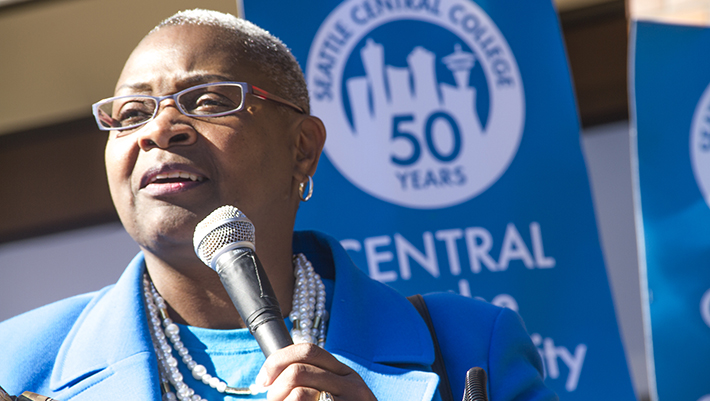
Last Thursday, Seattle Central President Sheila Edwards Lange led a collage of administrators, students, alumni and people from the community down Broadway commemorating Seattle Centrals achievements.
The sun was out, the booths were plentiful with information, the mood was festive and the people were in good spirits as the college and its staff showed their enthusiasm about the role it has played in the education of Seattle’s citizens.
Seattle Central’s roots are very diverse. Its beginnings stem from the 1890s as Seattle encountered a population boom. Broadway High School, which is now Seattle Central’s Broadway Performance Hall, was established during this time. The college’s main building was forged out of the Civil Rights era, in 1966, to address the educational, communal and broader movements of a growing and diverse community from the Central Area and Capital Hill.
Through the turbulent time of the 60s, Seattle Central found its identity through the schools long standing commitment to providing quality education to all who seek it.
During this period of time, different ethnic cultures placed their imprints in the building of the dynamics of this institution. For example, members of the Black Panther Party fought to make sure that the school was a full scale college that would serve the needs of the community.
“Initially we [Seattle Central] were gonna serve the Central District with vocational programs,” said Edwards Lange of the school’s beginnings. “[But] Black Panther members and leaders spoke up and said, ‘no, we want a real college that’s going to serve our community, not just vocational programs.’”
Even in the construction of the college, minorities were very instrumental in the decision-making process as minority leaders stressed the importance of the involvement of minority contractors and workers in the project.
“As the campus was being built, Tyree Scott and others came forward and said well you know what, if you’re going to build a campus to serve our community then you need to make sure that the people who are building it reflect our community,” said Edwards Lange.
In 1995, although possessing their own campuses Seattle Vocational Institute (SVI) became an integral part of the Seattle Central family as well as two satellite programs Wood Technology Center and Seattle Maritime Academy.
Today, the college enrolls 16,336 students, has 7 College Transfer Associate Degree programs, 22 Professional-Technical Associate Degree programs, 16 Certificate programs, and 2 Bachelor Degree programs.
The school plans to host a series of celebratory events to throughout the school year to commemorate its 50th anniversary. For more information on future celebrations, visit www.50years.seattlecentral.edu.