By Aaron Allen, The Seattle Medium
Seattle leaders and high-ranking Ghanaian officials gathered this week to strengthen economic ties between the Pacific Northwest and West Africa, signaling a shift from cultural connection to long-term investment and business collaboration.
The meeting, held in Seattle, brought together members of the Ghanaian diaspora, local organizations and diplomatic leadership to explore how the region can serve as a gateway for U.S. companies looking to engage with one of Africa’s most stable and rapidly growing economies.
Dr. Francis Abu Bila, president of the Ghana Association of Greater Seattle, said the region’s Ghanaian community is uniquely positioned to help bridge that connection.
“This event is very important for us because we as a diaspora group are looking for opportunities to connect the Pacific Northwest and Seattle in particular to Ghana,” said Abu Bila. “Ghana is one of the most stable economies in Africa and will serve as a gateway for investment, opportunities, tech, and other businesses that want to get into the African continent.”
Abu Bila said the growing diaspora, which spans from Vancouver, Washington, to Spokane, plays a critical role in linking local industries with emerging markets abroad. With a young and expanding population, Africa represents a significant opportunity for future economic growth, making Ghana an entry point for companies seeking to build a presence on the continent.
The message from Ghana’s leadership was clear: the focus is shifting away from aid and toward partnership.
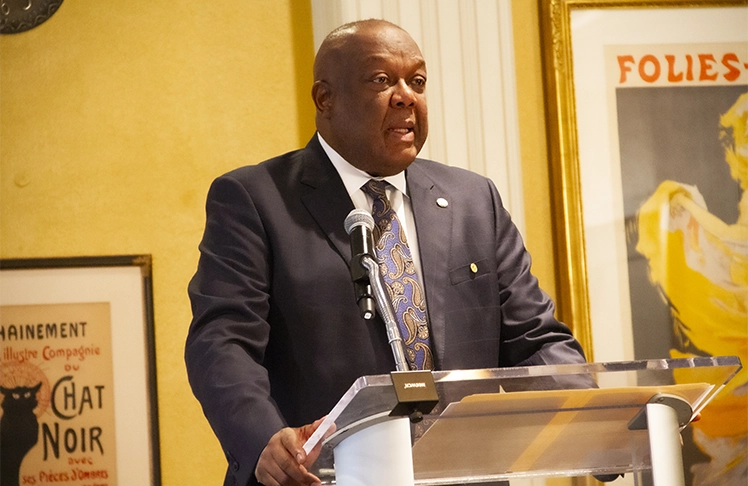
Ghana’s Ambassador to the United States, Victor Emmanuel Smith, outlined that vision in a keynote address, emphasizing trade, investment and shared economic growth as the foundation for future collaboration.
“The message I gave is to look for partnerships… to invest in Ghana,” said Smith. “We share in the belief that trade and investment, not aid, are what drive job creation, industrialization, innovation, and technology transfer.”
Smith pointed to several sectors where Seattle’s expertise could align with Ghana’s development goals, including the digital economy, agribusiness and health care infrastructure. He highlighted opportunities to connect the region’s technology sector with Ghana’s growing fintech and digital services landscape, as well as collaboration in telemedicine and agricultural processing.
At the same time, Smith issued a direct call to action to members of the diaspora, urging professionals to take an active role in shaping Ghana’s economic future.
“We have been talking to our brethren in the diaspora for so many years… we are trying to excite them about the opportunities, so they come and help us build our country,” said Smith. “Our country has potential—oil, gold, cocoa—we can build our country in a better way than we are doing at the moment.”
For many in attendance, the connection between Seattle and Ghana extends beyond business. It is rooted in shared identity and a growing effort to translate cultural ties into economic opportunity.
Michelle Merriweather, representing the Urban League of Metropolitan Seattle and the Black Teacher Co-op, described how that connection has evolved in recent years. Over the past three years, her organization has taken 70 Black leaders from Washington state to Ghana to build relationships and deepen understanding of the diaspora.
“We’re building bridges across the diaspora that build economic wealth,” said Merriweather. “Yes, we want to go for leisure, for vacation, for exploration, learning our ancestry. But now we’re building bridges… it’s an honor to be a part of this discussion and furthering that connection to the diaspora and to the continent.”
The gathering reflects a broader shift in how diaspora communities are approaching international engagement, moving from symbolic connection to structured economic collaboration.
With the African Continental Free Trade Area opening access to a market of more than 1.3 billion people, leaders said partnerships between cities like Seattle and countries like Ghana are increasingly positioned to play a role in global trade.
“The future of Ghana’s economy will not be built by government alone,” said Smith. “Together, we can unlock new opportunities, create sustainable wealth, and build a prosperous future that benefits us all.”