By Aaron Allen, The Seattle Medium
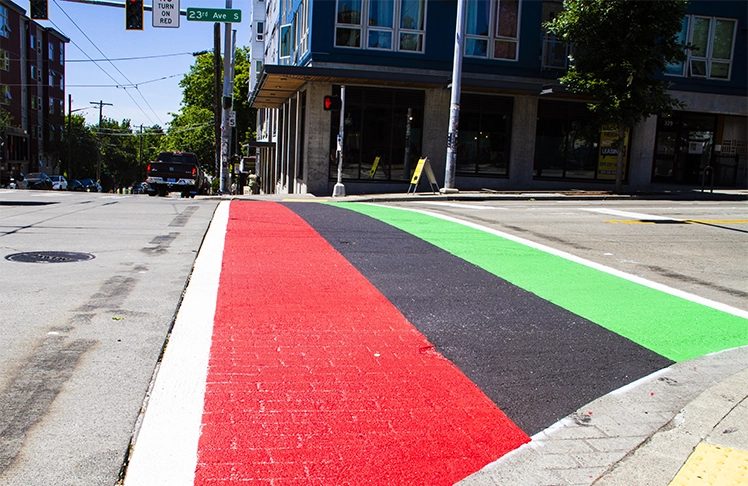
After markings indicating removal work appeared on several of the Central District’s historic Pan-African flag crosswalks, some community members expressed concern that the cultural landmarks were being eliminated. City officials say the markings were part of a restoration project designed to preserve and renew the crosswalks, not remove them.
The Seattle Department of Transportation (SDOT) is restoring 11 of the neighborhood’s iconic red, black and green crosswalks, which were originally created by community members and later adopted by the city as symbols of Black heritage, identity and resilience in Seattle’s historically Black neighborhood.
Funded through the Levy to Move Seattle, the project includes pressure washing, pavement repairs and repainting work intended to improve the visibility, safety and longevity of the crosswalks while preserving their original design.
For Wyking Garrett, president and CEO of the Africatown Community Land Trust, the restoration represents more than routine maintenance.
The crosswalks were born out of a community effort to preserve and celebrate the Central District’s Black identity amid rapid gentrification and displacement.
“Our community was being completely erased,” said Garrett, recalling the origins of the project in 2015. “It was on a trajectory to be as if we were never here. And I think it should never be as if we were never here.”
After noticing other Seattle neighborhoods receiving public recognition through murals and street art, Garrett issued a call to action. Community members responded by painting the original crosswalks themselves before the city eventually embraced the project and incorporated it into the public landscape.
“The idea wasn’t just to put it down for mere symbolism, but to really project the substance that we wanted,” said Garrett. “The real idea is that we want Black people and Black businesses to continue to be on the streets that they have been on for generations.”
Over time, weather and daily traffic took a toll on the crosswalks, causing portions of the paint to fade and deteriorate. As restoration work began and some markings were temporarily removed, residents expressed concern that another visible symbol of Black presence in the neighborhood was disappearing.
“They were getting worn, and I think people saw really, the alarm went up that they were again taking away another representation of us in the community,” said Garrett. “To know that they’re being restored and renewed, let that be a symbol of the renewal and restoration that really Africatown exists to help bring forth.”
According to Dahvee Enciso, SDOT’s decorative marking crew coordinator and senior civil engineer specialist, the restoration effort followed months of collaboration between city officials, the Black Heritage Society of Washington State, the CD Art Association and other community stakeholders.
“Through just a few months, we were able to get some funding and also SDOT was a big push to pull this together and get it all restored and pressure washed and cleaned up in time for the games and for the summer for the Central District to enjoy,” said Enciso.
The timing coincides with Seattle’s preparations to welcome visitors from around the world for the 2026 FIFA World Cup. Garrett said the restored crosswalks can serve not only as cultural landmarks but also as gateways that encourage visitors to explore the neighborhood and support local businesses.
“We know there’s potentially hundreds of thousands of people that are gonna be in the city with the World Cup and other tourists coming up,” said Garrett. “Hopefully, the crosswalks can help them find their way to supporting Black businesses.”
Enciso said decorative crosswalks differ from standard traffic markings because they often depend on community engagement to help identify maintenance needs. Residents can report faded or damaged markings through Seattle’s Find It, Fix It app, online reporting tools or by calling 206-684-ROAD.
For Enciso, projects like the Pan-African crosswalks carry meaning beyond traditional infrastructure work.
“Not many people can say they love their job. I’m probably one of the very few that can say that,” said Enciso. “One of the passions and loves of this job that I have is to work with underserved communities, and I get to learn a lot of different cultures. We’re able to bring an identity to the neighborhood by installing beautiful works of art that are sentimental, that mean something to the community.”
Restoration work is scheduled to be completed by June 14. While some locations require only pressure washing and minor repairs, others are receiving a full repainting using liquid thermoplastic materials designed to improve durability.
The primary restoration locations include:
• E Yesler Way and 14th Avenue
• E Yesler Way and 20th Avenue
• 23rd Avenue and S Jackson Street
• Martin Luther King Jr. Way South and S Alder Street
• E Cherry Street between 24th and 25th avenues
• S Jackson Street between 20th Place South and 22nd Avenue South
• Jefferson Street and 23rd Avenue
For Garrett, however, the restoration’s significance extends beyond the paint itself.
“It’s a crosswalk, and we need the structures also to help us get to the other side and get to the future,” said Garrett. “We always want to put substance with the symbols. The symbols are positive, but they’re shallow without the substance.”
Since the crosswalks were first installed, Garrett said the community has worked to ensure that physical investments accompany cultural recognition.
“Since the crosswalks went down, we’ve had buildings go up, and those buildings have visible recognition of the journey of Black people,” said Garrett. “We want to make sure that we don’t just turn into symbols, plaques, and murals, but that there are also Black people, Black institutions, and Black homeowners still in this community.”