By Kiara Doyal, The Seattle Medium
Jenefeness Franke remembers standing on a golf course wondering whether she belonged there. She worried about playing fast enough, knowing the rules and whether the people around her were judging her swing.
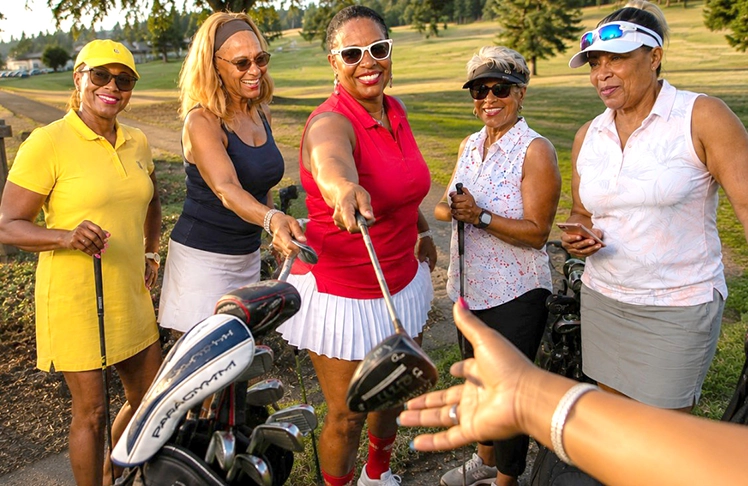
Those experiences eventually led Franke to create Soft Life Swing Society, a Washington-based golf community designed to give women, particularly Black women and other women of color, a more welcoming way into the game.
“I didn’t think this was for us. But once we get out there and we get that exposure and access to it, it’s like, no, this is for us,” said Franke. “This is Black girl magic. This is joy out here, and this is a part of where we should be and that to me is important.”
For Marquita Evans, who found golf through Soft Life Swing Society, that initial uncertainty was familiar.
“Everything about it was intimidating, even just showing up. What to wear actually was probably the easiest thing because the golf outfits are a little more cute, but how to hold a club and the rules were intimidating,” said Evans. “Getting out there was scary, because there’s people before you and behind you. What does this look like? And so, I think everything about it was intimidating.”
Since Franke began creating golf opportunities for women of color in 2019, 186 women have registered with Soft Life. According to the organization’s registration figures, about 97% entered as complete beginners who had never handled a golf club. For Franke, those numbers illustrate how many women remain outside of golf, not because they tried the sport and left, but because they never saw themselves as part of it in the first place.
“Sometimes I look around at our women, and I think about the fact that almost every one of them was sitting somewhere outside of golf before this. There aren’t women who stopped playing. I mean, we had one lady that just moved here from LA this past week, and she’s been here for five years and has never taken her clubs out. She was just like, I haven’t been motivated,” said Franke. “Then she saw a post that we put on Facebook, and she came out. She had a ball. She was like, it was like riding a bike.”
In November 2019, Franke partnered with Fir State Golf Club to offer free opportunities for women of color to experience golf. At the time, she was learning alongside the women she hoped to introduce to the game, taking lessons, competing in tournaments and improving her own skills. But becoming a better golfer did not erase the feeling that some golf environments were not made with beginners like her in mind.
“I don’t think I initially thought I’m going to create a different entry point into golf. I was trying to just figure out how to belong there myself. I would show up to play with men and sometimes even other women, and I constantly felt like I was being evaluated, I was being judged, I was being criticized even,” said Franke. “And I thought to myself, Am I playing fast enough? Am I hitting? Am I hitting the ball well enough? Do I know the rules? Am I holding these folks up?”
After one round, another golfer handed Franke three golf balls because she had lost so many during the game. The gesture may have been intended to help, but Franke said it reinforced how closely she felt her mistakes were being watched.
“I didn’t need somebody else telling me that or keeping inventory of my lost balls. But those little experiences matter to me because beginners are deciding every time if they want to come out,” said Franke. “And I started realizing that women didn’t necessarily need an easier version of golf. We need a kinder entry into golf.”
That realization became the foundation for Soft Life Swing Society. Franke wanted women to have room to learn the game without feeling they had to master it before they could belong.
For Evans, that has meant learning one part of the game at a time instead of feeling pressure to understand everything immediately.
“I feel like each time we go out, we’re learning something else instead of feeling like you are expected to know everything off the jump,” said Evans. “The first lesson, we might be learning how to hold your club or what to call each putt. You’re learning terminology, then you’re learning how to score, so it wasn’t everything compacted in one.”
That gradual approach has also changed how Evans thinks about mistakes, both on and off the course.
“I feel like it’s kind of helped transpire into real life outside of the golf course. In the sense that your best can also be your next worst. If we’re doing a Williams nine, you have nine holes,” said Evans. “The first one can be amazing. The second one can suck. The next one could be great. The next one can suck. You just really don’t have control of that, and that is like real life.”
Franke said finding other women of color also changed her own experience with golf, giving her room to relax and enjoy the game without feeling she needed to change herself to fit into golf culture.
“I didn’t have to explain myself. I could relax. I could have fun and enjoy myself,” said Franke. “And my game actually got better. And so that’s why representation matters to me because I can be myself. I don’t have to shrink. I don’t have to be all bottled up.”
Evans experienced that sense of belonging during a round that began with frustration and ended with one of her most memorable moments in golf. One week, it took her nine strokes to complete a hole after she had been playing well. The following week, she sank a long putt for a birdie.
“It was amazing. It was like I was a kid again,” said Evans. “So, it brought that childlike joy, and I feel like it may have been before that I knew I could do this, but in that moment, it’s like this is what I want to keep doing. We were out there slapping fives, celebrating. We were jumping for joy together.”
Over time, Evans’ relationship with the game became more tangible. She bought her own clubs, a golf cart and other equipment and continued returning to the course.
For Franke, that return is a more meaningful measure of success than simply getting someone to try golf once. She believes the future of women’s golf depends not only on attracting women to the game, but creating an environment that gives them reasons to stay.
“I think women are asking, ‘Do you just want our dollars, or do you actually want us here?’” said Franke. “Because if you want us here, then it should be about creating access, which is an investment into women in golf. Putting clubs into the women’s hands, giving beginners opportunities to learn, and supporting the organizations that are already creating these communities.”