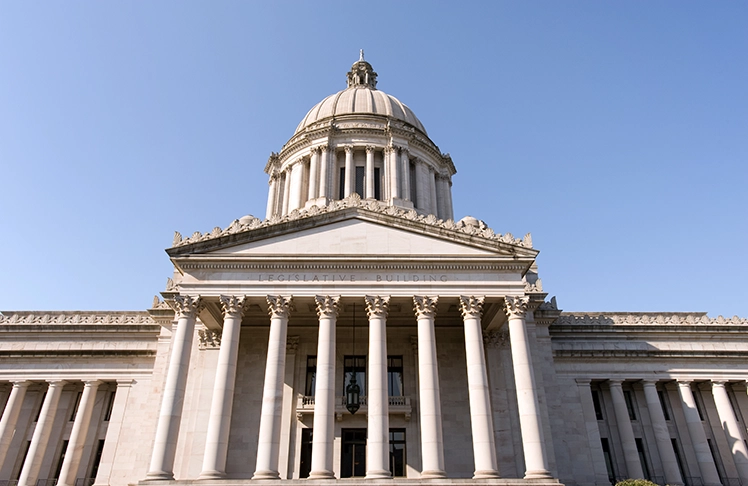
The Washington Senate has approved a proposal to impose a 9.9% tax on individual income above $1 million, marking the state’s most direct attempt in decades to establish a broad-based tax on high earners.
Senate Bill 6346 passed Feb. 16 on a 27-22 vote and now heads to the House of Representatives for further consideration . If enacted, the tax would take effect Jan. 1, 2028, with the first payments due in 2029 .
Supporters say the measure would generate roughly $3.7 billion annually beginning in fiscal year 2029 to fund public schools, health care, public defense and tax relief programs . Opponents argue it amounts to a statewide income tax in a state that has long prohibited one and could pave the way for broader taxation in the future.
The proposal now moves to the House Finance Committee, where a public hearing is scheduled for Feb. 24, followed by an executive session Feb. 27.
How the Tax Would Work
Beginning in 2028, individuals would pay a 9.9% tax on Washington taxable income exceeding $1 million .
The calculation starts with federal adjusted gross income, or AGI, which includes wages, business income and investment earnings, and applies state-specific modifications to determine what the bill calls “Washington base income” .
From that amount, taxpayers could claim a $1 million standard deduction per individual. Married couples or registered domestic partners would be limited to a combined $1 million deduction, regardless of filing status .
In practice, only income above $1 million would be taxed. A household earning $1,000,500 would owe tax on $500, roughly $50 at the 9.9% rate .
The bill also allows up to $100,000 in charitable deductions per individual, capped at $100,000 for couples . The $1 million standard deduction would be adjusted annually for inflation beginning in 2030 .
To avoid double taxation, the proposal includes credits for income taxes paid to other states, Washington’s capital gains tax and certain business and occupation taxes paid on the same income .
Who Would Pay
According to the Washington State Budget and Policy Center, about 20,000 households, less than 1% of state residents, would pay the tax . More than 99% of Washingtonians would not be affected, the organization says .
For Washington residents, all income would be allocated to the state. Nonresidents would pay tax only on income derived from Washington sources, such as wages earned in the state or business activity conducted here . Compensation for nonresident employees would be apportioned based on the number of days worked in Washington .
The bill also establishes sourcing rules for professional and student athletes using a “duty day” formula to determine what portion of compensation is taxable in Washington .
Revenue and Spending
Seven percent of revenue would be deposited into a new local government public defense funding stabilization account to support city and county public defense services .
The remainder would flow into the state general fund , where supporters say it would strengthen long-term funding for K-12 education, health care, higher education and other essential services.
The bill also includes several tax relief measures:
• Expands eligibility for the Working Families Tax Credit to individuals age 18 and older who meet other requirements, beginning in 2028 .
• Increases the small business B&O tax credit and raises the filing threshold to $250,000 .
• Creates a sales and use tax exemption for grooming and hygiene products .
• Expires a surcharge on businesses with more than $250 million in Washington taxable income one year earlier than scheduled .
Supporters argue the measure would make Washington’s tax system less regressive by shifting more responsibility to higher-income households .
Legal Context
Washington does not have a broad-based personal income tax. In 2024, lawmakers enacted Initiative 2111, which prohibits state and local governments from imposing a tax on personal income .
The bill would exempt the proposed tax from that statutory prohibition .
State courts have historically treated income as property under the Washington Constitution, which requires uniform taxation of property and limits tax rates. Supporters have structured the proposal as a tax on the “receipt” of income, similar to the state’s capital gains tax, which survived a Washington Supreme Court challenge in 2023.
Legal challenges are widely expected if the measure becomes law.
Public Reaction and Political Debate
Supporters describe the bill as a necessary structural reform.
“Today was a momentous step forward,” said Senate Majority Leader Jamie Pedersen, D-Seattle. “For Washington’s 1.1 million school kids, people struggling to afford health care, and small businesses looking for help, that help is on the way.”
Republicans have framed the proposal as an unconstitutional income tax and launched a campaign urging residents to oppose it through the legislative website.
More than 100,000 people signed in to oppose the bill ahead of its House committee hearing, according to Senate Republicans. Earlier this month, nearly 62,000 signed in “con” before its Senate budget hearing.
“I thank everyone who has responded to our call to sign in CON on the income tax,” said Senate Republican Leader John Braun, R-Centralia. “History is being made. We are impressed but not surprised by the opposition to this bill.”
“As people are learning more about it, their anger is growing. They are realizing that it’s not really a tax on high earners and they want to be part of the effort to defeat a state income tax just as Washington voters have already done eleven times. The only question is: ‘Will Democrats listen?’”
Braun also criticized the structure of the $1 million deduction.
“The claim that it only targets high earners is disingenuous,” Braun said. “The tax actually applies to everyone but contains a temporary deduction for people earning less than $1 million a year. All the majority will have to do to expand this tax is simply amend it later. Rejecting our amendment makes that possible.”
Democrats rejected several Republican amendments during Senate debate.
Impact on Businesses
Although the tax applies to individuals, business owners who report income on personal returns could be affected if household earnings exceed $1 million.
The bill increases the small business B&O credit and raises the filing threshold .
Pass-through entities such as partnerships and limited liability companies may elect to pay the tax at the entity level. Owners would receive a credit for taxes paid by the entity, and any related tax expense deducted federally would be added back into Washington taxable income .
What Happens Next
The bill was introduced Feb. 4, advanced through the Senate Ways & Means Committee and passed on third reading Feb. 16.
The House Finance Committee is scheduled to hold a public hearing Feb. 24 and an executive session Feb. 27.
If approved by the House and signed by the governor, the tax would take effect in 2028. Individuals with more than $5,000 in annual liability would be required to make estimated payments .