By The Seattle Medium
Washington Attorney General Nick Brown and Secretary of State Steve Hobbs are challenging a new U.S. Postal Service rule that could significantly alter Washington’s vote-by-mail system just weeks before the 2026 midterm election, arguing that the federal government is overstepping its authority and putting eligible voters at risk of not receiving their ballots.
Brown is co-leading a coalition of 25 states in a lawsuit seeking to block the rule, which requires states to provide USPS with information on voters eligible to receive ballots by mail, comply with new ballot-envelope standards and obtain USPS review of envelope designs. Under the rule, USPS could decline to deliver outbound ballots that do not meet the new requirements. The lawsuit argues that USPS lacks constitutional and statutory authority to regulate state mail-voting programs.
“The Constitution is clear: states control elections, not the president,” Brown said. “The U.S. Postal Service doesn’t have the authority to deny Washingtonians the ability to vote. We will protect the rule of law.”
The challenge carries particular significance in Washington, where voting is conducted primarily by mail. State law requires ballots to be mailed to active registered voters, who may return them through USPS or secure ballot drop boxes. Election officials verify the signature on a returned ballot against the voter’s registration record before accepting it. In the 2024 general election, nearly 4 million Washingtonians, or 98.5% of those who voted, cast ballots by mail, according to data cited in the lawsuit.
The new rule stems from a March 31 executive order from President Donald Trump directing USPS to develop regulations requiring states to submit lists of voters eligible to vote by mail and meet new ballot-envelope design and tracking standards.
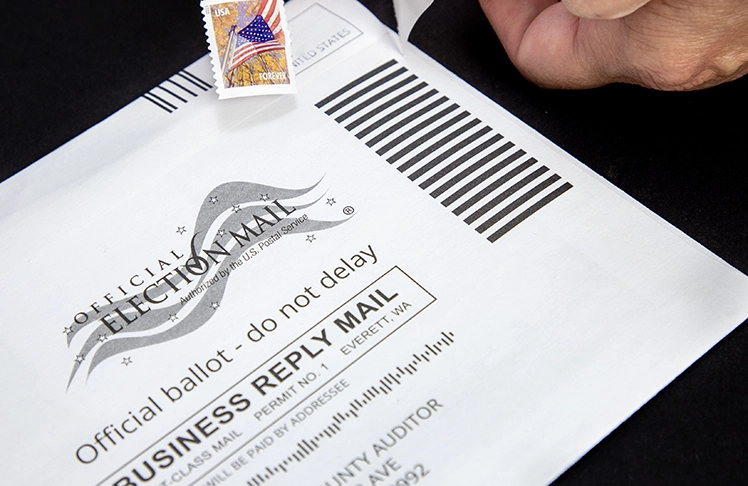
The final USPS rule, published Aug. 26, requires states to enroll eligible mail voters through a federal ballot mail portal and assigns unique Intelligent Mail barcodes to outgoing and return ballot envelopes. State and local election officials also must submit ballot-envelope designs for USPS review before voter information can be uploaded to the portal.
According to the lawsuit, USPS would not deliver outbound ballots to voters who are missing from the agency’s state-specific lists or ballots sent in envelopes that do not comply with the new standards. The states contend those requirements could prevent otherwise eligible and properly registered voters from receiving ballots.
Washington election officials say complying with the requirements so close to the November election would create substantial logistical and financial challenges.
“Instead of focusing our attention on preparing for the upcoming midterms, we are being forced to spend valuable time and resources defending our constitutional right to administer its own elections,” Hobbs said. “I appreciate Attorney General Brown’s partnership in standing with us to protect our authority and defend Washington’s free and fair elections.”
According to Hobbs’ office, Washington counties could be required to destroy and replace more than 5 million ballot envelopes that have already been printed for the November general election.
Election officials would also have to submit information for more than 5 million voters through the USPS portal, including each voter’s name, mailing address and the unique Intelligent Mail barcode associated with outgoing and return ballot envelopes.
The Secretary of State’s Office estimates that validating ballot envelopes at a post office, at the rate contemplated by USPS, could amount to more than 9.5 years of processing time for the more than 5 million Washington voters expected to receive ballots.
The states’ complaint describes broader burdens across the country. Election offices could have to purchase equipment capable of applying the required barcodes, order replacement envelopes, submit outgoing and return envelopes for USPS review, enroll voters in the federal portal, retrain employees and continually update voter information as registrations change. The lawsuit notes that many jurisdictions have already purchased envelopes for November, meaning replacement requirements could effectively double their budgeted envelope costs.
“Right now, our focus should be on delivering a secure, accessible and accurate election for citizens,” Hobbs said. “Instead, we are fighting the federal government who is trying to turn our safe and secure election system upside down for no benefit.”
The legal dispute follows an earlier challenge to Trump’s executive order. A federal district court previously blocked provisions directing USPS to establish the mail-ballot system, finding that USPS had not been given authority by Congress to control mail-in voting. The U.S. Supreme Court stayed that injunction on Aug. 24, concluding that the states lacked standing at that stage because USPS had not yet implemented the executive order through a final rule. According to the complaint, the Supreme Court said states could challenge a final USPS rule if it caused them harm. USPS published the final rule two days later.
The new lawsuit directly challenges that final rule.
Brown and the other attorneys general argue that the rule infringes on authority the Constitution gives states to administer elections, exceeds USPS’ statutory authority, violates the Privacy Act and conflicts with federal voting rights law. They also contend USPS failed to follow legally required procedures before implementing a nationwide change in postal services.
One of the coalition’s concerns involves the voter information states would be required to provide USPS. The complaint argues that collecting and maintaining information about voter registration and participation in mail voting violates provisions of the Privacy Act. That is an allegation in the lawsuit and has not been resolved by the court.
The states also argue that USPS cannot independently impose additional requirements determining whether an eligible voter receives a mail ballot. Their complaint says states have constitutional authority to establish and administer mail-voting programs, subject to federal election laws enacted by Congress.
The coalition is asking the court to block implementation of the rule while the case proceeds and ultimately declare it unlawful.
The timing is central to the states’ case. Election officials are preparing for the Nov. 3 midterms while voter registration and ballot information continue to change. The complaint argues that the new requirements could force election offices to simultaneously overhaul their systems, train workers, educate voters and prepare for an increase in people choosing to vote in person because of uncertainty surrounding mailed ballots.
“There is no reason to do this. Voter fraud is exceedingly rare and does not impact the outcomes of our elections,” Hobbs said. “No matter how many times the federal government repeats the lie, it does not make it true.”
The lawsuit does not ask the court to determine the overall merits or security of voting by mail. Rather, the central legal question is whether USPS has the authority to impose its new requirements on state election systems and refuse to deliver outbound ballots that fail to comply.
Brown is co-leading the lawsuit with the attorneys general of California, Massachusetts and Nevada.
For Washington, where virtually every voter receives a ballot by mail, the outcome could determine whether election officials must make substantial changes to a system the state has used for years, and whether those changes will take effect in time for this fall’s election.