By Aaron Allen, The Seattle Medium
Seattle Mayor Katie Wilson recently signed an executive order aimed at speeding up residential permitting and housing construction by creating an interdepartmental permitting team, proposing an affordable housing ombuds position and establishing a task force to recommend additional changes to the city’s housing policies.
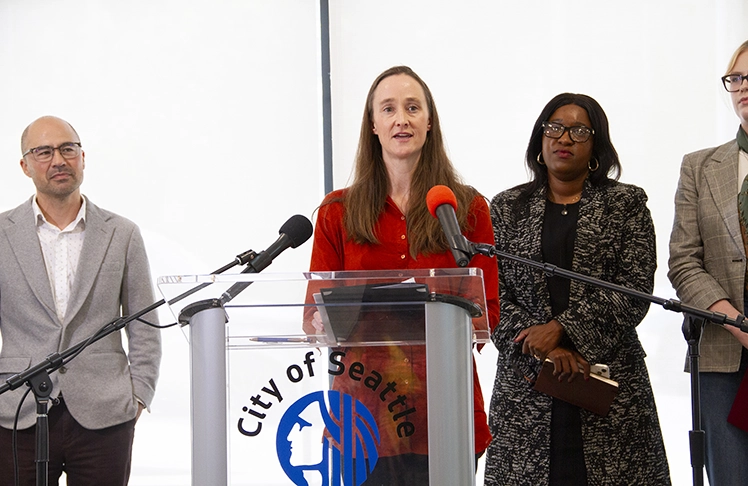
Wilson announced the executive order at El Centro de la Raza’s Four Amigos development, framing faster permitting and increased housing production as part of the city’s response to high housing costs that continue to put pressure on working families and longtime residents.
“To keep building this city we need abundant housing of all kinds,” said Wilson. “So, the size of your paycheck doesn’t determine your zip code, your access to healthy air, or the safety of your streets.”
The executive order calls for an interdepartmental residential permitting team involving the Seattle Department of Construction and Inspections, Seattle Department of Transportation, Seattle Public Utilities, Seattle City Light and Seattle Fire Department. The team is intended to coordinate reviews across departments and reduce delays as housing projects move through the city’s permitting process.
Unlike some of the longer-term initiatives announced by Wilson, the permitting team is expected to begin its work immediately.
The administration also plans to propose funding in the city’s 2027-28 budget for an affordable housing ombuds position within the Seattle Department of Construction and Inspections. The position would serve as a point of contact for nonprofit and community-led housing developers navigating city reviews, with designated contacts at other departments helping resolve issues that cross agency lines.
A third component of the executive order establishes a Housing Production Task Force that will bring together labor representatives, nonprofit and market-rate housing developers, community organizations and other stakeholders to recommend broader housing policy changes.
The task force is expected to examine issues including zoning reform, the city’s Mandatory Housing Affordability program, permanent supportive housing preservation, anti-displacement strategies and other regulatory changes affecting housing production.
Initial recommendations are expected in February 2027, with a final report scheduled for September 2027.
During a question-and-answer session, Wilson was asked whether waiting until 2027 for the task force’s recommendations was fast enough given the urgency of Seattle’s housing affordability challenges.
Wilson said the city will not wait for the final report to begin making changes. The task force is expected to make recommendations on a rolling basis, beginning with early action items in February, while the interdepartmental permitting team begins working immediately.
The administration also used the location of the announcement to connect its housing push to Seattle’s history of community organizing around housing, displacement and economic opportunity.
Four Amigos is an El Centro de la Raza development named in honor of four longtime Seattle civil rights and community leaders: Bernie Whitebear, Bob Santos, Roberto Maestas and Larry Gossett, collectively known as the Gang of Four. The four leaders worked across racial and ethnic communities on issues including housing, civil rights and economic opportunity for Black, Indigenous, Asian American and Latino residents.
“Four Amigos is one of the many jewels across our city that shows what is possible when we listen to communities,” said Wilson.
The administration’s emphasis on permitting comes amid concerns that lengthy reviews involving multiple city departments can increase development costs as projects continue to carry financing, labor and other expenses while awaiting approvals. For affordable housing projects supported with public dollars, those additional costs can also reduce how far limited housing funds can stretch.
Seattle City Councilmember Tammy J. Morales drew on her previous experience working with the city’s Office of Housing to describe how delays can affect not only private developers, but also public resources being used to produce affordable housing.
“My background was as a city attorney working with the Office of Housing… seeing how those delays and timelines were adding significant costs,” explained Morales. “Those were city dollars… It’s essential not just for those searching for a safe place to live, but also for our businesses [and] for city government trying to make sure our workers can live in the community where they serve.”
For community and nonprofit housing developers, reducing regulatory barriers could also affect their ability to build affordable housing in neighborhoods experiencing displacement pressures.
Joel Ing, principal at Edge Developers, said he has watched those changes unfold during his lifetime in Seattle.
“As a native Seattleite, I have seen both the development and displacement of residents in many of our neighborhoods,” said Ing. “This is an opportunity to reduce the regulatory barriers that slow good projects down and make sure longtime residents who grew up in the community can afford to stay.”
Patience Malaba, executive director of the Housing Development Consortium, said community-based organizations can face many of the same regulatory barriers while trying to build housing for people who are not being adequately served by the private market.
“Community-based developers are working in direct connection with our communities,” said Malaba. “It should not be the business of government to make that work harder… In order to address the housing crisis, we need an increase in supply in affordable housing where the market is not going to serve households, [and] at the same time, we need a healthy private market sector.”
Carter Nelson, representing the Commercial Real Estate Development Association, said cooperation among nonprofit developers, housing advocates, community organizations and the private development industry will be important if Seattle is to increase housing production.
“Our members are the workforce of architects, engineers, contractors, and developers who help deliver much of the multifamily housing Seattle needs,” said Nelson. “Bringing together community leaders, non-profits, housing advocates, and industry professionals is exactly the kind of collaboration we need.”
The broader issue of whether longtime residents can afford to remain in Seattle also surfaced during questions about rising property taxes.
Asked about homeowners facing increasing tax bills, Wilson called for greater outreach to ensure seniors and lower-income homeowners know about existing property tax exemptions. She also expressed support for changes at the state level that would make Washington’s property tax system more progressive.
While those changes are separate from the executive order, the issue reflects a broader challenge confronting city officials as Seattle attempts to increase housing production without further accelerating the displacement of residents already struggling with the city’s cost of living.
The executive order itself will unfold on different timelines. The interdepartmental permitting team is expected to begin its work immediately, while funding for the affordable housing ombuds will be considered as part of the 2027-28 budget process. The Housing Production Task Force is scheduled to issue its first recommendations in February 2027 and its final report in September 2027.